Transcription of ankle Rules - ohri.ca
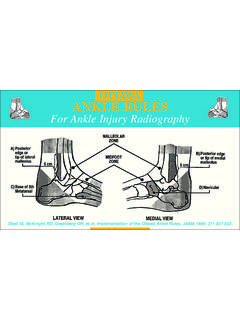
1 Ottawa ankle Rules for ankle Injury Radiography MALLEOLAR. ZONE. A) Posterior edge or B) Posterior edge tip of lateral or tip of medial MIDFOOT. malleolus malleolus 6 cm ZONE 6 cm C) Base of 5th D) Navicular Metatarsal LATERAL VIEW MEDIAL VIEW. An ankle x-ray series is only required if there is any pain in the malleolar zone and any of these findings: 1. bone tenderness at A. OR. 2. bone tenderness at B. OR. 3. inability to take 4 complete steps both immediately and in ED. A foot x-ray series is only required if there is any pain in the midfoot zone and any of these findings: 1. bone tenderness at C. OR. 2. bone tenderness at D. OR. 3. inability to take 4 complete steps both immediately and in ED. RECOMMENDATIONS. Apply the Ottawa ankle Rules accurately: palpate the entire distal 6 cm of the fibula and tibia do not neglect the importance of medial malleolar tenderness do not use for patients under age 18.
2 Clinical judgement should prevail over the Rules if the patient: is intoxicated or uncooperative has other distracting painful injuries has diminished sensation in the legs has gross swelling which prevents palpation of malleolar bone tenderness Give written instructions and encourage follow-up in 5 to 7 days if pain and ability to walk are not better. Stiell IG, McKnight RD, Greenberg GH, et al. Implementation of the Ottawa ankle Rules . JAMA 1994; 271:827-832. Ottawa Hospital Research Institute Institut de recherche 1992 and 2013, Ottawa Hospital Research Institute de l'H pital d'Ottawa 725 Parkdale Avenue, Ottawa, Ontario, Canada, K1Y 4E9. R GLE D'OTTAWA. concernant la radiographie de la cheville Zone mall olaire A Bord post rieur B) Bord post rieur ou pointe de la ou pointe de la mall ole externe M dio-pied mall ole interne 6 cm 6 cm C) Base du D) Os naviculaire 5e m tatarsien FACE EXTERNE FACE INTERNE.
3 Demander une radiographie de la cheville seulement s'il y a douleur dans la zone mall olaire et l'un des signes suivants : 1. douleur osseuse au point A. OU. 2. douleur osseuse au point B. OU. 3. incapacit de faire 4 pas complets tout de suite apr s le traumatisme et l'urgence. Demander une radiographie du pied seulement s'il y a douleur au m dio-pied et l'un des signes suivants : 1. douleur osseuse au point C. OU. 2. douleur osseuse au point D. OU. 3. incapacit de faire 4 pas complets tout de suite apr s le traumatisme et l'urgence. RECOMMANDATIONS. Appliquez la r gle d'Ottawa avec pr cision : Palpez la partie post rieure du fibula et du tibia sur une hauteur de 6 cm Ne n gligez pas l'importance d'une douleur l'os mall olaire m dial Ne suivez pas la r gle si le patient a moins de 18 ans Le jugement clinique doit pr valoir sur la r gle si le patient : est en tat d' bri t ou ne collabore pas a d'autres blessures douloureuses qui peuvent alt rer son attention prouve une sensation r duite dans les jambes a une enflure importante qui vous emp che de palper l'os mall olaire.
4 Donnez au patient des directives crites et encouragez-le consulter de nouveau dans 5 7 jours s'il a de la douleur et ne constate aucune am lioration de sa capacit de marcher. Stiell, , McKnight, Greenberg et collab. Implementation of the Ottawa ankle Rules , JAMA, no 271 (1994), p. 827-832. Ottawa Hospital Research Institute Institut de recherche 1992 et 2013, Institut de recherche de l'H pital d'Ottawa de l'H pital d'Ottawa 725, av. Parkdale Ottawa ON K1Y 4A9 Canada