Transcription of Annex DD Appendix 1 Example Excavation Risk Assessment
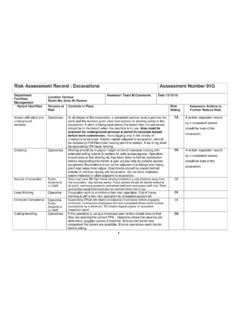
1 1 Risk Assessment Record : excavations Assessment Number 91G Department Facilities Management Location Various Room All Rooms Assessor/ Team Date 13/10/10 Hazard Identified Persons at Risk Controls in Place Risk Rating Assessors Actions to Further Reduce Risk Impact with plant and underground services. Operatives At all stages of the Excavation , a competent person must supervise the work and the workers given clear instructions on working safely in the Excavation . If plant is being used above the trench then no operatives should be in the trench when the machine is in use. Area must be scanned for underground services & permit to excavate issued before work commences. Hand digging only in the vicinity of underground services. Electric cables adjacent to Excavation , should be isolated by FM Electrician issuing permit to isolate.
2 Area of dig shall be secured by 2M heras fencing. C8 A written inspection record by a competent person should be kept of the Excavation . Crushing Operatives Shoring should be in place if depth of trench warrants it along with extended poling boards & ladders for safe access/egress. Operative should ensure that shoring etc has been done to his/her satisfaction before descending into trench & gain access only by suitable access equipment. excavations must not be adjacent to buildings and heavy plant kept away from edges. Stop blocks should be placed behind wheels of vehicles tipping into Excavation . Do not store materials, waste materials or plant adjacent to Excavation . C8 A written inspection record by a competent person should be kept of the Excavation . Security of Excavation Public, Students & LU Staff Area must have 2M high Heras fencing erected at a safe distance away from the Excavation , ring fencing works.
3 Fence panels should be double bolted at all joints, restricting access to authorised staff and contractors staff only. Plant and access equipment must also be secured when not in use. C8 Lone Working Operative Excavation work is a minimum two man operation. Out of hours working is still a two man operation by competent personnel. C5 Contractor Competence Operative Public, Students & LU Staff Supervising Officer will check competence of contractor before engaging contractor. Contractors employees will have completed Street works course successfully as a minimum. SO should request copies of Excavation inspection report. C6 Cutting/severing Operatives If the operative is using a motorised saw he/she should ensure that they are wearing the correct PPE - Operative should be wearing ear defenders, goggles, gloves & hard hat.
4 Ensure first aid kit and competent first aiders are available. Ensure operatives wash hands before eating. C8 2 Falls from height & falling objects Operative Public, Students & LU Staff Area must have 2M high Heras fencing erected at a safe distance away from the Excavation , ring fencing works. Fall prevention barriers shall be erected around Excavation . Stop blocks installed at a safe distance from Excavation preventing vehicles from falling into Excavation . PPE Hard hats & Safety shoes to be worn. C8 A written inspection record by a competent person should be kept of the Excavation . Reduced stability of nearby structures and buildings. Operative Public, Students & LU Staff excavations in close proximity to buildings or structures must be assessed by competent person before work commences.
5 B10 A written inspection record by a competent person should be kept of the Excavation . Vehicles and traffic collisions Operative Public, Students & LU Staff Vehicles should be kept away as far as possible using warning signs & barriers forming pedestrian routes. Area should be illuminated at night. C8 Hazardous substances in ground Operative Public, Students & LU Staff Any hazards found before or after work has started should be registered in the inspection report and remedial measures taken by contractors. Exhaust fumes should not be sited near the top of the Excavation . C6 A written inspection record by a competent person should be kept of the Excavation . Safe access egress Operative Public, Students & LU Staff Safe access by ladders to be ensured. Where possible the workings should be completely covered outside normal working hours as children have access to site.
6 C6 Assessment team s comments Reassessment date Managers signature - DHSO/RAC Signature Origional signed & retained Date Date Legislation:-The principal duties are: a. The Health and Safety at Work etc Act 1974 (HSW Act) which places a duty on employers to ensure the health and safety of employees and others who may be affected by their work activities. b. Electricity at Work Regulations 1989 places a duty on employers to avoid and prevent injuries from electricity. c. Management of Health Safety at Work Regulations 1999 require employers to make suitable and sufficient risk assessments.
7 3 5 x 5 RISK MATRIX GUIDELINES 1 Estimate the category of Harm using the guide box below. 2 Estimate the category of likelihood of occurrence from the guide box. 3 Read off the intersection of the two numeric estimates on the risk calculation matrix. 4 The resultant value should then be compared to the Risk Rating and actioned accordingly. may utilise either a number or lettering system. Both are indicated below as a comparison but either will provide an acceptable Assessment for practical purposes. GUIDE BOX CATEGORY 1 2 3 4 5 HARM Non-injury First Aid < 3 days > 3days Major injury LIKELIHOOD Almost impossible Unlikely Possible Likely Almost certain RISK CALCULATION MATRIX LIKELIHOOD 5 5 10 15 20 25 4 4 8 12 16 20 3 3 6 9 12 15 2 2 4 6 8 10 1 1 2 3 4 5 1 2 3 4 5 RISK RATING RISK RATING EQUIVALENT EQUIVALENT 1 - 4 C No further immediate action Review periodically.
8 5 - 9 C Re-assess during next review. 10 16 B Within 3 months. (Improvement Notice). Reduce risk to acceptable levels and re-assess following risk reduction/mitigation actions to ensure additional risks have not been introduced. 17 - 25 A Immediate (Prohibition Notice) Do not proceed until action has been taken to reduce the risk and/or Mitigate the effects. HARM