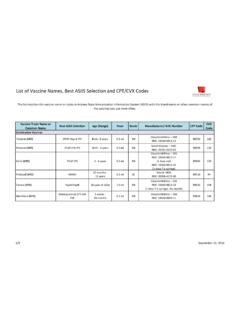
Transcription of ANNOTATIONS
1 Given intradermally (ID) The dose of BCG is ml for children < 12 months and ml for children 12 months Given at the earliest possible age after birth preferably within the first 2 months of life For healthy infants and children > 2 months who are not given BCG at birth, PPD prior to BCG vaccination is not necessary. However, PPD is recommended prior to BCG vaccination if any of the following is present: oCongenital TB oHistory of close contact to known or suspected infectious cases oClinical findings suggestive of TB and/or chest x-ray suggestive of TB In the presence of any of these conditions, an induration of 5 mm is considered positive and BCG is no longer recommended Given intramuscularly (IM) Given at a minimum age of 6 weeks. The primary series consists of 3 doses with a minimum interval of 4 weeks Booster series consists of 3 doses until adolescence with the following schedule.
2 O12-23 months (DTP) o4-7 years (DTP) o9-15 years (Td/Tdap) Ideally, the minimum interval between booster doses should be at least 4 years Full-dose DTP should preferably be used only until age 7 years, but package inserts should be consulted for maximum age indications of specific products Given intramuscularly (IM) Given as a 3-dose primary series with a minimum age of 6 weeks and a minimum interval of 4 weeks A booster dose is given between age 12-15 months with an interval of 6 months from the third dose Refer to Vaccines for Special Groups for Hib recommendation in high risk children Inactivated Hepatitis A vaccine Given intramuscularly (IM) Minimum age: 12 months 2 dose series: minimum interval between first and second dose is 6 months Live attenuated Hepatitis A vaccine oGiven subcutaneously (SC) oMinimum age: 18 months oGiven as single dose BACILLE CALMETTE GUERIN (BCG) DIPHTHERIA, TETANUS, PERTUSSIS vaccine (DTP) ANNOTATIONS HAEMOPHILUS INFLUENZAE TYPE B CONJUGATE vaccine HEPATITIS A vaccine (HAV) Given intramuscularly (IM) Administer the first dose of monovalent HBV to all newborns 2kgs within 24 hours of life A second dose is given 1-2 months after the birth dose The final dose is administered not earlier than 24 weeks of age Another dose is needed if the last dose was given at age <24 weeks For infants born to HBsAg (+) mothers (preterm or term infants): Administer HBV* and HBIG ( ) within 12 hours of life.
3 HBIG should be administered not later than 7 days of age, if not immediately available. For infants born to mothers with unknown HBsAg status: With birth weight 2 kgs, administer HBV within 12 hours of birth and determine the mother s HBsAg as soon as possible. If HBsAg (+), administer HBIG not later than 7 days of age. With birth weight <2 kgs, administer HBIG in addition to HBV* within 12 hours of life *For infants born <2 kgs, the 1st dose received at birth is not counted as part of the vaccine series. Additional 3 HBV doses are needed Given intramuscularly (IM) For ages 9-14 years, a 2-dose series is recommended oBivalent HPV (2vHPV), quadrivalent (4vHPV) or nonavalent (9vHPV) given at 0 and 6 months oIf the interval between the first and second dose is less than 6 months, a third dose is needed, the minimum interval between the second and third dose is 3 months For ages 15 years and older, a 3-dose series is recommended.
4 OBivalent HPV (2vHPV), quadrivalent (4vHPV) or nonavalent 9vHPV) at 0, 2 and 6 months oThe minimum interval between the first and the second dose is 1 month and the minimum interval between the second and third dose is 3 months, the third dose should be given at least 6 months from the first dose oFor males age 9-18 years, a 4vHPV and 9vHPV can be given for the prevention of anogenital warts and anal cancer. Trivalent influenza vaccine (TIV) given intramuscularly (IM) or subcutaneously (SC) Quadrivalent influenza vaccine (QIV) given intramuscularly (IM) Given at a minimum age of 6 months For pediatric dose, follow the manufacturer s recommendations Children age 6 months to 8 years receiving influenza vaccine for the 1st time should receive 2 doses separated by at least 4 weeks If only one dose was given during the previous influenza season, give 2 doses of the vaccine then one dose yearly thereafter Children age 9 to 18 years should receive one dose of the vaccine yearly Annual vaccination should begin in February but may be given throughout the year Given subcutaneously (SC)
5 Given at a minimum age of 9 months Children age 9 months to 17 years should receive one primary dose followed by a booster dose 12-24 months after the primary dose Individuals 18 years and older should receive a single dose only HEPATITIS B vaccine (HBV) HUMAN PAPILLOMAVIRUS vaccine (HPV) INFLUENZA vaccine (TRIVALENT/QUADRIVALENT INFLUENZA vaccine ) japanese encephalitis LIVE ATTENUATED RECOMBINANT vaccine Given subcutaneously (SC) Given at the age of 9 months, but may be given as early as age 6 months in cases of outbreaks as declared by public health authorities If monovalent measles vaccine is not available, then MMR/MR vaccine may be given as substitute for infants below 12 months of age. In such cases, the recipient should receive 2 more MMR vaccines starting at 1 year of age, following recommended schedules Given subcutaneously (SC) Given at a minimum age of 12 months 2 doses of MMR vaccine are recommended The second dose is usually given at 4-6 years of age but may be given at an earlier age with a minimum of 4 weeks interval between doses.
6 Given subcutaneously (SC) Given at a minimum age of 12 months MMRV may be given as an alternative to separately administered MMR and Varicella vaccines The maximum age is 12 years The recommended minimum interval between doses is 3 months, but a second dose given 4 weeks from the first dose is considered valid Given intramuscularly (IM) Given at a minimum age of 6 weeks Primary vaccination consists of 3 doses with an interval of at least 4 weeks between doses. A booster dose is given 6 months after the third dose. For previously unvaccinated infants age 7-11 months, give a total of 3 doses. The first 2 doses are given 1 month apart. The interval between the second and third dose is at least 2 months but should ideally be given at or after the first birthday.
7 For previously unvaccinated older children age 12 months to 5 years oPCV 10: 1-5 years old: give 2 doses at least 2 months apart oPCV 13: 12-23 months: give 2 doses at least 2 months apart 2 to 5 years old: give 1 dose Inactivated Polio vaccine (IPV) Given intramuscularly (IM), as a monovalent formulation or in combination with DPT-containing vaccines Given at a minimum age of 6 weeks, at least 4 weeks apart The primary series consists of 3 doses given at 6, 10, and 14 weeks. The first booster is given at 12-18 months. The minimum interval between the third dose and the first booster dose is 6 months. The second booster is given at age 4-6 years. If the fourth dose is given at age 4 years onward, no further doses are necessary Oral Polio vaccine (OPV) Only available as part of the government s NIP The primary series consists of 3 doses beginning at age 6 weeks with a minimum interval of 4 weeks; a dose of monovalent IPV is given together with the third dose MEASLES vaccine MEASLES-MUMPS-RUBELLA (MMR) vaccine MEASLES-MUMPS-RUBELLA-VARICELLA vaccine (MMRV) PNEUMOCOCCAL CONJUGATE vaccine (PCV) POLIOVIRUS vaccine Human (RV1) Given per orem (PO) as oral liquid formulation Given as a 2-dose series Given at a minimum age of 6 weeks with a minimum interval of 4 weeks between doses.
8 The last dose should be administered not later than 24 weeks of age. Human-Bovine live-attenuated reassortant (RV5) (oral liquid formulation) Given per orem (PO) Given as a 3-dose series First dose is given at age 6-12 weeks, with a minimum interval of 4-10 weeks between doses. The last dose should not be administered beyond 32 weeks of age. Human-Bovine live-attenuated reassortant (RV5) (oral freeze-dried formulation) Given per orem (PO) Given as a 3-dose series, recommended at 2, 4 and 6 months Given at minimum age 6 weeks with a minimum interval of 4 weeks between doses oThe last dose should not be administered beyond 12 months of age. Given intramuscularly (IM) For children who are fully immunized, Td /Tdap booster doses should be given every 10 years For children age >7 years a single dose of Tdap can be given to replace due Td.
9 Tdap can be administered regardless of the interval since the last tetanus and diphtheria-toxoid containing vaccine . Subsequent doses are given s Td/Tdap. Fully immunized is defined as 5 doses of DTP, or 4 doses of DTP if the 4th dose was given on or after the 4th birthday Give 1 dose of Tdap for every pregnancy oFor fully immunized pregnant adolescents, administer 1 dose of Tdap vaccine at 27 to 36 weeks AOG, regardless of previous Td or Tdap vaccination oFor unimmunized pregnant adolescents, administer a 5-dose tetanus-diphtheria (Td)-containing vaccine following a 0-,1-, 6-,18-, and 30-month schedule. Use Tdap as one of the 5 doses, preferably given at 27-36 weeks AOG Given subcutaneously (SC) Given at a minimum age of 12 months 2 doses of varicella vaccine are recommended The second dose is usually given at 4-6 years of age, but may be given earlier at an interval of 3 months from the first dose.
10 If the dose was given 4 weeks from the first dose, it is considered valid. For children 13 years of age, the recommended minimum interval between doses is 4 week ROTAVIRUS vaccine (RV) TETANUS AND DIPHTHERIA TOXOID (Td)/ TETANUS AND DIPHTHERIA TOXOID AND ACELLULAR PERTUSSIS (Tdap) vaccine VARICELLA vaccine Given intramuscularly (IM) Immunocompromised children and those with high-risk medical conditions should receive both PCV and PPSV23. oThe two vaccines should not be co-administered. The minimum interval between PCV and PPSV23 is 8 weeks. If a dose of PPSV23 is inadvertently given earlier than the recommended interval, this dose need not be repeated. oAll recommended PCV doses should be given prior to PPSV23 if possible. The following tables summarize the indication and schedule of PCV/PPSV23 administration to children with high risk conditions according to age group: VACCINES FOR HIGH RISK / SPECIAL GROUPS PCV-PPSV23 VACCINATION SCHEDULE INDICATIONS FOR PNEUMOCOCCAL VACCINES Age: 24 months to 5 years Administer 1 dose of PCV if only 3 doses of PCV was received previously; give 1* or 2** doses of PPSV23 at least 8 weeks after the most recent dose of PCV Administer 2 doses of PCV at least 8 weeks apart if unvaccinated or less than 3 doses of PCV was received previously.
![3rd PAPP Update [2016] in the Evaluation and Management …](/cache/preview/7/4/7/c/f/6/1/3/thumb-747cf6135d9f39e2a4daa20388e4076e.jpg)