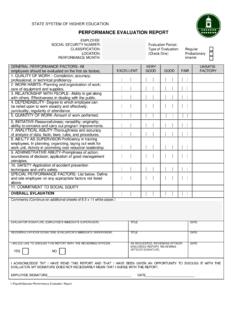
Transcription of ANNUAL APPRAISAL FORM
1 PERFORMANCE PLANNING AND APPRAISAL FORM NON- bargaining unit , NON-MANAGEMENT PERSONNEL Employee Name: Position Title: Department: Supervisor Name: Date of Review: For Period: To At the beginning of each performance cycle, employee and supervisor review key responsibilities (from the job description). The supervisor and employee document specific responsibilities, with outcomes that describe how successful performance will be measured.
2 Employee and supervisor then assign a priority to each activity. These will be documented in Section I Key Responsibilities (pages 2 and 3). In addition, employee and supervisor should discuss the Performance Factors described on pages 4 and 5 and agree on how they apply to the employee s work. Ongoing communication regarding performance is expected, both in informal and formal settings throughout the year. Either the supervisor or employee should feel free to initiate discussion of performance progress, expectations, priorities or obstacles. At the end of each performance cycle, a formal review of achievements in relation to the performance standards is documented. This includes a summary of employee performance during the performance cycle in relation to individual responsibilities and outcomes.
3 The following ratings are given to indicate how the employee has performed in relation to performance responsibilities and outcomes. RATINGS SCALES Rating Level 1 = Below Standards or Expected Results Performance is below standards. Employee does not fully achieve assigned goals. Work assignments are not consistent in meeting quality standards or deadlines. Employee requires close supervision and does not consistently demonstrate the ability to perform job functions at expected level of proficiency. 2 3 = Meets Expectations Satisfactorily performs assigned activities and achieves expected outcomes. Work assignments typically are completed on time and meet all quality standards. Employee works under general or minimum supervision, with demonstrated understanding of all job functions and expected standards.
4 4 5 = Exceeds Expectations Quality and quantity of work is routinely higher than expected. Performance reflects high degree of initiative, commitment to excellence and ability to anticipate and respond to FIT s needs. Employee demonstrates mastery of all job functions and frequently raises the bar in contributing to new systems and procedures. PERFORMANCE PLANNING AND APPRAISAL FORM NON- bargaining unit , NON-MANAGEMENT PERSONNEL 2 Section I - KEY RESPONSIBILITIES Employee Name: Position Title: Department: Supervisor Name: Date of Review: For Period.
5 From To At the beginning of the performance cycle, employee and supervisor review key responsibilities from the employee s job description. The supervisor documents specific outcomes to be achieved, in a way that describes how successful performance will be measured. Employee and supervisor then assign a Priority (Critical, Moderate or Routine/episodic) for each responsibility or objective. The priority designation guides both employee and supervisor in monitoring activities relative to their importance to the department. Employee and supervisor establish appropriate timeframes for regular performance feedback to monitor progress toward achieving goals. Such timeframes may be As Needed, Weekly, Monthly, Quarterly, or Semi-annually, depending on the nature of the activity.
6 It is expected that the employee and primary supervisor will meet throughout the performance cycle to review progress, identify and resolve problems and modify this plan, if necessary. If there are changes ( , responsibilities, outcomes or priorities), they should be noted on the performance log. At the end of the year, the employee rates his or her own performance, and the supervisor rates the employee s performance, using the rating scale on page 1. The purpose of the self-evaluation is to encourage dialogue around performance outcomes and related issues. This provides the basis for discussion between the employee and supervisor about accomplishments and issues that affected performance. Following the discussion, the supervisor determines the Final Rating for each objective, considering the employee s self-evaluation, the relative priority of the objective and other relevant factors.
7 Section I - KEY RESPONSIBILITIES DATE MODIFIED KEY RESPONSIBILITY EXPECTED OUTCOME PRIORITY FEEDBACK FREQUENCY SELF-RATING SUPERVISOR RATING FINAL RATING PERFORMANCE PLANNING AND APPRAISAL FORM NON- bargaining unit , NON-MANAGEMENT PERSONNEL 3 DATE MODIFIED KEY RESPONSIBILITY EXPECTED OUTCOME PRIORITY FEEDBACK FREQUENCY SELF-RATING SUPERVISOR RATING FINAL RATING Section I Total Rating: _____ (Add Final Ratings for each responsibility, then divide by total number of responsibilities assigned) PERFORMANCE PLANNING AND APPRAISAL FORM NON- bargaining unit , NON-MANAGEMENT PERSONNEL 4 Section II - PERFORMANCE FACTORS The following factors are important indicators of the skills and abilities an employee brings to the performance of his or her duties.
8 In addition to evaluating key responsibilities and performance objectives, these performance factors help to assess total performance. At the beginning of the ANNUAL performance cycle, supervisors and employees identify expectations for successful performance. These performance expectations may be explained in the Comments section. At the end of the ANNUAL performance cycle, the supervisor rates the degree -- 1 (Below Standards/Expectations), 2 or 3 (Meets Expectations) or 4 or 5 (Exceeds Expectations) -- to which the employee reflects these characteristics in the regular performance of his/her duties. Please use specific examples and comments to illustrate your rating. Performance Factors Applies Not Applicable Self Rating Supervisor Rating Final Rating PROFICIENCY IN CURRENT ROLE: Demonstrates knowledge of position and/or team role.
9 Understands how position and responsibilities fit within the organization and contribute to department results. QUALITY OF WORK: Maintains standards consistently. Is consistent in achieving accuracy, neatness, thoroughness, overall effectiveness and attentiveness to detail. QUANTITY OF WORK: Produces expected volume of work in a timely manner. PLANNING AND ORGANIZATION OF WORK: Establishes priorities. Anticipates and prepares for changing workload or working conditions. Coordinates and uses available resources to get work done to assure important deadlines are met. INITIATIVE: Shows ability to work independently in context of the job. Demonstrates willingness to assume additional responsibility. Suggests ways to enhance work processes or operations.
10 INTERPERSONAL RELATIONS: Maintains positive working relationships. Is flexible and willing to cooperate with others. Demonstrates ability to listen and understand. PERFORMANCE PLANNING AND APPRAISAL FORM NON- bargaining unit , NON-MANAGEMENT PERSONNEL 5 Performance Factors Applies Not Applicable Self Rating Supervisor Rating Final Rating VERBAL & LISTENING SKILLS: Expresses self well verbally, using language appropriate for the intended audience. Listens actively and acknowledges understanding. WRITING SKILLS: Presents ideas clearly in written format, using appropriate language, grammar and style. TEAM PARTICIPATION: Proactively builds partnerships and seeks involvement with other constituencies/employees. Works cooperatively and effectively with team members.