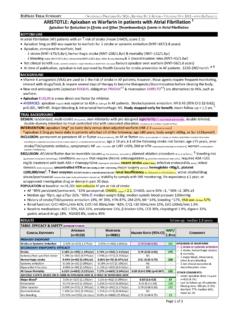
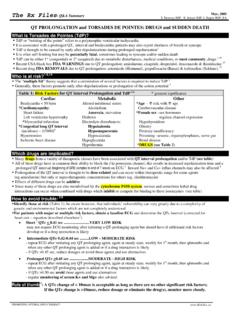
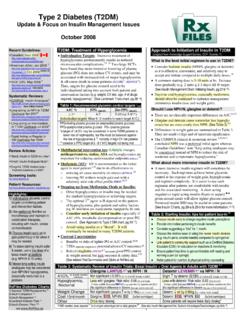
Transcription of Antibiotics & Common Infections
1 Antibiotics & Common InfectionsStewardship, Effectiveness, Safety & Clinical PearlsOctober 2016 ANTIMICROBIAL RELATED LINKSCANADIAN GUIDELINESBugs & Drugs (Alberta/BC): MUMS Guidelines Orange Book (Anti-infective Review Panel): RESOURCES Canadian Antibiotic Awareness: which includes:1. Viral Prescription Pad for respiratory Infections (download or order for free); provides information about symptomatic relief for viral Infections and indicates when patients should consider a return Talking with Patients about When to Use Antibiotics provides communication tips to effectively address requests for Antibiotics for viral communication skills reduce antibiotic prescribing (27% absolute risk reduction - ARR).3. Posters for office A poster displayed in the practice waiting room stating a commitment to reducing antibiotic use reduces inappropriate antibiotic use (20% ARR). Handouts for more public/patient resource links STEWARDSHIP There are world-wide efforts that look for strategies to deal with the challenge of growing antimicrobial resistance.
2 How can we all work together to be stewards of this important, but limited resource?SELECT ANTIBIOTIC RESISTANT PATHOGENS OF MAJOR CONCERN methicillin-resistant Staphylococcus aureus (MRSA) multi-drug resistant Streptococcus pneumonia (MRSP) vancomycin-resistant enterococci (VRE) multi-drug resistant Escherichia coli & other gram negative bacteria ( ESBL) KEY STRATEGIES FOR REDUCING Antibiotics vaccinations to prevent Infections and decrease antibiotic use practice and educate on infection prevention (wash hands, avoid touching eyes, cough etiquette, stay home when sick) avoid Antibiotics for Infections of predominantly viral cause use of point-of-care tools/tests treat infection, not contamination avoid treating positive cultures in the absence of signs/symptoms STRATEGIES WHEN Antibiotics INDICATED Whenever suitable: use narrow-spectrum agent use shorter duration therapy tailor empiric antibiotic choice & dosage according to local bacterial prevalence and resistance patterns calculate weight-based dose in kids if patient experiences an adverse reaction, provide patient education and document details to avoid labelling a side effect as an allergy discourage saving of left-over Antibiotics for future use1 STRATEGIES TO WORK - REAL WORLD Public, patient & provider education over time to change expectations Realistic appreciation for viral versus bacterial etiologies Delayed prescriptions for select conditions with instructions to fill only if symptoms do not resolve or condition worsens.
3 (Offer to those who value convenience.) It s easy to prescribe Antibiotics . It takes time, energy & trust not to do so. i Success lies in changing the culture & the understanding of antibiotic limitations, benefits & HARMS UNDERAPPRECIATEDQ To the Patient 1 in 5 emergency room visits for adverse drug events (ADEs) are from Antibiotics . Antibiotics are the most Common cause of ADEs in children, accounting for 7 of the top 15 drugs leading to ADE-related ER visits. Antibiotic associated diarrhea, including Clostridium difficile diarrhea Cardiac - QT interactions: with clarithromycin & fluoroquinolones Central nervous system (CNS) adverse effects ( dizziness, headache, sleep disturbance, seizure, encephalopathy) Hyperkalemia (cotrimoxazole) Skin: minor/major ( cotrimoxazole) Tendon rupture (fluoroquinolones) Risk of drug interactions (warfarin, statins/macrolides, ..) r risk of secondary fungal Infections r risk of an untreatable infection in the patient due to r bacterial resistance Q To Society financial costs of treating adverse reactions (USA: $20 billion in excess healthcare costs) 1 antimicrobial resistance: more difficult to treat Infections over time, leading eventually to no adequate options For what s inside, see Table of Contents, Page 2 Antibiotics & Common Infections Part 1 Table of Contents Common Infections Part 1 Stewardship, Effectiveness, Safety & Clinical Pearls.
4 1 Bronchitis, Acute ..3 Community Acquired Pneumonia (CAP) ..4 Pharyngitis ..6 Sinusitis, Acute ..8 Oral Antibiotics - General Overview ..10 Pregnancy/Lactation ..10 Oral Antibiotics Drug Comparison Charts Penicillins ..11 Cephalosporins ..11 Macrolides ..12 Tetracyclines ..12 Fluoroquinolones ..13 Antifolates: Sulfamethoxazole, Trimethoprim ..13 Other Clindamycin Metronidazole Nitrofurantoin Fosfomycin Linezolid Probenecid (used to prolong effective levels of cefazolin) Vancomycin.
5 14 Dealing with Patient s Expectations & Demands Non-antibiotic Rx for Predominantly Viral Infections ..15 We asked some Getting patient buy-in..16 Acknowledgements (more details online) RxFiles is very pleased to acknowledge those who contributed to Part 1 topic development & review. Overall ABX topic/project guidance: Lynette Kosar Pharmacist, RxFiles Loren Regier Pharmacist, RxFiles Tessa Laubscher Family Physician, Saskatoon Yvonne Shevchuk UofS, College of Pharmacy Pam Komonoski RN(NP) UofS Student Health Linda Sulz Pharmacist, RQHR Justin Kosar Pharmacist, SHR Stewardship Casey Phillips Pharmacist, RQHR Stewardship Content development ABX Part 1: Lynette Kosar* Pharmacist, RxFiles Topic Lead Alex Crawley Pharmacist, RxFiles Andrew Plishka Pharmacy Resident, SHR Rachel Martin Pharmacy Resident, SHR Loren Regier Pharmacist, RxFiles Co-Lead Topic input and review: Anne Nguyen Pharmacist, BC Brent Jensen Pharmacist, RxFiles Jessica Minion RQHR Microbiology Jill Blaser-Farrukh Family physician, Saskatoon Joe Blondeau SHR Microbiology John Alport Family Physician, Regina Jonathan Hey Family Physician, Saskatoon Marlys LeBras Pharmacist, RxFiles Nora McKee Family Physician, Saskatoon Reid McGonigle Family Physician, Northern SK Roger Bristol Emergency Med, SHR Shaqil Peermohamed MD, SHR Infectious Disease Tom Smith-Windsor Family Physician, Prince Albert The RxFiles academic detailing team (Zack Dumont, Vaughn Johnson, Tanya Nystrom, Lisa Rutherford, Brenda Schuster, Pam Karlson) * Although many contributed to this topic workup, Lynette Kosar took the lead on the 4 primary therapeutic topic areas, including the overseeing related resident rotations.
6 Well done Lynette!!! Graphic design: Debbie Bunka, Colette Molloy ( ) Coming up next, Spring 2017 ABX Part 2: Skin Infections , Acute Cystitis DISCLAIMER: The content of this newsletter represents the research, experience and opinions of the authors and not those of the Board or Administration of Saskatoon Health Region (SHR). Neither the authors nor Saskatoon Health Region nor any other party who has been involved in the preparation or publication of this work warrants or represents that the information contained herein is accurate or complete, and they are not responsible for any errors or omissions or for the result obtained from the use of such information. Any use of the newsletter will imply acknowledgment of this disclaimer and release any responsibility of SHR, its employees, servants or agents. Readers are encouraged to confirm the information contained herein with other sources. Additional information and references online at 2016 RxFiles, Saskatoon Health Region (SHR) Pg 2 ACUTE BRONCHITIS: Management Considerations Oct 2016 PEARLS for the MANAGEMENT of ACUTE UNCOMPLICATED BRONCHITIS Antibiotics are NOT recommended, as bronchitis is predominantly viral.
7 Advise on treatments that will provide symptomatic relief: maintaining hydration & humidity. Cough suppressants may be considered for managing cough, & inhaled bronchodilators if wheezing is present. Honey may help children. Patients should see their prescriber if: 1) symptoms worsen, 2) new symptoms develop ( dyspnea, fever, vomiting), 3) cough >1month, or 4) >3 episodes/yr. PRE-TREATMENT CONSIDERATIONS Inappropriate antibiotic use is driving resistance & leading to a crisis. Please examine your own prescribing practices. Refer to newsletter cover. The majority of acute uncomplicated bronchitis cases are viral (90% in adults & 95-100% in children). Antibiotics are NOT recommended for acute uncomplicated bronchitis. Several RCTs assessing the efficacy of Antibiotics for this indication have failed to show a benefit; however, up to 80% of adults in the still receive an antibiotic. Acute uncomplicated bronchitis is self-limiting. Cough usually persists for 1 to 3 weeks, although up to 50% of viral cases will have a cough beyond 3 weeks.
8 Airway hyperactivity may last up to 6 weeks. Recommend symptom management. Acute complicated bronchitis ( history of smoking, impaired lung function, chronic heart disease, immunocompromised) may require further investigation ( lung function tests, chest x-ray). Rule out pneumonia if the following signs are present: HR>100bpm, RR >24 breaths/min, oral temperature >38 C, or findings of local consolidation. Coloured sputum does not reliably differentiate between bacterial or viral origin. Fever is uncommon, & may be indicative of influenza or pneumonia. If the patient has confirmed pertussis, see RxFiles pg 78 for antibiotic regimens. Uncommon, but there is the occasional outbreak. Encourage vaccination. MOST Common PATHOGENS Viral Influenza A, Influenza B, Parainfluenza, RSV, & Adenovirus EMPIRIC DRUG REGIMENS OF CHOICE & SUSCEPTIBILITY CONCERNS Antibiotics are not recommended for acute uncomplicated bronchitis. Multiple studies & meta-analyses assessing Antibiotics for the treatment of acute uncomplicated bronchitis have shown no benefit or modest improvement, along with an risk of adverse events.
9 For example, a 2014 Cochrane review (17 RCTs, n=3,936) evaluating Antibiotics (beta-lactams, doxycycline, macrolides, TMP-SMX) vs placebo found no difference in clinical improvement. Antibiotics cough (NNT=6), night cough (NNT=7) & mean duration of cough by days, but risk of adverse events (NNH=5, primarily gastrointestinal related). SYMPTOM MANAGEMENT no quality evidence, but anecdotally may help NONPHARM /maintain hydra on humidity ( PRN humidifier to maintain 30-50% humidity) - No evidence for or Hydration: caution in HF & CKD patients - Humidifier: clean frequently to risk of bacteria/fungi growth Honey to 10mL po HS Not recommended in <1yr due to concerns with infant botulism - No strong evidence for or against. - Cochrane review (3 RCTs, n=568): better than placebo, but inferior to dextromethorphan in cough frequency (cough duration not assessed). COUGH SUPPRESSANTS Dextromethorphan (DM) BENYLIN DM, ROBITUSSIN DM 10-30mg po q6-8hr PRN - May number of coughing episodes but does not duration of illness.
10 - Not recommended in children under 6 years of age due to safety & efficacy concerns. HEALTH CANADA BRONCHODILATORS Salbutamol VENTOLIN 100mcg 2 puffs inhaled QID - Limited evidence (1 study with fenoterol, n=80). - May duration of cough in patients with wheezing/airflow obstruction when used x 1wk (NNT=2, NNH=2 for tremor, shakiness, nervousness). Ipratropium ATROVENT 20mcg 4 puffs QID - Limited evidence (1 study, n = 14 for 3 weeks) in post-infectious cough. - May improve daytime & nighttime cough, & dyspnea associated with coughing. Encourage prevention smoking cessation, exposure to second-hand smoke. Not routinely recommended for symptom management: Oral or inhaled corticosteroids are not recommended in patients with acute bronchitis without asthma. Expectorants ( guaifenesin): most evidence failed to show a benefit. Clinical Q&A Should pts 65yrs be treated with an ABX to the risk of developing pneumonia? No, but patients presenting with signs of pneumonia should undergo investigation ( chest x-ray).