Transcription of ANTICIPATORY MEDICATION GUIDELINES
1 1 ANTICIPATORY MEDICATION GUIDELINES Guideline author and job title Dr Anna Lock, Palliative Medicine Consultant Sue law, Palliative Care Service Lead Group, Directorate and Specialty Primary Care, Communities and Therpaies Approving body and date of approval PCCT Quality and Safety Committee Medicine Prescribing and Effectiveness Committee DTC approval date Dec 2020 Guideline reference SWBH/PTCARE/102 Date uploaded onto Connect 14th January 2021 Next review date January 2024 Consultation process: This is an update so the whole palliative care team have seen this, plus consultants. If review of existing guideline what has been changed: Minor update in current practice What National Guidance has been incorporated? West Midlands Palliative Medicine Physicians GUIDELINES for Symptom Control Scope (who does the GUIDELINES apply to or not apply to): Nurses; Community and Acute Doctor; Hospital and GPs Pharmacy DOCUMENT CONTROL AND HISTORY Version No Date Approved Date of im plem entation Next Review Date Reason for change ( full rew rite, am endm ent to reflect new legislation, updated flow chart, etc.)
2 1 May 2009 May 2009 May 2012 Full review 2 September 2013 September 2013 September 2016 3 May 2017 May 2017 4 Dec 2020 Jan 2021 January 2024 Update 2 1. Ant icipatory MEDICATION GUIDELINES Symptoms commonly experienced by patients entering the terminal phase include pain, agitation, nausea, vomiting, breathlessness and excessive chest secretions. To provide prompt and effective symptom control and to reduce distress and anxiety for patients and their carers, it is advocated that medications used to manage these symptoms are prescribed in anticipation of need. The following table outlines common doses of drugs used to treat the above symptoms and is for use in all settings. It should however only be used as a guideline. For further information, or if symptoms not managed, please consult the palliative care team or your pharmacist.
3 These medications are prescribed in anticipation of patient being unable to swallow their regular symptom control medications, and given by the subcutaneous (SC) route if needed when unable to take by oral route. For the purposes of this document, the dying phase is considered to be a prognosis of less than six weeks, or if phase of illness ranking is used then when patient considered to be deteriorating or dying (further guidance on recognising the dying phase). Symptom Drug Dose Route Notes Pain (eGFR >30 ml/ ) Morphine sulfate 5 mg Subcutaneous injection If patient already taking regular morphine the PRN dose is usually 1/6th of the 24-hour opioid dose. For patients receiving alternative opioids please contact the palliative care team or pharmacist for advice. Pain (eGFR <30 ml/ ) Fentanyl 25 micrograms Subcutaneous injection As required Agitation Midazolam 5 mg *(If eGFR <30 ml/ dose reduction to mg) Subcutaneous injection To be given as required.
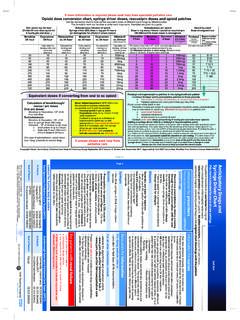
4 Maximum 30 mg in 24 hours may go higher with specialist advice if eGFR <30 ml/ Maximum 30mg in 24 hours Nausea and vomiting Levomepromazine 5 mg Subcutaneous injection Four hourly as required. Maximum dose 25 mg in 24 hours Chest Secretions Hyoscine butylbromide 20mg Subcutaneous injection Two hourly as required. Maximum dose 180 mg in 24 hours Breathlessness Morphine sulfate Subcutaneous injection As required Breathlessness eGFR <30 ml/ Fentanyl 25 micrograms Subcutaneous injection As required 3 2. OPIOID CONVERSION: ANTICIPATORY MEDICATION There is no exact equivalent between opioids, starting low and titrating upwards is recommended safe practice. Approximately equivalent opioid doses for PRN use: Oral morphine M orphine inje ction Fe ntanyl inje ction For patient with renal impairment (eGFR<30 ml/ ) 5 mg mg 25 micrograms 10 mg 5 mg 50 micrograms DO NOT use these equivalent doses for larger doses without specialist palliative advice, as the small numbers entailed have been rounded up.
5 Approximately equivalent opioid doses for starting doses in subcutaneous infusions: Oral morphine in 24 hours M orphine inje ction v ia CSCI Fe ntanyl inje ction v ia CSCI 30 mg 15 mg 150 micrograms 60 mg 30 mg 300 micrograms Opioid choice in pre existing renal impairment: DO NOT use morphine in continuous infusion for patients with known renal impairment (eGFR <30 ml/ ) because of the high risk of accumulation and adverse effects. However it is not necessary to routinely check the renal function of all dying patients who are comfortable on their regular opioid - even if they develop undetected renal impairment, it may not be necessary to convert to an alternative unless they develop side effects or signs of opioid toxicity such as myoclonic jerks; please note drowsiness and reduced consciousness can be part of the dying process and doesn t necessarily mean the person is opioid toxic.
6 Fentanyl excretion is not affected by renal impairment, therefore it is less likely to cause side effects and opioid toxicity due to accumulation in this situation, and is the drug of choice for continuous subcutaneous infusion. Se e k Specialist Palliative Care Adv ice: If converting from alternative strong opioids, if analgesia requirements are escalating or distressing opioid side effects or alfentanil (an alternative opioid) is prescribed. Fentanyl and alfentanil are not interchangeable as the doses are not equivalent. CSCI = Continuous Subcutaneous Infusion Further information: West Midlands Palliative Care Physicians Symptom Control GUIDELINES Connected Palliative Care: 0121 5073611 4 Algorithm for Pain in patient s in t he DYING PHASE using morphine sulfat e SUBCUTANEOUSLY (eG FR >30 ml/ ) Explanation & psychological support for patient/carers /family Exclude treatable causes for pain constipation Consider positioning for comfort Example conversions: 1.
7 To calculate the equivalent total 24 hourly dose of SC morphine, divide total 24 hourly dose of regular oral morphine plus sum total of morphine sulfate liquid PRNs used by 2 ( 20 mg oral morphine = 10 mg SC morphine) 2. To calculate the breakthrough dose of morphine sulfate divide total 24-hourly dose of SC morphine by 6 and prescribe this dose, SC PRN ( mg SC morphine over 24 hours = 15 mg/6 = mg SC PRN) Review pain at each visit - if more than 2 PRN doses used in 24 hours, consider if 24 hour CSCI needs to be increased or seek specialist advice. Is patient already taking opioids? Morphine Sulfate No Contact the Specialist Palliative Care Team for advice If they are not available & patient unable to swallow use Opioid Conversion Guidance to calculate CSCI equivalent dose NB. Fentanyl patches should be left in place, seek advice re PRN SC dose Morphine sulfate 5mg SC PRN If two or more doses are required over 24 hours consider starting a CSCI of morphine sulfate over 24 hours The prn dose should be adjusted to be approx.
8 1/6th of the new 24-hour dose Pain If unable to swallow, commence CSCI with subcutaneous morphine sulfate in a dose equivalent to the oral morphine requirements in the preceding 24 hours Ye s Other strong opioids If able to swallow continue oral MEDICATION All: Prescribe 1/6th of total 24-hour opioid dose SC PRN 5 Algorithm for Pain in pat ient s wit h renal impairment (eG FR <30 ml/ ) in t he DYING PHASE using FENTANYL SUBCUTANEOUSLY Explanation & psychological support for patie nt/carers /family Exclude treatable causes for pain constipation Consider positioning for comfort Starting dose of fentanyl CSCI: this should be based on prior opioid requirements and titrated upwards according to the amount of subsequent PRN doses required in addition to the continuous infusion there is no upper limit provided the pain is responding well to the opioid and there are no symptoms or signs of adverse effects or toxicity.
9 Breakthrough analgesia accompanying fentanyl CSCI: use of fentanyl for as required doses is limited by the volume of solution required at higher doses do not give more than 100 micrograms at once. An alternative is to use low dose alternative subcutaneous opioid morphine sulfate. Is patient already taking opioids? Ye s No If patient is already taking strong opioids, contact the Specialist Palliative Care Team for advice. Fentanyl 25 micrograms 1 to 2 hourly SC PRN Or Morphine sulf ate mg SC PRN If tw o or more doses are required over 24 hours consider starting a CSCI of f entanyl 100 250 micrograms over 24 hours. PRN dose should be approx. 1/6th of the 24-hourly dose. Exam ple: 150 micrograms/24 hours give 25 micrograms PRN or 300 micrograms/24 hours give 50 micrograms PRN Pain 6 Algorit hm for Agit at ion in pat ient s in t he DYING PHASE Explanation & psychological support for patient/carers /family Exclude causes of delirium e.
10 G. constipation, urinary re tention, hype rcalcemia, nicotine withdrawal Consider e nv ironmental modifications & non-drug management Example : If patient has required 4 doses of mg midazolam to manage restlessness in previous 24 hours then a suitable dose would be 10 mg midazolam in CSCI over 24hours. *If eGFR <30 ml/ dose give reduced dose of midazolam mg No Contact the Specialist Palliative Care Team for advice Midazolam 5 mg SC PRN* to be prescribed in anticipation Is the patient restless & agitated? Ye s If symptoms do not resolve with non-drugs management give midazolam SC PRN* After 30 minutes give another 5 mg SC midazolam If requires 2 or more PRN doses in 24 hours doses consider commencing CSCI of midazolam with dose equivalent to number of PRN doses used in previous 24 hours.