Transcription of ANWCCS Simulation Center - anwresidency.com
1 Digoxin toxicity ANWCCS . Simulation Center Overview Cardiac glycoside toxicity potentially fatal with mortality ranging from 3-50%. Caused by numerous substances usually by digitalis (one form is Digoxin). Conditions leading to Dig toxicity Renal insufficiency/ESRD. ESRD prolongs half-life and reduces volume of distribution Advanced age Cardiac diseases Active ischemia, myocarditis, cardiomyopathy, amylodosis, cor pulmonale Metabolic factors Hypokalemia, hypomag, hypoxemia, hypernatremia, hypercalcemia, acid-base Pharmacology Dig inhibits Na-K-ATPase Increasing intracellular Na reducing gradient Na-Ca driving force reduced increasing intracellular Ca--increasing cardiac contractility; positive ionotropic effect Digoxin also increases the automaticity of Purkinje fibers but slows conduction through the atrioventricular (AV) node.
2 Cardiac dysrhythmias associated with an increase in automaticity and a decrease in AV node conduction may result. Kinetics Digoxin bioavailability is 80%. Half-life days Major storage area in body skeletal muscle Not removed by HD. 1/3 body stores/day excreted 30% Unchanged in urine 3% as metabolites in stool Signs/Syptoms of Dig Overdose History suggesting change in Dig dosage History of any other new drugs Fatigue, blurred vision, disturbed color perception, N/V, anorexia, diarrhea, abdominal pain, HA, dizziness, confusion, delirium, hallucinations Bradycardia Occasional tachycardia Hypotension in severe cases K.
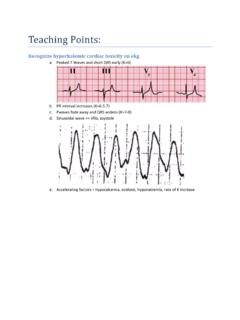
3 Hyperkalemia Hyperkalemia in acute settings shows degree of Na-K-ATPase poisoning Hypokalemia Potentiates toxicity --correct immediately Normal Dig ECG. ECG-normal T wave changes QT interval shortening Scooped . appearance of ST. segment Increase U wave amplitude Atrial Tachycardia with AV block First Degree AV block Mobitz I. Afib with accelerated Junctional Rhythms Bidirectional Ventricular Tachycardia Ventricular Bigeminy Treatment Support treatment if needed-intubation, etc Symptomatic bradycardia-atropine Do not use transvenous pacing as first line -can lead to arrhythmias Avoid Beta agonists (isoproterenol).
4 Gut decontamination with activated charcoal (w/in 6-8 hours of acute ingestion). Manage K as usual except do not use calcium salts Replace Mg Treatment Digibind Digoxin-specific Fab fragments Made in sheep Bind rapidly to intravascular dig Dig stored in other tissues then goes into intravascular space and digibind binds that also Digibind/digoxin complex small and is rapidly removed by normal kidneys ESRD on HD responds clinically the same to digibind except elimination of complex slow Theoretically can get rebound dig toxicity When to Use Digibind Hemodynamic instability Life-threatening arrhythmias Severe Bradycardia-even if atropine works Plasma K above 5.
5 Plasma Dig above 10. Presence of dig toxicity rhythm combined with dig toxic level References b=ArticleURL&_udi=B6T8B-42C07N1- 8&_user=130907&_coverDate=02%2F28%2F2001 &_rdoc=1&. _fmt=&_orig=search&_sort=d&view=c&_acct= C000004198&. _version=1&_urlVersion=0&_userid=130907& md5=461c196c 5db7aa1916fb4a1dec1035dd Ismail, Nuhad, MD. Digitalis (cardiac glycoside) intoxication. UpToDate. 2007. Arnsdorf, Morton, MD. Electrophysiology of arrythmias due to digitalis toxicity . UpToDate. 2007.