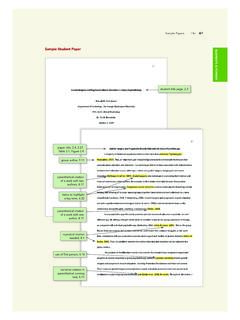
Transcription of APA 7 - Professional Sample Paper
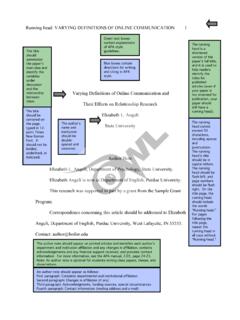
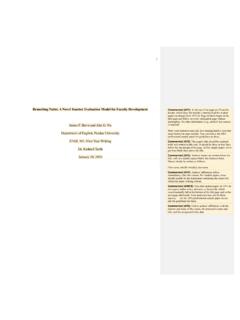
1 A NOVEL TEACHER EVALUATION MODEL 1 Branching Paths: A Novel Teacher Evaluation Model for Faculty Development Kim A. Park,1 James P. Bavis,1 and Ahn G. Nu2 1 Department of English, Purdue University 2 Center for Faculty Education, Department of Educational Psychology, Quad City University Author Note Kim A. Park James P. Bavis is now at the MacLeod Institute for Music Education, Green Bay, WI. We have no known conflict of interest to disclose. Correspondence concerning this article should be addressed to Ahn G. Nu, Dept. of Educational Psychology, 253 N. Proctor St., Quad City, WA, 09291. Email: Commented [AF1]: The running head is a shortened version of the Paper 's title that appears on every page. It is written in all capitals, and it should be flush left in the document's header.
2 No "Running head:" label is included in APA 7. If the Paper 's title is fewer than 50 characters (including spaces and punctuation), the actual title may be used rather than a shortened form. Commented [AF2]: Page numbers begin on the first page and follow on every subsequent page without interruption. No other information ( , authors last names) are required. Commented [AF3]: The Paper 's title should be centered, bold, and written in title case. It should be three or four lines below the top margin of the page. In this Sample Paper , we've put three blank lines above the title. Commented [AF4]: Authors' names appear one double-spaced line below the title. They should be written as follows: First name, middle initial(s), last name. Omit all Professional titles and/or degrees ( , Dr.)
3 , Rev., PhD, MA). Commented [AF5]: Authors' affiliations follow immediately after their names. If the authors represent multiple institutions, as is the case in this Sample , use superscripted numbers to indicate which author is affiliated with which institution. If all authors represent the same institution, do not use any numbers. Commented [AF6]: Author notes contain the following parts in this order: 1. Bold, centered "Author Note" label. 2. ORCID iDs 3. Changes of author affiliation. 4. Disclosures/ acknowledgm ents 5. Contact information. Each part is optional ( , you should omit any parts that do not apply to your manuscript or omit the note entirely if none apply). Format each item as its own indented paragraph. Commented [AF7]: ORCID is an organization that allows researchers and scholars to register Professional profiles so that they can easily connect with one another.
4 To include an ORCID iD in your author note, simply provide the author's name, followed by the green iD icon (hyperlinked to the URL that follows) and a hyperlink to the appropriate ORCID page. A NOVEL TEACHER EVALUATION MODEL 2 Abstract A large body of assessment literature suggests that students evaluations of their teachers (SETs) can fail to measure the construct of teaching in a variety of contexts. This can compromise faculty development efforts that rely on information from SETs. The disconnect between SET results and faculty development efforts is exacerbated in educational contexts that demand particular teaching skills that SETs do not value in proportion to their local importance (or do not measure at all). This Paper responds to these challenges by proposing an instrument for the assessment of teaching that allows institutional stakeholders to define the teaching construct in a way they determine to suit the local context.
5 The main innovation of this instrument relative to traditional SETs is that it employs a branching tree structure populated by binary-choice items based on the Empirically derived, Binary-choice, Boundary-definition (EBB) scale developed by Turner and Upshur for ESL writing assessment. The Paper argues that this structure can allow stakeholders to define the teaching construct by changing the order and sensitivity of the nodes in the tree of possible outcomes, each of which corresponds to a specific teaching skill. The Paper concludes by outlining a pilot study that will examine the differences between the proposed EBB instrument and a traditional SET employing series of multiple-choice questions (MCQs) that correspond to Likert scale values. Keywords: college teaching, student evaluations of teaching, scale development, ebb scale, pedagogies, educational assessment, faculty development Commented [AF8]: Note that both the running head and the page number continue on the pages that follow the title.
6 Commented [AF9]: The word "Abstract" should be centered and bolded at the top of the page. Commented [AF10]: By standard convention, abstracts do not contain citations of other works. If you need to refer to another work in the abstract, mentioning the authors in the text can often suffice. Note also that some institutions and publications may allow for citations in the abstract. Commented [AF11]: An abstract quickly summarizes the main points of the Paper that follows it. The APA 7 manual does not give explicit directions for how long abstracts should be, but it does note that most abstracts do not exceed 250 words (p. 38). It also notes that Professional publishers (like academic journals) may have a variety of rules for abstracts, and that writers should typically defer to these.
7 Commented [AF12]: The main paragraph of the abstract should not be indented. Commented [AF13]: Follow the abstract with a selection of keywords that describe the important ideas or subjects in your Paper . These help online readers search for your Paper in a database. The keyword list should have its first line indented inches. Begin the list with the label "Keywords:" (note the italics and the colon). Follow this with a list of keywords written in lowercase (except for proper nouns) and separated by commas. Do not place a period at the end of the list. A NOVEL TEACHER EVALUATION MODEL 3 Branching Paths: A Novel Teacher Evaluation Model for Faculty Development According to Theall (2017), Faculty evaluation and development cannot be considered separately.
8 Evaluation without development is punitive, and development without evaluation is guesswork (p. 91). As the practices that constitute modern programmatic faculty development have evolved from their humble beginnings to become a commonplace feature of university life (Lewis, 1996), a variety of tactics to evaluate the proficiency of teaching faculty for development purposes have likewise become commonplace. These include measures as diverse as peer observations, the development of teaching portfolios, and student evaluations. One such measure, the student evaluation of teacher (SET), has been virtually ubiquitous since at least the 1990s (Wilson, 1998). Though records of SET-like instruments can be traced to work at Purdue University in the 1920s (Remmers & Brandenburg, 1927), most modern histories of faculty development suggest that their rise to widespread popularity went hand-in-hand with the birth of modern faculty development programs in the 1970s, when universities began to adopt them in response to student protest movements criticizing mainstream university curricula and approaches to instruction (Gaff & Simpson, 1994; Lewis, 1996; McKeachie, 1996).
9 By the mid-2000s, researchers had begun to characterize SETs in terms like ..the predominant measure of university teacher performance [..] worldwide (Pounder, 2007, p. 178). Today, SETs play an important role in teacher assessment and faculty development at most universities (Davis, 2009). Recent SET research practically takes the presence of some form of this assessment on most campuses as a given. Spooren et al. (2017), for instance, merely note that that SETs can be found at almost every institution of higher education throughout the world (p. 130). Similarly, Darwin (2012) refers to teacher evaluation as an established orthodoxy, labeling it a venerated, axiomatic institutiona l practice (p. 733). Moreover, SETs do not only help universities direct their faculty development efforts.
10 They have also come to occupy a place of considerable institutional importance for their role in Commented [AF14]: The Paper 's title is bolded and centered above the first body paragraph. There should be no "Introduction" header. Commented [AF15]: Here, we've borrowed a quote from an external source, so we need to provide the location of the quote in the document (in this case, the page number) in the parenthetical. Commented [AF16]: By contrast, here, we've merely paraphrased an idea from the external source. Thus, no location or page number is required. Commented [AF17]: Spell out abbreviations the first time you use them, except in cases where the abbreviations are very well- known ( , "CIA"). Commented [AF18]: For sources with two authors, use an ampersand (&) between the authors' names rather than the word "and.