Transcription of APA Formatting & Style - Allen College
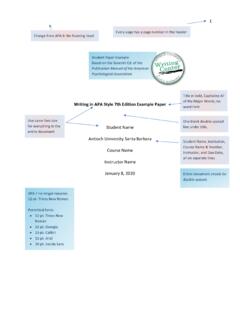
1 APA Formatting & STYLEDr. Brenda Barnes, PhD, MT(ASCP)SBBJANUARY 2021 What is APA Style / Formatting ? Refers to guidelines and Style Formatting used by the American Psychological Association (APA) Current edition 7thImage source: source: APA? Uses a structured, consistent format Allows focus to be placed on content rather than format Used in most academic journals It s what your instructor expects Papers Discussion posts Others be sure to ask!Image source: ResourcesAPAO thers Publication Manual of the American Psychological Association, 7thEdition Concise Guide to APA Style , 7thEdition APA Style Website - College Website - #APA%20 ResourcesAPA Structural ElementsImage source: that follows is taken from the APA Style Instructional Aids webpage and includes the structural elements of a student paper.
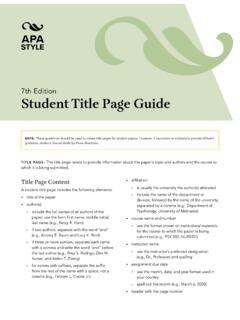
2 A variety of useful resources can be found at the site indicated out: source: Title Page Format (Section ) Entire page is double-spaced Each element is centered Do not use italics, underlining, or different font sizes Title (Section ) Summarizes main idea concisely in an engaging way Title case Capitalize first letter and any major words of four letters or more (plus any linking verbs Is, Are, and Be) Double-space, center, and bold the title Should be in upper half of title page Author Name (Section ) Full name of each author Format First M. Last Centered, two double-spaced lines after title Author Affiliation (Section ) Name of the department of the course and name of College or university Format Department, College Centered, one double-spaced line after author name(s) Course Number and Name (Section ) Include number and name of course on the same line use format shown on syllabus Centered, one double-spaced line after author affiliation Instructor Name (Section )
3 Include name of course instructor use format shown on syllabus Centered, one double-spaced line after course number and name Due Date (Section ) Include month, day, year (spell out month) Centered, one double-spaced line after Instructor name Page Header (Section ) Page number 1 flush right in headerAPA, 2020 Image source: Format Page Header (Section ) Page number flush right of all pages Insert page number using automatic page-numbering function Note: Running heads are not required for student papers Font and Font Size (Section ) Use the same font and size throughout paper Recommendations: 11-point Calibri 11-point Arial 10-point Lucida Sans Unicode 12-point Times New Roman 11-point Georgia 10-point Computer Modern Line Spacing (Section ) Double-space throughout Do not add extra lines before or after headings or between paragraphs Margins (Section ) 1 in.
4 On all sides Paragraph alignment (Sections ) Left-align text (do not use full justification) Ident first line of each paragraph in. (one tab key) Paper Length (Section ) Follow assignment guidelines May use word count as a guideAPA, 2020 Image source: Organization Introduction (Section ) Repeat the paper title on first line of first page of text, before opening paragraph Center and bold title Do not include Introduction heading Use Level 2 headings for subsections in the introduction Text (Section ) Use headings as needed to organize Use Level 1 heading for main section after the introduction Page Order (Section ) Title page Abstract (if needed) Text References Footnotes (if needed) Tables (if needed) Figures (if needed) Appendices (if needed) Headings(Section )
5 Start each new section with a heading Write all headings in title case and bold Italicize Level 3 and 5 headings Follow guidelines for alignment of headings (see next slide and link) Section Labels (Section ) Bold and center, including Abstract and References APA, 2020 Image source: (Section )Writing Style Continuity (Sections ) Check for continuity in words, concepts, and thematic development Clearly explain relationships between ideas Present in logical order Use transitionsto connect sentences, paragraphs and ideas Conciseness (Sections ) Be careful and deliberate with word choices Eliminate wordiness, redundancy, overuse of passive voice No jargon, contractions, colloquialisms Vary sentence length Paragraphs No single-sentence paragraphs Avoid paragraphs longer than one double-spaced page Clarity (Sections )
6 Clear and precise language Use professional tone and language Avoid anthropomorphisms Make logical comparisonsThe theory , 2020 Scholarly Voice Clear, succinct language Follows tools and rules of grammar Free from bias Depends on purpose of assignment or paper framing Relationship: cause-effect Comparison: similarity, difference Process: How did it work and how might it work now? Definition: What is involved in the issue? Testimony authority: What do the experts say? What does the data say? Chronology: How has this evolved over time?Johnson & Rulo, 2019; Schwartz, Landrum, & Gurung, 2021 One is not required to write in an expeditiousmanner with increased facticity.
7 The author should write perspicaciouslyand avoid obfuscatingthe central message. Why use a five-dollar wordwhen a fifty-cent word will do?See: ~hcexres/style_ and Logical Comparisons Anthropomorphism attributing human actions to inanimate objects The theory concludes humans have difficulty dealing with change. Acceptable usage, per APA: This section This paper focuses The results Logical Comparisons Illogical comparisons result from poor sentence structure or omitting key wordsSmith (2010) agreed with Jones (2016) regarding the theory at source: , 2020 Grammar Verb Tense (Section ) Use consistent verb tense in paragraphs and sections Voiceand Mood (Sections ) Use active rather than passive voice in most instances Subject and Verb Agreement (Section ) Use verbs that agree in number (singular or plural) with their subjects Pronouns (Sections ) Use first-person pronouns to describe your work and personal reactions I ; I agreed Singular they Use it when referring to a person who uses it as their self-identified pronoun or when gender is unknown or irrelevantImage source: , 2020 Active vs.
8 Passive Voice Active voice: Subject (performer) verb object (receiver) The boy kicked the ball. Passive voice: Object verb subject The ball was kicked by the boy. Image source: : Patients are killed by heart attacks more often than other is passive voice! Patients are killed by zombies (by heart attacks)..Improved sentence: Heart attacks kill more patients as compared to other conditions. Pronouns APA does allow using I to address yourself Correct: I performed a literature Check with your instructor to ensure use is appropriate for assignment Do not refer to yourself in the third person Incorrect: The author created this presentation.
9 Correct: I created this presentation. If referring to a group, we is appropriate (if allowed) Correct: We simulated Avoid editorial we Image source: : As nurses, we tend to rely : We tend to rely , 2020 Bias-Free Language (Chapter 5) Eliminate it from your writing and avoid perpetuating beliefs or demeaning attitudes Use language with inclusivity and respect in mind Considerations: Age Disability Gender Participation in research Racial and Ethnic identity Sexual orientation Socioeconomic status IntersectionalityBias-Free Language ResourceImage source.
10 , 2020 Mechanics of Style Punctuation (Sections , ) Use punctuation marks correctly including reference list entries Use varied punctuation marks Avoid multiple punctuation marks in same sentence split into multiple shorter sentences One space after a period or other punctuation mark Use a serial comma before the final element in lists of three or more items Use parentheses to set off in-text citations Quotation Marks (Section ) Commas and periods are placed inside closing quotation marks Other punctuation marks ( , colons, semicolons, ellipses) are placed outside closing quotation marks Placed around direct quotations Not used in reference list Italics (Sections ) Use to draw attention to text First use of key terms or phrases accompanied with a definition Not used for emphasis Spelling and Hyphenation (Sections ) Matches or APA Dictionary of Psychology Words with prefixes or suffixes do not include a hyphen Capitalization (Sections ) Use title case and sentence case correctly Capitalize proper nouns Do not capitalize diseases, disorders, theories, othersAPA, 2020 Image source.