Transcription of APA Style thQuick Guide (7 Ed.)
1 0 [Updated: November 2021] APA Style quick Guide (7th Ed.) Click to see section: Introduction 1 What is APA Style ? 1 What to Document? 1 Formatting Rules 1 Order of pages/sections 1 Fonts and Size 1 Margins 1 Page Numbering 1 Spacing 1 Title Page Elements 1 Headings 2 In-Text Citations 2 Paraphrase 2 Direct quote 2 Direct Quotes from Material without Page Numbers 3 Long Quotes or Block Quotes 3 Secondary Sources (Material Referring to Other Sources) 3 The Reference List 4 Elements of a Reference List Citation 4 JOURNAL, MAGAZINE, AND NEWSPAPER ARTICLES 4 WEBSITES 5 REPORTS 6 BOOKS & BOOK SECTIONS 7 ENCYCLOPEDIAS AND DICTIONARIES 8 DATABASE RESEARCH 8 BUSINESS CASE STUDIES 9 AUDIOVISUAL MEDIA (MUSIC, TV, MOVIES, ETC.) 9 IMAGES (TABLES & FIGURES) 11 Figure Example 12 Table Example 13 1 [Updated: November 2021] Introduction It is not the intention of this handout to replace the Publication Manual of the american psychological association (APA, 2020), nor is it to give examples of every possible situation.
2 Rather, this handout is offered as a quick reference for general academic writing use. What is APA Style ? american psychological association (APA) Style is one of several styles for academic writing. This Guide provides an introduction to formatting rules and examples of common types of citations. The full seventh edition of the Publication Manual of the american psychological association is available as a print book in the UCW Library. What to Document? Be sure to document all the sources you have cited in writing your assignment. You will need to cite sources for: Direct quotes Paraphrases and summaries of ideas and information Information that is not common knowledge or is not available in a standard reference work Any other borrowed material that might appear to be your own if there were no citation. Formatting Rules Order of pages/sections 1. Title page 2. Abstract (note: Table of Contents is not required in APA and therefore no guidelines exist) 3.
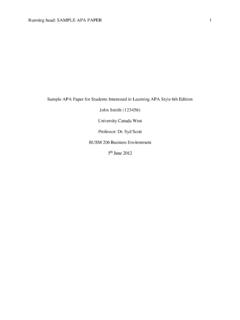
3 Text/Main body 4. References 5. Footnotes 6. Tables 7. Figures 8. Appendices Note: each section starts a new page. Fonts and Size: Accessible font (such as Calibri, Arial, Times New Roman or Georgia in either 11 pt. or 12 pt.) should be used throughout all papers. Margins: 1-inch margins on the top, bottom, left, and right sides of the page. Page Numbering: Identify the title page with the page number 1. The remaining pages should be numbered consecutively. Spacing: Double-spacing throughout paper text and inch (use tab key) indentions at the beginning of each paragraph (unless there is a level four or five heading see chart below). Title Page Elements The title page includes six elements: title, author name(s), author(s) institutional affiliation, course, instructor, and due date. 2 [Updated: November 2021] Headings It is helpful to organize complex papers into various sections using headings.
4 This clearly identifies new sections of the paper for the reader. For most papers, three heading styles are sufficient. In-Text Citations A citation is giving credit whenever you use someone s information. This is done when paraphrasing their ideas or using direct quotes. The purpose is to give credit to the person whose information you are using and allow readers to find out more information about the source. 1. Paraphrase: Include author(s) last name and date (no page number is necessary). Narrative (written within the sentence): o Walker (2008) Parenthetical (written at the end of the sentence): o A study of the comparison process (Walker, 2008). 2. Direct quote: Include the author(s) last name, year of publication, and page number of quote. Narrative (written within the sentence): o Boal (2009) defines stereotypes as generalized and usually value-laden impressions that one s social group uses in characterizing members of another group ( ).
5 Parenthetical (written at the end of the sentence): o Stereotypes have been defined as generalized and usually value-laden impressions that one s social group uses in characterizing members of another group (Boal, 2009, p. 110). Note: The period or other punctuation is placed after the citation. Note: For in-text citations with three or more authors, use et al. after the first author listed. Do not list the remainder of the authors in the in-text citation. 3 [Updated: November 2021] Direct Quotes from Material without Page Numbers: For online sources without page numbers, provide readers with another way of locating the quoted material. You may do any of the following: Provide a heading or section name Provide a shortened heading or section name in quotation marks Provide a paragraph number (count manually if not numbered) Provide a paragraph number in combination with a section or heading name Examples: Basu and Jones (2007) went so far as to suggest the need for a new intellectual framework in which to consider the nature and form of regulation in cyberspace (Regulation of Cyberspace section).
6 (Basu & Jones, 2007, Monitoring section). (Basu & Jones, 2007, para. 5). (Basu & Jones 2007, Conclusion, para. 1). Long Quotes or Block Quotes: If the quote is 40 words or more in length, the whole quote should be indented inches (tab key) and double-spaced throughout. Quotation marks are not used with long quotes and it is introduced by a colon (:). A long quote is ended with a period followed by the citation in parentheses; there is no punctuation after the parentheses. Take a look at the example below. Ford (2015) discusses the concept of business and peace scholarship and goes on to state: Adding to firm diversity are the myriad idiosyncrasies of host societies. A place certainly exists for general thematic and conceptual work here. However, in practice the more valuable contributions might come from efforts to distinguish why or how certain types of firms in certain kinds of situations might act or avoid acting in ways that may or may not enhance various ideas about peace.
7 (p. 453) Secondary Sources (Material Referring to Other Sources) Use sparingly and only when necessary. For example, use when the original work is out of print, unavailable through usual sources, or not available in English. Always try to find the original source. When quoting material containing embedded citations, include the citations within the quotation. Climate change is proving to be of urgent concern for young people (Sottero, 2005) particularly in comparison to older generations (Edgar & Mathieson, 2019, p. 38). When paraphrasing material containing reference to other sources, ensure the reader knows where you got the information. Suppose that you want to refer to a 1989 study by Smith, which you read about in a 1996 article by Becker. Use one of the following citations: Smith (as cited in Becker, 1996) found the opposite effect in two-year-olds. The opposite effect was observed in two-year-olds (Smith, 1989, as cited in Becker, 1996).
8 In the References, only list the source(s) that you have read, not the secondary source. 4 [Updated: November 2021] The Reference List The reference page is a detailed list of all the citations in your paper. Its purpose is to provide the reader with information on how to locate the sources you used. It includes all sources cited in the paper (do not include works that you reviewed but did not cite in your work). Begin the reference list on a new page titled References. Elements of a Reference List Citation Reference citations included detailed information such as author(s), title of work, date of publication, publisher, volume and issue number, page numbers, website URLs and digital object identifiers (DOIs). JOURNAL, MAGAZINE, AND NEWSPAPER ARTICLES Article with a DOI: AuthorLastName, A. A. (year). Title of article. Title of Journal/Magazine/Newspaper, volume(issue), page range. Article without a DOI (Library database): AuthorLastName, A.
9 A. (year ). Title of article. Title of Journal/Magazine/Newspaper, volume(issue), page range. Article without a DOI (Non-database): AuthorLastName, A. A. (year). Title of article. Title of Journal/Magazine/Newspaper, volume(issue), page range. Note: Newspaper Articles in this section refers to articles that are from established newspapers posted online. For news websites, please see the Websites section below. Note: Volume, issue, and page numbers may not be available for all articles. Note: Magazine and newspaper articles require year, month, and if possible, day of publication. Journal articles require only year. Image: Elements of a Journal Article Citation 5 [Updated: November 2021] WEBSITES Website AuthorLastName, A. A. (year, Month day). Title of webpage. Title of Website. Note: When the author and the website name are the same, omit the site name. Examples: Webpage on a website: Group author National Defense and the Canadian Armed Forces.
10 (2004, November 15). Backgrounder: Post traumatic stress disorder (PTSD). disorder-ptsd/hnocfnhe In-text citation: (National Defense and the Canadian Forces, 2004) Webpage on a website: No date, Group author Phillips. ( ). Sustainability. In-text citation: (Phillips, ) Examples: Article: Online with DOI Rutherford, B. J. (2006). Reading disability and hemispheric interaction on a lexical decision task. Brain and Cognition, 60(2), 55-63.. In-text citation (direct quote): (Rutherford, 2006, p. 56) Article: Online without DOI (Library database) Pilar, L., Moulis, P., Pitrov , J., Bouda, P., Gresham, G., Balcarov , T., & Roj k, S. (2019). Education and business as a key topics at the Instagram posts in the area of gamification. Journal on Efficiency and Responsibility in Education and Science, 12(1). 26-33. In-text citation: (Pilar et al., 2019) Note: For in-text citations with three or more authors, use et al. after the first author listed.