Transcription of Aparent …
1 Behaviour Research and Therapy 42 (2004) 813 parent-report measure of children s anxiety: psychometricproperties and comparison with child-report in a clinicand normal sampleMaaike H. Nautaa,b, , Agnes Scholingc, Ronald M. Rapeed, Maree Abbottd,Susan H. Spencee, Allison WaterseaDepartment of Clinical Psychology, University of Groningen, Grote Kruisstraat 2/1, 9712 T SGroningen,The NetherlandsbAcademic Centre for Child and Adolescent Psychiatry Groningen, Accare, PO Box 660,9700 AR Groningen, The NetherlandscDepartment of Clinical Psychology, University of Amsterdam, Roetersstraat 15, 1018 WB Amsterdam,The NetherlandsdDepartment of Psychology, Macquarie University, Sydney, NSW 2109, AustraliaeSchool of Psychology, University of Queensland, Brisbane, QLD 4072, AustraliaReceived 7 January 2003; received in revised form.
2 Accepted 2 July 2003 AbstractThis study examined the psychometric properties of the parent version of the Spence Children s Anxi-ety Scale (SCAS-P); 484 parents of anxiety disordered children and 261 parents in a normal controlgroup participated in the study. Results of confirmatory factor analysis provided support for six inter-correlated factors, that corresponded with the child self-report as well as with the classification of anxietydisorders by DSM-IV (namely separation anxiety, generalized anxiety, social phobia, panic/agoraphobia,obsessive compulsive disorder, and fear of physical injuries).
3 A post-hoc model in which generalizedanxiety functioned as the higher order factor for the other five factors described the data equally reliability of the subscales was satisfactory to excellent. Evidence was found for both convergent anddivergent validity: the measure correlated well with the parent report for internalizing symptoms, andlower with externalizing symptoms. Parent child agreement ranged from to in the anxiety-dis-ordered group, and from to in the control group. The measure differentiated significantly betweenanxiety-disordered children versus controls, and also between the different anxiety disorders except Corresponding author.
4 Tel.: +31-50-3637601; fax: + ( Nauta).0005-7967/$ - see front matter#2003 Elsevier Ltd. All rights (03)00200-6 GAD. The SCAS-P is recommended as a screening instrument for normal children and as a diagnosticinstrument in clinical settings.#2003 Elsevier Ltd. All rights :Children; Parents; Assessment; Anxiety; Confirmatory factor analysis1. IntroductionIn the past few years, research on the assessment of childhood anxiety has focused on con-structing child self-report questionnaires that are related to the commonly used classificationsystem of DSM-IV (American Psychiatric Association, 1994).
5 Prior to this, questionnaires didnot examine specific anxiety disorders, but were typically designed to measure indicators ofanxiety in general. Moreover, they were generally derived from adult anxiety measures ratherthan being based on child specific need for a child self-report questionnaire following the DSM-classification was evident andled to the development of measures such as the Spence Children s Anxiety Scale (SCAS;Spence,1997) and the Screen for Child Anxiety Related Emotional Disorders (SCARED;Birmaher et al., 1997). Both instruments have recently been studied on their psychometric qual-ities, both separately as well as in relation to each other.
6 Satisfactory reliability is a basic andessential requirement for an assessment instrument. For individual assessment purposes, Cron-bach s alpha s of at least have been recommended, whereas for research purposes reliabilitiesof or higher may suffice (Nunnally, 1978). Further, a sound instrument should preferablyshow different types of validity. Convergent validity should be reflected by relatively high correla-tions with instruments that are meant to measure similar constructs whereas divergent validityshould be demonstrated by relatively low correlations with instruments measuring other varia-bles.
7 In addition, clinical practice requires that an instrument can differentiate between anxietydisorders and normal controls, and ideally also between the distinct anxiety results for the SCAS and the SCARED produced support for the classification of anxietydisorders according to the DSM-IV and demonstrated their psychometric properties to beacceptable (Essau, Muris & Ederer, 2002; Muris, Merkelbach, Ollendick, King & Bogie, 2002).Although the SCAS and the SCARED display many similarities, they also show some differ-ences. First, the SCAS was developed as a screening instrument in normal populations, whereasthe SCARED was developed in clinical populations.
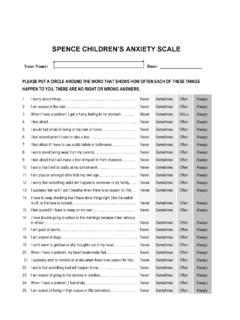
8 Second, the SCAS contains 38 items andwas intended to measure symptoms of the following DSM-IV anxiety disorders: (1) panic dis-order/agoraphobia, (2) generalized anxiety disorder, (3) social phobia, (4) separation anxietydisorder, (5) obsessive compulsive disorder, and (6) some specific fears, mainly fear of physicalinjury/animals. The original SCARED, consisting of 85 items and subsequently reduced to 41items (Birmaher et al., 1997), was developed to measure symptoms of (1) panic disorder, (2)generalized anxiety disorder, (3) social phobia, (4) separation anxiety disorder and (5) schoolphobia (the latter not being a DSM-IV anxiety disorder).
9 So, despite fewer items, the SCAS shows a broader scope and a closer connection with the DSM-IV structure than the originalversion of the SCARED. This situation inspired some researchers (Muris, Merkelbach, Nauta et al. / Behaviour Research and Therapy 42 (2004) 813 839814 Brakel & Mayer, 1999; Muris, Schmidt & Merckelbach, 2000) to present adaptations of theSCARED, including 66 items, with symptoms of obsessive compulsive disorder and PTSS added, but in recent studies only the 41-item, five subscale version is used. Third, the correlationbetween the social phobia subscales of both questionnaires appeared to be unexpectedly low(r 0:37 inMuris et al.)
10 , 1999;r 0:58 inMuris et al., 2002;r 0:59 inEssau et al., 2002), sug-gesting that they measure different aspects of social phobic fears; the SCARED predominantlymeasures fear of meeting unfamiliar people, whereas the social phobia items in the SCAS aremore closely related to the DSM-IV social phobia criteria, such as fear of social or performancesituations and fear of negative evaluation (Essau et al., 2002). Finally, the SCAS is rated on afour-point scale with a broader range of possible answers (ranging from 0 never to3 always), while the present 41-item version of the SCARED is rated on a three-point scale(0 almost never, 1 sometimes, 2 often).