Transcription of Appendix A: Disease-Specific Chapters
1 Appendix A: Disease-Specific Chapters chapter : lyme disease Infectious Diseases Protocol Revised April 2015 lyme disease Communicable Virulent Health Protection and Promotion Act: Ontario Regulation 558/91 Specification of Communicable Diseases Health Protection and Promotion Act: Ontario Regulation 559/91 Specification of Reportable Diseases Aetiologic Agent lyme disease is a tick-borne zoonotic disease caused by the bacterium, Borrelia burgdorferi (B. burgdorferi), a spirochete first identified in North America in , 2 Case Definition Surveillance Case Definition See Appendix B Outbreak Case Definition N/A Identification Clinical Presentation lyme borreliosis is generally divided into three stages in which infected persons may experience any of the following symptoms: Early localized disease o Erythema migrans (EM) or bull s eye rash at the site of a recent tick bite, fever, malaise, headache, myalgia, neck stiffness, fatigue, and arthralgia; Early disseminated disease o Multiple EM in approximately 15% of people occurs several weeks after infective tick bite, cranial nerve palsies, lymphocytic meningitis, conjunctivitis, arthralgia, myalgia, headache, fatigue, carditis (heart block).
2 And Late disease o May develop in people with early infection that was undetected or not adequately treated. Involves the heart, nervous system and joints; arrhythmias, heart block and sometimes myopericarditis; recurrent arthritis affecting large joints ( , knees); peripheral neuropathy; central nervous system manifestations meningitis; encephalopathy ( , behavior changes, sleep disturbance, headaches); and , 2 2 Diagnosis Note: Diagnosis is primarily based on clinical and epidemiological findings. Laboratory testing is used to support clinical suspicion of lyme disease . Serological evidence using the two-tier enzyme-linked immuno-sorbent assay ( ELISA) and Western Blot criteria (as described by the guidelines of the Canadian Public Health Laboratory Network) is used to support clinical diagnosis of lyme disease . For further information about human diagnostic testing, contact the Public Health Ontario Laboratories or refer to the Public Health Ontario Laboratory Services webpage: See Appendix B for diagnostic criteria relevant to Case Definitions.
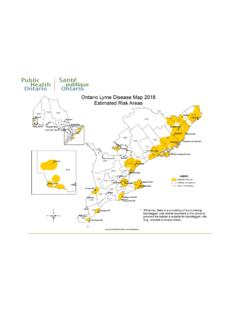
3 Epidemiology Occurrence lyme disease has been found in the USA, Canada, Europe, the former Soviet Union, China and Epidemiologic data for Ontario indicate that infection occurs primarily during summer, with a peak in June and July, but may occur throughout the year, depending on seasonal abundance of the tick locally. Between 2007 and 2011, an average of 100 cases (confirmed and probable) of lyme disease were reported per year in Ontario. Please refer to the Public Health Ontario Monthly Infectious Diseases Surveillance Reports and other infectious diseases reports for more information on disease trends in Ontario, available at; , 4 While cases can occur anywhere in Ontario, areas of greatest risk are currently along the north shores of Lake Erie, Lake Ontario and the St. Lawrence River. Endemic areas in Ontario are specified at the following links: or Reservoir Deer and small mammals such as rodents serve as important hosts to the tick vector, Ixodes scapularis, the primary B.
4 Burgdorferi vector in eastern Canada and Ontario. This tick is commonly known as a deer tick or blacklegged Modes of Transmission Mode of transmission is tick-borne and infection does not occur until an infected tick has been attached for at least 24 Incubation Period For EM rash, from 3 to 32 days after tick exposure with a mean of 7 to 10 days; early stages of the illness may not be apparent and the person may present with later 3 Period of Communicability There is no evidence of person to person Host Susceptibility and Resistance General susceptibility, with increased risk to those that live in or travel to lyme disease endemic Reporting Requirements To local Board of Health Individuals who have or may have lyme disease shall be reported as soon as possible to the medical officer of health by persons required to do so under the Health Protection and Promotion Act, 1990 (HPPA).
5 5 To the Ministry of Health and Long-Term Care (the ministry) or Public Health Ontario (PHO), as specified by the ministry Cases shall be reported using the integrated Public Health Information System (iPHIS), or any other method specified by the ministry, within five (5) business days of receipt of initial notification as per iPHIS Bulletin Number 17: Timely Entry of The minimum data elements to be reported for each case are specified in the following: Ontario Regulation 569 (Reports) under the HPPA;7, 5 The iPHIS User Guides published by PHO; and, Bulletins and directives issued by PHO. Infection Prevention and Control (IPAC) Measures Personal Prevention Measures Provide public education and advice on preventive measures including: Education about the mode of tick transmission and the means for personal protection such as: tucking pants into socks, wearing light coloured long sleeve shirts and long pants in wooded areas, and use of tick repellents that contain DEET (a light coating will do).
6 The concentration of DEET should be no greater than 30% for adults and no greater than 10% for children; Avoiding tick-infested areas when possible; and Removing ticks from domestic , 2 IPAC Strategies The board of health shall develop and utilize a local vector-borne management strategy in order to mitigate risk. This strategy shall include measures such as: Local risk assessments; 4 Public education and source reduction when and where applicable; and For healthcare settings, conducting routine IPAC strategies is all that is necessary. For more information on lyme disease management strategies refer to the ministry lyme disease Surveillance and Management Guidelines. Refer to Public Health Ontario s website at to search for the most up-to-date Provincial Infectious Diseases Advisory Committee (PIDAC) best practices on IPAC. PIDAC best practice documents can be found at: Management of Cases Refer to Ontario Regulation 569 for relevant data to collect and determine the most likely location of Inquire about: Travel to endemic area and activities in the previous 32 days; Outdoor recreational activities and outdoor occupations; Symptoms and date of symptom onset and presence or history of EM-like rash; and Date of tick bite.
7 Treatment is under the direction of the attending healthcare provider. Provide education about the infection and how it is acquired. Management of Contacts None Management of Outbreaks N/A References 1. Heymann DL, editor. Control of communicable diseases manual. 19th ed. Washington, DC: American Public Health Association; 2008. 2. American Academy of Pediatrics. Section 3: summaries of infectious diseases. In: Pickering LK, Baker CJ, Long SS, McMillan JA, editors. Red book: 2012 report of the Committee on Infectious Diseases. 29th ed. Elk Grove Village, IL: American Academy of Pediatrics; 2012:474-9. 3. Ontario Agency for Health Protection and Promotion (Public Health Ontario). Monthly infectious diseases surveillance report. Toronto, ON: Queen s Printer for Ontario; 2014. Available from: 5 4. Ontario Agency for Health Protection and Promotion (Public Health Ontario).
8 Reportabledisease trends in Ontario, 2011. Toronto, ON: Queen s Printer for Ontario; from: Protection and Promotion Act, 1990, c. Available from: Ontario. Ministry of Health and Long-Term Care. Timely entry of cases. iPHIS , ON: Queen s Printer for Ontario; 2014 , 1990, Reg. 569. Available from: Additional Resources Centers for disease Control and Prevention, National Center for Emerging and Zoonotic Infectious Diseases, Division of Vector-Borne Infectious Diseases [Internet]. Atlanta, GA: CDC; 2014. lyme disease ; [updated 2014 Jun 23; cited 2014 Jun 26]. Available from: National Advisory Committee on Immunization. An Advisory Committee Statement (ACS). Statement on immunization for lyme disease . Can Commun Dis Rep. 2000;26(ACS-3):1- 11. Available from: Agency for H ealth Protection and Promotion (Public Health Ontario), Sider D, Patel S, Russell C, Jain-Sheehan N, Moore S.
9 Technical report: update on lyme disease prevention and control. Toronto, ON: Queen s Printer for Ontario; 2012. Available from; Ontario. Ministry of Health and Long-Term Care. lyme disease surveillance management guidelines. Toronto, ON: Queen s Printer for Ontario; 2011. 6 Document History Table 1: History of Revisions Revision Date Document Section Description of Revisions April 2015 General New template. Section Document History added. April 2015 Clinical Presentation Under Late disease , significant myocardial dysfunction replaced with and sometimes myopericarditis . Under Late disease , addition of and fatigue at the end of the bullet. April 2015 Diagnosis Entire section revised. April 2015 Occurrence Addition of second and third paragraphs. Last paragraph revised. April 2015 Modes of Transmission Tick-borne: transmission usually does not occur until the tick has been attached for at least 24 hours revised to Mode of transmission is tick -borne and infection does not occur until an infected tick has been attached for at least 24 hours.
10 April 2015 Host Susceptibility and Resistance Title of Section changed from Susceptibility and Resistance to Host Susceptibility and Resistance . All persons are probably susceptible, particularly persons that live in or travel to lyme disease endemic areas revised to General susceptibility, with increased risk to those that live in or travel to lyme disease endemic areas . April 2015 To Local Board of Health Confirmed and suspected cases shall be reported to the medical officer of replaced with Individuals who have or may have lyme disease shall be reported as soon as possible to the medical officer of 7 Revision Date Document Section Description of Revisions April 2015 To the Ministry of Health and Long-Term Care (the ministry), or Public Health Ontario (PHO), as specified by the ministry Title of Section changed from To Public Health Division (PHD) to To the Ministry of Health and Long-Term Care (the ministry) or Public Health Ontario (PHO), as specified by the ministry.