Transcription of APPENDIX: UNIFIED MSA RATING SCALE (UMSARS) Part I ...
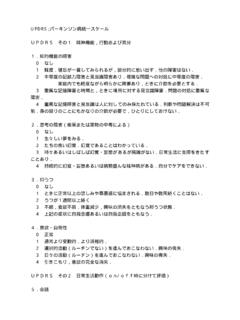
1 appendix : UNIFIED MSA RATING SCALE (UMSARS) part I: historical ReviewRate the average functional situation for the past 2 weeks (unless specified) according to the patient and caregiver interview. Indicate the scorethat best fits with the patient status. Rate the function independently from the nature of the Speech0 Not affected. No difficulties being affected. Sometimes (less than half of the time) asked to repeat affected. Frequently (more than half of the time) asked to repeat most of the impairment. Choking less than once a impairment. Occasional food aspiration with choking more than once a impairment. Frequent food tube or gastrostomy Handwriting0 Normal1 Mildly impaired, all words are impaired, up to half of the words are not impaired, the majority of words are not to Cutting food andhandling slow and/or clumsy, but no help cut most foods, although clumsy and slow; some help must be cut by someone, but can still feed to be slow and/or clumsy, but no help assistance with buttoning, getting arms in help required, but can do some things slow and/or clumsy, but no help help to shower or bathe; or very slow in hygienic assistance for washing, brushing teeth, combing hair, using the Disorders, Vol.
2 19, No. 12, 2004( part I, continued)7. impaired. No assistance needed. No walking aid required (except for unrelated disorders).2 Moderately impaired. Assistance and/or walking aid needed impaired. Assistance and/or walking aid needed walk at all even with Falling (rate thepast month) falling (less than once a month).2 Occasional falling (less than once a week).3 Falls more than once a at least once a day (if the patient cannot walk at all, rate 4).9. Orthostaticsymptoms0No orthostatic symptoms.*1 Orthostatic symptoms are infrequent and do not restrict activities of daily orthostatic symptoms developing at least once a week. Some limitation in activities of daily symptoms develop on most occasions. Able to stand 1 min on most occasions. Limitation in mostof activities of daily consistently develop on orthostasis.
3 Able to stand 1 min on most occasions. Syncope/presyncopeis common if patient attempts to stand.*Syncope, dizziness, visual disturbances or neck pain, relieved on lying Urinary function* and/or frequency, no drug treatment and/or frequency, drug treatment incontinence and/or incomplete bladder emptying needing intermittent needing indwelling catheter.*Urinary symptoms should not be due to other Sexual function0No impairment compared to healthy impairment compared to healthy impairment compared to healthy sexual activity Bowel function0No change in pattern of bowel function from previous constipation but no medication constipation requiring use of constipation requiring use of laxatives and have a spontaneous bowel score part I: part II: Motor Examination ScaleAlways rate the worst affected Facial hypomimia, could be normal ( Poker face ).
4 2 Slight but definitely abnormal diminution of facial hypomimia; lips parted some of the or fixed facies with severe or complete loss of facial expression, lips parted inch or SpeechThe patient is asked to repeat several times a standard slow, slurred, and/or dysphonic. No need to repeat slow, slurred, and/or dysphonic. Sometimes asked to repeat slow, slurred, and/or dysphonic. Frequently asked to repeat Disorders, Vol. 19, No. 12, 2004( part II, continued)3. Ocular motor dysfunctionEye movements are examined by asking the subject to follow slow horizontal finger movements of the examiner, to looklaterally at the finger at different positions, and to perform saccades between two fingers, each held at an eccentric posit ion ofapproximately 30.
5 The examiner assesses the following abnormal signs: (1) broken-up smooth pursuit, (2) gaze-evokednystagmus at an eye position of more than 45 degrees, (3) gaze-evoked nystagmus at an eye position of less than 45 degrees,(4) saccadic hypermetria. Sign 3 suggests that there are at least two abnormal ocular motor signs, because Sign 2 is also abnormal ocular motor abnormal ocular motor abnormal ocular motor abnormal ocular motor Tremor at rest (rate the most affected limb) and infrequently in amplitude and persistent. Or moderate in amplitude, but only intermittently in amplitude and present most of the time,4 Marked in amplitude and present most of the time,5. Action tremorAssess postural tremor of outstretched arms (A) and action tremor on finger pointing (B).
6 Rate maximal tremor severity inTask A and/or B (whichever is worse), and rate the most affected tremor of small amplitude (A). No interference with finger pointing (B).2 Moderate amplitude (A). Some interference with finger pointing (B).3 Marked amplitude (A). Marked interference with finger pointing (B).4 Severe amplitude (A). Finger pointing impossible (B).6. Increased tone (rate the most affected limb)Judged on passive movement of major joints with patient relaxed in sitting position; ignore or detectable only when activated by mirror or other to , but full range of motion easily , range of motion achieved with Rapid alternating movements of handsPro-supination movements of hands, vertically or horizontally, with as large an amplitude as possible, each hand separately,rate the worst affected limb.
7 Note that impaired performance on this task can be caused by bradykinesia and/or cereb ellarincoordination. Rate functional performance regardless of underlying motor barely perform the Finger tapsPatient taps thumb with index finger in rapid succession with widest amplitude possible, each hand at least 15 to 20 the worst affected limb. Note that impaired performance on this task can be caused by bradykinesia and/or cere bellarincoordination. Rate functional performance regardless of underlying motor barely perform the Leg agilityPatient is sitting and taps heel on ground in rapid succession, picking up entire leg. Amplitude should be approximately10 cm, rate the worst affected leg. Note that impaired performance on this task can be caused by bradykinesia and/or cer ebellarincoordination.
8 Rate functional performance, regardless of underlying motor barely perform the Heel-knee-shin testThe patient is requested to raise one leg and place the heel on the knee, and then slide the heel down the anterior tibial surfaceof the resting leg toward the ankle. On reaching the ankle joint, the leg is again raised in the air to a heig ht of approximately40 cm and the action is repeated. At least three movements of each limb must be performed for proper assessment. Rate theworst affected dysmetric and dysmetric and dysmetric and barely perform the Disorders, Vol. 19, No. 12, 2004( part II, continued)11. Arising from chairPatient attempts to arise from a straight-back wood or metal chair with arms folded across , or may need more than one self up from arms of to fall back and may have to try more than once but can get up without to arise without quite erect, slightly stooped posture; could be normal for older stooped posture, definitely abnormal; can be slightly leaning to one stooped posture with kyphosis; can be moderately leaning to one flexion with extreme abnormality of Body swayRate spontaneous body sway and response to sudden, strong posterior displacement produced by pull on shoulder whilepatient erect with eyes open and feet slightly apart.
9 Patient has to be body sway and/or retropulsion with unaided body sway and/or deficient postural response; might fall if not caught by body sway. Very unstable. Tends to lose balance to stand without impaired. Walks with difficulty, but requires little or no impaired. Requires walk at all, even with score part II: part III: Autonomic ExaminationSupine blood pressure and heart rate are measured after 2 minutes of rest and again after 2 minutes of standing. Orthostatic symptoms mayinclude lightheadedness, dizziness, blurred vision, weakness, fatigue, cognitive impairment, nausea, palpitations, tremulousness, headache,neckand coat-hanger blood pressureSupineStanding (2 minutes)Unable to recordDiastolic blood pressureSupineStanding (2 minutes)Unable to recordHeart rateSupineStanding (2 minutes)Unable to recordOrthostatic symptomsYesNoPart IV: Global Disability Scale1.
10 Completely independent. Able to do all chores with minimal difficulty or impairment. Essentially normal. Unaware of any Not completely independent. Needs help with some More dependent. Help with half of chores. Spends a large part of the day with Very dependent. Now and then does a few chores alone or begins alone. Much help Totally dependent and helpless. Disorders, Vol. 19, No. 12, 2004