Transcription of Applications of Second-Order Differential Equations
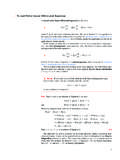
1 Applications of Second-Order Differential EquationsSecond- order linear Differential Equations have a variety of Applications in science andengineering. In this section we explore two of them: the vibration of springs and SpringsWe consider the motion of an object with mass at the end of a spring that is either ver-tical (as in Figure 1) or horizontal on a level surface (as in Figure 2).In Section we discussed Hooke s Law, which says that if the spring is stretched (orcompressed) units from its natural length, then it exerts a force that is proportional to :where is a positive constant (called the spring constant).
2 If we ignore any external resist-ing forces (due to air resistance or friction) then, by Newton s second Law (force equalsmass times acceleration), we haveThis is a Second-Order linear Differential equation. Its auxiliary equation is with roots , where . Thus, the general solution iswhich can also be written aswhere(frequency)(amplitude)(See Exercise 17.) This type of motion is called simple harmonic 1A spring with a mass of 2 kg has natural length m. A force of N isrequired to maintain it stretched to a length of m.
3 If the spring is stretched to a lengthof m and then released with initial velocity 0, find the position of the mass at anytime .SOLUTIONFrom Hooke s Law, the force required to stretch the spring isso . Using this value of the spring constant , together with in Equation 1, we haveAs in the earlier general discussion, the solution of this equation isx t c1 cos 8t c2 sin 8t22 d2xdt2 128x 0m 2kk 128k is the phase angle sin c2 Acos c1A A sc12 c22 sk mx t Acos t x t c1cos t c2sin t sk mr imr2 k 0m d2xdt2 kx 0orm d2xdt2 kx1krestoring force kxxxm1 FIGURE 2 FIGURE 1x0xequilibrium positionmmx0xmequilibriumpositionWe are given the initial condition that.
4 But, from Equation 2,Therefore,. Differentiating Equation 2, we getSince the initial velocity is given as , we have and so the solution isDamped VibrationsWe next consider the motion of a spring that is subject to a frictional force (in the case ofthe horizontal spring of Figure 2) or a damping force (in the case where a vertical springmoves through a fluid as in Figure 3). An example is the damping force supplied by ashock absorber in a car or a assume that the damping force is proportional to the velocity of the mass and actsin the direction opposite to the motion.
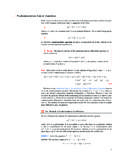
5 (This has been confirmed, at least approximately,by some physical experiments.) Thuswhere is a positive constant, called the damping constant. Thus, in this case, Newton sSecond Law givesorEquation 3 is a Second-Order linear Differential equation and its auxiliary equation is. The roots areWe need to discuss three I (overdamping)In this case and are distinct real roots andSince , , and are all positive, we have , so the roots and given byEquations 4 must both be negative.
6 This shows that as . Typical graphs of as a function of are shown in Figure 4. Notice that oscillations do not occur. (It s pos-sible for the mass to pass through the equilibrium position once, but only once.) This isbecause means that there is a strong damping force (high-viscosity oil or grease)compared with a weak spring or small II (critical damping)This case corresponds to equal rootsr1 r2 c2mc2 4mk 0c2 4mktxtl xl0r2r1sc2 4mk ckmcx c1er1t c2er2tr2r1c2 4mk 0r2 c sc2 4mk2mr1 c sc2 4mk2m4mr2 cr k 0m d2xdt2 c dxdt kx 03m d2xdt2 restoring force damping force kx c dxdtcdamping force c dxdtx t 15 cos 8tc2 0x 0 0x t 8c1sin 8t 8c2cos 8tc1 0 0 FIGURE 3mFIGURE 4 Overdampingxt0xt0 Applications OF Second-Order Differential Equations 3and the solution is given byIt is similar to Case I, and typical graphs resemble those in Figure 4 (see Exercise 12)
7 , butthe damping is just sufficient to suppress vibrations. Any decrease in the viscosity of thefluid leads to the vibrations of the following III (underdamping)Here the roots are complex:whereThe solution is given byWe see that there are oscillations that are damped by the factor . Since and, implies thatasthat is, the motion decays to 0 as time increases. A typical graph is shown in Figure 2 Suppose that the spring of Example 1 is immersed in a fluid with dampingconstant . Find the position of the mass at any time if it starts from the equili-brium position and is given a push to start it with an initial velocity of m Example 1 the mass is and the spring constant is , so thedifferential equation (3) becomesorThe auxiliary equation is with roots and , so the motion is overdamped and the solution isWe are given that , so.
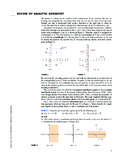
8 Differentiating, we getsoSince , this gives or . Thereforex e 4t e 16t c1 c1 x 0 4c1 16c2 x t 4c1e 4t 16c2e 16tc1 c2 0x 0 0x t c1e 4t c2e 16t 16 4r2 20r 64 r 4 r 16 0 d2xdt2 20 dxdt 64x 0 2 d2xdt2 40 dxdt 128x 0k 128m 40tl ;xl0tl e c 2m tl0 c 2m 0m 0c 0e c 2m tx e c 2m t c1cos t c2sin t s4mk c22mr1r2 c2m ic2 4mk 0x c1 c2t e c 2m tFIGURE 5 Underdampingxt0x=Ae (c/2m)tx=_Ae (c/2m)t Figure 6 shows the graph of the positionfunction for the overdamped motion in Example OF Second-Order Differential EQUATIONS4 Forced VibrationsSuppose that, in addition to the restoring force and the damping force, the motion of thespring is affected by an external force.
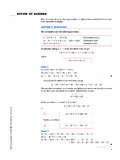
9 Then Newton s second Law givesThus, instead of the homogeneous equation (3), the motion of the spring is now governedby the following nonhomogeneous Differential equation:The motion of the spring can be determined by the methods of Additional Topics:Nonhomogeneous linear commonly occurring type of external force is a periodic force functionIn this case, and in the absence of a damping force (), you are asked in Exercise 9 touse the method of undetermined coefficients to show thatIf , then the applied frequency reinforces the natural frequency and the result isvibrations of large amplitude.
10 This is the phenomenon of resonance(see Exercise 10). 0 x t c1 cos t c2 sin t F0m 2 02 cos 0t 6c 0where 0 sk mF t F0cos 0tm d2xdt2 c dxdt kx F t 5 kx c dxdt F t m d2xdt2 restoring force damping force external forceF t Electric CircuitsIn Section we were able to use first- order separable Equations to analyze electric cir-cuits that contain a resistor and inductor (see Figure 5 on page 515). Now that we knowhow to solve Second-Order linear Equations , we are in a position to analyze the circuitshown in Figure 7.