Transcription of Applied Suicide Intervention Skills Training
1 Promising Applied Suicide Intervention Skills Training Program Snapshot Evidence Ratings* Self-Concept *Ratings definitions can be found in the appendix. Program Contact Heather Stokes, MSW Vice-President of Strategic Development, LivingWorks Education, Inc. 1-888-733-5484 Dissemination/Implementation Contact Heather Stokes, MSW Vice-President of Strategic Development, LivingWorks Education, Inc. Program Type Mental health promotion Gender Male Female Age 13-17 (Adolescent) 18-25 (Young adult) 26-55 (Adult) 55+ (Older adult) Geographic Locations This program description was created for SAMHSA s National Registry for Evidence-based Programs and Practices (NREPP).
2 Please note that SAMHSA has discontinued the NREPP program and these program descriptions are no longer being updated. If you are considering this program, you may wish to visit the full program listing on our website or search other sources for more up-to-date information. Applied Suicide Intervention Skills Training 2 Rural and/or frontier Tribal Settings Other Race/Ethnicity Other Implementation/Dissemination Implementation materials available Dissemination materials available Program Description The Applied Suicide Intervention Skills Training (ASIST) program was developed in 1983.
3 ASIST is a 2-day Training program aimed at developing Suicide first aid Skills and competencies. The program is available to anyone seeking to increase the immediate safety of persons at risk of Suicide . Since people at risk are often inclined to reach out first to family and friends, ASIST fulfills a gatekeeper role that seeks to build and empower a broad network of community helpers. ASIST also provides those in more formal helping roles with professional development to ensure that they are prepared to provide Suicide first aid help as part of the care they provide.
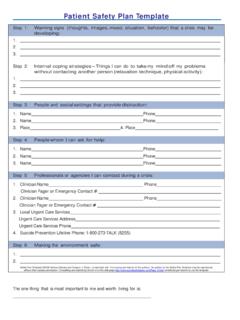
4 The ASIST model involves assessment of Suicide risk and the development of a safeplan, which provides various options depending on present and future risk, available resources, and the needs of the person at risk. Options include not only referrals to formal mental health services, but also connection to and support from friends, family members, and other sources. The ASIST philosophy posits that the Suicide Intervention may be sufficient to reduce risk without the need for further referral. ASIST comprises five progressive components in which trainees gradually build comfort and understanding around Suicide and Suicide Intervention .
5 ASIST participants learn to 1) understand attitudes about Suicide ; 2) provide guidance and Suicide first aid to a person at risk; 3) identify the key elements of an effective Suicide safety plan and the actions required to implement it; 4) appreciate the value of improving community Suicide prevention resources; and 5) recognize important aspects of Suicide prevention, including life-promotion and self-care. ASIST has been implemented in multiple locations in the United States and internationally. ASIST workshops are open to anyone over the age of 16; no previous experience or education is required.
6 The 2-day workshop is interactive and includes audiovisual aids, discussions in large and small groups, and Skills practice and development. A half-day, tune-up Training is available for ASIST participants who would like a review and improve ASIST-related knowledge and Skills . Evaluation Findings by Outcome OUTCOME: SELF-CONCEPT Applied Suicide Intervention Skills Training 3 PROGRAM EFFECTS ACROSS ALL STUDIES This program is promising for improving personal resiliency and self-concept. The review of the program yielded sufficient evidence of a favorable effect.
7 Based on one study and one measure, the effect size for personal resiliency and self-concept is .13 (95% CI = .03, .24). Click here to find out what other programs have found about the average effect sizes for this outcome. KEY STUDY FINDINGS Data from monitored calls of suicidal individuals showed a significant improvement in callers behaviors ( , feeling less depressed, less suicidal, less overwhelmed) by the end of calls handled by ASIST trained counselors, compared with the wait-list control group (Gould et al., 2013). MEASURES Gould et al. (2013): Counselor s ratings on the changes in the callers based on the caller s affect and statements during the call ( , feeling less agitated, less alone, less depressed, less overwhelmed, less suicidal, more confident and in control, and more hopeful) ADDITIONAL DETAILS None provided.
8 References STUDIES REVIEWED Gould, M., Cross, W., Pisani, A., Munfakh, M., & Kleinman, M. (2013). Impact of Applied Suicide Intervention Skills Training on the National Suicide Prevention Lifeline. Suicide and Life-Threatening Behavior, 43(6), 676 691. doi: SUPPLEMENTAL AND CITED DOCUMENTS None provided. OTHER STUDIES None provided. Study Evaluation Methodology GOULD ET AL. (2013) STUDY DESIGN NARRATIVE The study randomized Suicide crisis centers into an Intervention group, in which counselors received ASIST Training , and a wait-list control group. SAMPLE DESCRIPTION Data used in the study were derived from monitored calls from 1,410 suicidal individuals from 17 lifeline crisis centers during 2008 to 2009.
9 Seven hundred sixty-four of the calls were directed to centers randomized to the Intervention group, while 646 were directed to the centers in the control group. No demographic information was provided. Resources for Dissemination and Implementation * * Dissemination and implementation information was provided by the program developer or program contact at the time of review. Profile information may not reflect the current costs or availability of materials (including Applied Suicide Intervention Skills Training 4 newly developed or discontinued items). The dissemination/implementation contact for this program can provide current information on the availability of additional, updated, or new materials.
10 Implementation/ Training and Technical Assistance Information Approximately million people have taken ASIST Training . ASIST has been implemented in multiple states in the United States and internationally in Australia, Canada, England, Ireland, New Zealand, Northern Ireland, Norway, Scotland, Singapore, South Korea, and Wales. Organizations and agencies that have adopted ASIST include the Army and Navy, the National Suicide Prevention Lifeline (NSPL), the California Mental Health Services Authority (CalMHSA), the New York State Office of Mental Health (NYSOMH), Ireland s National Office of Suicide Prevention, Lifeline Australia, Scotland s Choose Life Suicide Prevention Training Program, and Norway s Action Plan Against Suicide (VIVAT), among others.