Transcription of APREPITANT FOR CHEMOTHERAPY-INDUCED …
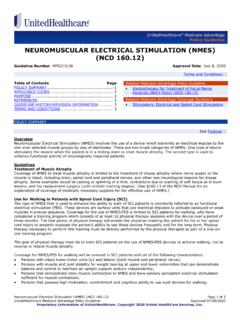
1 Apre pitant fo r CHEMOTHERAPY-INDUCED Em esis (NCD ) Page 1 o f 5 UnitedHealthcare Medicare Advantage Policy Guideline Approved 10/09/2019 Proprietary Information of UnitedHealthcare. Copyright 2019 United HealthCare Services, Inc. APREPITANT FOR CHEMOTHERAPY-INDUCED EMESIS (NCD ) Guideline Number: Approval Date: October 9, 2019 Table of Contents Page POLIC Y APPLIC ABLE C ODES ..3 PURPOSE ..3 REFERENC GUIDELINE HISTORY/REVISION INFORMATION ..4 TERMS AND POLIC Y SUMMARY Overview C hemotherapy- induced nausea and vomiting (C INV) can range from mild to severe, with the most severe cases resulting in dehydration, malnutrition, metabolic imbalances, and potential withdrawal from future chemotherapy treatments. The incidence and severity of CINV are influenced by the specific chemotherapeutic agent(s) used; dosage, schedule and route of administration; and drug combinations.
2 Patient specific risk factors such as gender, age, history of motion sickness, and prior exposure to chemotherapeutic agents can also have an effect on C INV incidence and severity. Progress has been made in reducing C INV, although it can still be hard to control symptoms that occur more than a day after chemotherapy , during repeat cycles of chemotherapy , and when chemotherapy is given on more than one day or in very high doses. No single antiemetic agent is completely effective in all patients. As noted above, many factors influence the incidence and severity of C INV, with the specific chemotherapeutic agent as the primary factor to consider when deciding which antiemetic to administer. APREPITANT (Emend ) is the first Food and Drug Administration-approved drug of its type.
3 APREPITANT has been proposed to function in combination with other oral antiemetics for a specified population of patients receiving highly emetogenic chemotherapy and/or moderately emetogenic chemotherapy . CMS is defining highly emetogenic chemotherapy and moderately emetogenic chemotherapy as those anticancer agents so designated in at least two of three guidelines published by the National Comprehensive Cancer Network (NC C N), American Society of C linical Oncology (ASC O), and European Society of Medical Oncology (ESMO)/Multinational Association of Supportive C are in C ancer (MASC C ). The inclusive examples are: NC C N plus ASCO, NCCN plus ESMO/MASCC, or ASCO plus ESMO/MASCC. Guidelines Effective for services performed between April 4, 2005, and May 28, 2013, the Centers for Medicare & Medicaid Services makes the following determinations regarding the use of APREPITANT in the treatment of reducing CHEMOTHERAPY-INDUCED emesis: The evidence is adequate to conclude that the use of the oral antiemetic three-drug combination of oral APREPITANT (Emend ), an oral 5HT3 antagonist, and oral dexamethasone is reasonable and necessary for a specified patient population.
4 We have defined the patient population for which the use of the oral antiemetic three-drug combination of oral APREPITANT (Emend ), an oral 5HT3 antagonist, and oral dexamethasone is reasonable and necessary as only those patients who are receiving one or more of the following anti-cancer chemotherapeutic agents: C armustine C isplatin C yclophosphamide Dacarbazine Mechlorethamine Streptozocin Doxorubicin Epirubicin Related Medicare Advantage Policy Guideline Anzemet for C hemotherapy induced nausea Related Medicare Advantage Coverage Summary C hemotherapy, and Associated Drugs and Treatments Unit edHealt hcare Medicare Advantage Policy Guideline Terms and C onditions See Purpose Apre pitant fo r CHEMOTHERAPY-INDUCED Em esis (NCD ) Page 2 o f 5 UnitedHealthcare Medicare Advantage Policy Guideline Approved 10/09/2019 Proprietary Information of UnitedHealthcare.
5 Copyright 2019 United HealthCare Services, Inc. Lomustine Effective for services performed on or after May 29, 2013, the oral three-drug regimen of oral APREPITANT , an oral 5H T3 antagonist and oral dexamethasone is reasonable and necessary for beneficiaries receiving, either singularly or in combination with other drugs the following anticancer chemotherapeutic agents: Alemtuzumab Azacitidine Bendamustine C arboplatin C armustine C isplatin C lofarabine C yclophosphamide Cytarabine Dacarbazine Daunorubicin Doxorubicin Epirubicin Idarubicin Ifosfamide Irinotecan Lomustine Mechlorethamine Oxaliplatin Streptozocin The oral three drug regimen must be administered immediately before and within 48 hours after the administration of these chemotherapeutic agents.
6 Nationally Noncovered Indications The evidence is adequate to conclude that APREPITANT cannot function alone as a full replacement for intravenously administered antiemetic agents for patients who are receiving highly emetogenic chemotherapy and/or moderately emetogenic chemotherapy . Medicare does not cover under Part B for oral antiemetic drugs in antiemetic drug combination regimens that are administered in part, via an oral route and in part, via an intravenous route. Medicare does not cover under Part B APREPITANT when it is used alone for anticancer chemotherapy related nausea and vomiting. Other UnitedHealthcare may determine coverage for other all-oral three-drug antiemesis regimens of APREPITANT or any other FDA approved oral NK-1 antagonist in combination with an oral 5HT3 antagonist and oral dexamethasone with the chemotherapeutic agents listed above, or any other anticancer chemotherapeutic agents that are FDA approved and are defined as highly or moderately emetogenic.
7 Documentation Requirements The supplier must enter a diagnosis code corresponding to the beneficiary's cancer diagnosis on each claim. The billing of an oral antiemetic 3-drug combination is accomplished by one of the following methods: APREPITANT (J8501) or rolapitant (J8670) used with a separate 5HT3 antagonist (Q0162, Q0166 or Q0180) and dexamethasone (J8540) must be billed on the same claim. Netupitant with its fixed combination of palonosetron (J8655) and dexamethasone (J8540) must be billed on the same claim. If the NK-1 antagonist and/or dexamethasone is given as an oral anti-emetic outside of the 3-drug regimen, claims will be denied as statutorily non-covered, no benefit. In addition to the diagnosis code corresponding to the beneficiary s cancer diagnosis, claims for oral APREPITANT (J8501), rolapitant (J8670) 300mg palonosetron (J8655), or Q0181 must also be accompanied with a diagnosis code of an encounter for antineoplastic chemotherapy .
8 If dexamethasone (J8540) and either APREPITANT (J8501), rolapitant (J8670) or 300mg palonosetron (J8655) are used in conjunction with one of the anticancer chemotherapeutic agents listed in this policy, a KX modifier must be added to each code. Apre pitant fo r CHEMOTHERAPY-INDUCED Em esis (NCD ) Page 3 o f 5 UnitedHealthcare Medicare Advantage Policy Guideline Approved 10/09/2019 Proprietary Information of UnitedHealthcare. Copyright 2019 United HealthCare Services, Inc. APPLIC ABLE C ODES The following list(s) of codes is provided for reference purposes only and may not be all inclusive. Listing of a code in this guideline does not imply that the service described by the code is a covered or non-covered health service. Benefit coverage for health services is determined by the member specific benefit plan document and applicable laws that may require coverage for a specific service.
9 The inclusion of a code does not imply any right to reimbursement or guarantee claim payment. Other Policies and Guidelines may apply. HCPCS Code Description J8501 APREPITANT , oral, 5 mg J8540 Dexamethasone, oral, mg J8655 Netupitant 300 mg and palonosetron mg, oral J8670 Rolapitant, oral, 1 mg Q0162 Ondansetron 1 mg, oral, FDA approved prescription antiemetic, for use as a complete therapeutic substitute for an IV antiemetic at the time of chemotherapy treatment, not to exceed a 48 hour dosage regimen Q0166 Granisetron HC l, 1 mg, oral, FDA approved prescription antiemetic, for use as a complete therapeutic substitute for an IV antiemetic at the time of chemotherapy treatment, not to exceed a 24-hour dosage regimen Q0180 Dolasetron mesylate, 100 mg, oral, FDA approved prescription antiemetic.
10 For use as a complete therapeutic substitute for an IV antiemetic at the time of chemotherapy treatment, not to exceed a 24-hour dosage regimen Q0181 Unspecified oral dosage form, FDA approved prescription antiemetic, for use as a complete therapeutic substitute for an IV antiemetic at the time of chemotherapy treatment, not to exceed a 48-hour dosage regimen Modifier Description EY No physician or other licensed health care provider order for this item or service GZ Item or service expected to be denied as not reasonable and necessary KX Requirements specified in the medical policy have been met ICD-10 Diagnosis C ode Description Encounter for antineoplastic chemotherapy PURPOSE The Medicare Advantage Policy Guideline documents are generally used to support UnitedHealthcare Medicare Advantage claims processing activities and facilitate providers submission of accurate claims for the specified services.