Transcription of Aristotle Notes - Nicomachean Ethics - Good TOC
1 Aristotle Notes ON Nicomachean Ethics By Dr. Dave Yount Mesa Community College May 2014 Table of Contents Introduction .. 8 BOOK I: .. 8 Every Human Activity Aims at Some Good (1094a).. 8 We Must Study the Chief (Human) Good; Politics End is the Chief Human Good (1094a-b).. 8 We Cannot be Too Precise; Inexperienced Youth do Not Benefit from Political Science (1094b-1095a).. 9 Political Science Aims at Happiness; the Many and Wise Agree, but Differ on What Happiness is; Those with Good Habits can Hear Lectures on Political Science (1095a-b).. 9 Three Kinds of Life; Pleasure, Honor, Virtue, and Money-Making/Wealth are Not the Chief Good (1095b-1096a).
2 10 Criticisms of Plato s Form/Idea of the Good (1096a-1097a).. 10 Happiness is the Good we Seek for the Sake of Everything Else; It is Complete and Self-Sufficient; the Function of Humans/the Human Good in a Complete Life; Not a Precise Account (1097a-1098b).. 11 Our Account of Happiness Agrees with Others; Happiness is the Best, Noblest and Most Pleasant; Happiness Needs External Goods (1098b-1099b).. 12 Happiness is Acquired by Study and Care; It Might be God-Given; Animals and Boys Cannot be Happy (1099b-1100a).. 13 Can We Call a Man Happy While He s Alive?
3 Do the Misfortunes of Children Cause Unhappiness (After Death)? The Happy Man Cannot Become Miserable and is Blessed (1100a-1101a).. 13 The (Mis)Fortunes of Friends Cannot Make a Happy Man Unhappy or Significantly Affect the Dead (1101a-b).. 14 Happiness is Blessed, Divine, Complete, and Prized as a First Principle; Virtue is Praised (1101b-1102a).. 14 A Political Scientist Must Know the Soul; Two Irrational Parts of the Soul (Vegetative and Appetitive) and One Rational (Reason), All with Subparts; Two Kinds of Virtue: Intellectual and Moral (1102a-1103a).. 15 BOOK II.
4 15 Whence Intellectual and Moral Virtue Come; We Exercise Virtues to Gain Them, as With Crafts; Dispositions Arise Out of Activities; Habits in Youth Make All the Difference to Produce Virtue/Vice (1103a-b).. 16 How We Ought to Do Actions; Virtues are Destroyed by Excess and Defect, and Preserved by the Mean; Having Virtue Means Abstaining from Excess or Defect (1103b-1004b).. 16 From Pleasure We do Bad Things; From Pains, We Refrain from doing Good Things; Virtue does What is Best Regarding Pleasures and Pains; Vice the Opposite; So Pleasures and Pains are the Focus of the Study of Political Science and Virtue (1104b-1105a).
5 17 Being Grammatical Requires Knowledge; Being Virtuous Requires Knowledge, Choosing Acts For Their Own Sakes, and Proceeding from a Firm and Unchangeable Character; A Just Action is Done How a Just Man Would do It; Most People Theorize about Good Actions But do Not do Them (1105a-b).. 17 Virtue is a Disposition v. a Passion or a Capacity (1105b-1106a).. 18 Virtue is a Disposition Concerned with Choice that Makes a Person Good and Do Well; Virtue is (and aims at) an Intermediate Relative to Us, Between Two Extremes (Excess and Deficiency); One can be Vicious in Many Ways, but Virtuous in Only One Way; Every Action/Passion does Not Admit of a Mean(1106a-1107a).
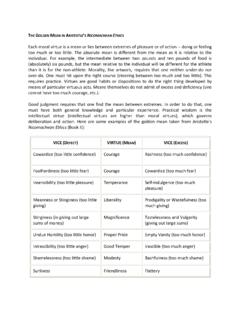
6 18 2 Virtues (Means) and Their Excesses and Deficiencies Named (and Unnamed): Courage, Temperance, Liberality, Magnificence, Proper Pride, Ambition, Good Temper, Truthfulness, Ready-Wit, Friendliness, Modesty, and Righteous Indignation (1107a-1108b).. 20 The Excess, Deficiency, and Mean are All Opposed to One Another; the Greatest Contrariety is Between the Extremes; Sometimes the Deficiency or the Excess is More Distant from the Mean (1108b-1109a).. 21 It is Hard to be Good, Since We Must do the Right Thing at the Right Time, etc.; It is Hard to Determine in What Way, How Long, to What Extent, etc.
7 To be Angry (1109a-b).. 21 BOOK III: .. 22 Voluntary and Involuntary Passions/Actions; Involuntary Occur Due to Compulsion or Ignorance; Voluntary Occur When the Moving Principle is in the Person, and in His/Her Power to do or Not do; Things Done Due to Ignorance are Non-Voluntary; Acts Done in Anger or Due to Appetite are Not Involuntary (1109b-1111b).. 22 Choice; Children and Animals do Voluntary Actions but do Not Choose; Choice is Not Appetite, Anger, Wish, Nor an Opinion; Choice is Voluntary and Might Be the Result of Previous Deliberation (1111b-1112a).. 23 We do Not Deliberate about Eternal Things, Things that Move in the Same Way or Variously, or Even All Human Affairs; We Deliberate about Things That are in our Power, Done by the Agent Himself and Not about the End, but about the Means to the End; Choice is Deliberate Desire about Things in our Own Power (1112a-1113a).
8 24 Wish for the Good v. the Apparent Good; Dilemma Thereof (1113a-b).. 25 The Exercise of Virtues/Vice is Concerned with Wish, Deliberation and Choice; Virtues/Vices are in our Power; No One is Involuntarily Blessed, but Wickedness is Voluntary; Punishing or Honoring Acts; Bodily Vices are in our Power; Dispositions are Voluntary (1113b-1115a).. 25 Courage; We Should Fear Some Evils (Death, Disgrace) but Not Others (Poverty, Disease); Death is the Most Terrible of All Things; the Brave Person is Fearless in the Face of a Noble Death (in War) (1115b).. 27 Courage; The Brave Person Faces/Fears the Right Things at the Right Time, and so on, as Reason Directs; the Coward Flies from What is Troublesome; the Rash Exceeds in Confidence about What Really is Terrible (1115b-1116a).
9 27 Five Kinds of Apparent (Not True) Courage: Political, Experience with Particular Facts, Passion, Sanguinity, and Ignorance (1116a-1117a).. 28 Courage is Concerned with Things that Inspire Fear; It is Harder to Face What is Painful Than to Abstain from What is Pleasant (1117a).. 29 Temperance is Concerned with Bodily Pleasures (Not Sight, Sounds or Smells, but Taste and Mostly with Touch); Touch can be Self-Indulgent; Since Animals have Touch Too, Humans who Enjoy Touch are Brutish (1117a-1118b).. 30 Temperance; Natural Appetites (Food, Drink, Sex); the Self-Indulgent Err in Three Ways; the Pains and Cravings of the Self-Indulgent; Insensibles Who Delight in Pleasures Less Than They Should are Not Human (1118b-1119a).
10 30 Temperance; Self-Indulgence Actuated by Pleasure; Cowardice by Pain, and Both are Voluntary; Children Live at the Beck and Call of Appetite; Desire for Pleasure (Not) in Conflict with Reason (1119a-b).. 31 BOOK IV: .. 31 Liberality (Virtue), and Prodigality and Meanness (Extremes); The Liberal Person Gives and Takes Wealth in the Right Way, etc.; the Prodigal Person Gives Too Much and Takes Too Little, and from the Wrong Sources; the Mean Person Takes Too Much and/or Gives Too Little (1119b-1122a).. 32 Magnificence (Virtue), Niggardliness and Vulgarity (Extremes); The Magnificent Person Spends Large Amounts of Money on the Right Kind of Thing and in the Right Way; the Niggardly Person Spends Too Little and Laments Spending Anything; the Vulgar Person Spends Too Much, is Tasteless, and Shows Off his Wealth (1122a-1123a).