Transcription of Arkansas 2021-2022 Immunization Exemption Application ...
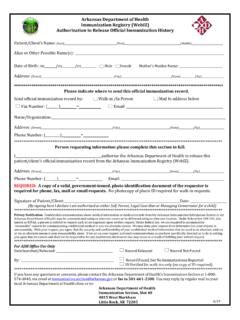
1 Arkansas 2021-2022 Immunization Exemption Application Packet for Childcare or school StudentsThe Arkansas Board of Health requires that all children attending childcare facilities and public or private schools in the State of Arkansas be immunized against vaccine-preventable diseases. The Arkansas Department of Health is authorized by Act 999 of 2003 to grant individual exemptions from the Immunization requirements. This packet contains an Application for Exemption , which you have requested, or you may complete the online Application at An Application requesting an Exemption must be submitted for each child.
2 An Application with a notarized signature of the parent or guardian must be submitted each school year to the Department of Health. Only a 2021-2022 Immunization Exemption Application will be accepted for the 2021-2022 school year. When approved, exemptions will be effective for the start of the Fall session in 2021 and go through the Summer sessions of 2022. As part of the Application , the law requires that the parent/guardian complete an educational activity when requesting an Exemption . The require d educational activity can be met by reading the enclosed Vaccine Information Statements from the Centers for Disease Control and Prevention.
3 These statements provide information about the required vaccines. On page 6 of this Application packet, you are asked to sign that you have rece ived and reviewed the Vaccine Information Statements, that you understand the risks and benefits of the vaccines, and that you still choose to request an Exemption . This form must also be signed by a Notary Public. Please submit your completed Application to the Arkansas Department of Health Immunization Section. Be sure to complete each part of the Application . Applications that are incomplete will not be accepted and will be returned to you for completion.
4 This delay will increase the time needed for processing your Application . We will send you a letter of approval or denial within ten working days of receiving a completed Application . If your Application is not complete, we will send you a checklist showing the reason(s) we were unable to process your Application . You will then need to include the requested information and return the updated Application for processing as soon as possible by fax, email, or mail; see page six of the Application . After you have received your approval letter, you are responsible for notifying your child s daycare or sch ool that your Exemption request has been approved.
5 You are responsible for retaining the original letter . A cop y of the approval letter is to be placed in your child s file at the daycare or school . Release of information will be provided only to the custodial parent/guardian who completes this Application and according to the notarized signature. If you have questions, please call the Immunization Section toll free at 1-800-574-4040. Sincerely, Jennifer Dillaha, MD medical Director, Immunizations Center for Health Protection If You Choose Not to Vaccinate Your Child, Understand the Risks and Responsibilities. If you choose to delay some vaccines or reject some vaccines entirely, there can be risks.
6 Be aware: Any vaccine-preventable disease can strike at any time in the because all of these diseases still circulate either in the or elsewhere in the world. Some of the vaccine-preventable diseases that still circulate in the include pertussis (whooping cough), varicella (chickenpox), Haemophilus influenzae type b (Hib, which is a cause of meningitis), and influenza. These diseases, as well as the other vaccine-preventable diseases, can range from mild to severe and life-threatening. In most cases, there is no way to know beforehand if a child will get a mild or serious case.
7 When there is a vaccine-preventable disease in your community: It may not be too late to get protection by getting vaccinated. If there are cases (or, in some circumstances, a single case) of a vaccine-preventable disease in your community, you may be asked to take your child out of school , childcare, or organized activities (for example, playgroups or sports). Your school , childcare facility, or other institution will tell you when it is safe for an unvaccinated child to return. Be prepared to keep your child home for several days and up to several weeks. Why vaccinate?
8 Vaccines save lives and protect against the spread of disease. If you decide not to vaccinate your child, you put your child at risk. Your child could catch a disease that is dangerous or deadly. Getting vaccinated is much better than getting the disease. Vaccines work. They have kept children healthy and have saved millions of lives for more than 50 years. Most childhood vaccines are 90 to 99 percent effective in preventing disease. And if a vaccinated child does get the disease, the symptoms are usually less serious than in a child who has not been vaccinated. Vaccines are safe.
9 All vaccines used in the must be approved by the Food and Drug Administration (FDA). The FDA will not let a vaccine be given unless it has been proven to be safe and to work well in children. The results are reviewed again by the Centers for Disease Control and Prevention (CDC), the American Academy of Pediatrics, and the American Academy of Family Physicians before a vaccine is officially recommended to be given to children. Also, the FDA monitors where and how vaccines are made. The places where vaccines are made must be licensed. They are regularly inspected and each vaccine lot is safety-tested.
10 Page 2 of 6 What if you don t immunize your child? Your child will be left at risk of catching the disease. Vaccines were developed to protect people from dangerous and often fatal diseases. Vaccines are safe and effective, and the vaccine-preventable diseases are still a threat. Your child will be an infectious disease threat to others. Children who are not vaccinated can readily transmit vaccine-preventable diseases to others in their community. o Unvaccinated children can pass diseases on to babies who are too young to be fully immunized. o Unvaccinated children pose a threat to children and adults who cannot be immunized for medical reasons.