Transcription of Articles Translational Investigation - ResearchGate
1 See discussions, stats, and author profiles for this publication at: of less invasive surfactant administration (LISA) on oxygenation,pulmonary surfactant distribution and lung compliance in spontaneouslybreathing preterm in Pediatric Research May 2014 DOI: Source: PubMedCITATIONS39 READS4258 authors, including:Some of the authors of this publication are also working on these related projects:Stem cell therapy for neonatal brain injury View projectEtiology of Prematurity: a data-scientific approach View projectHendrik J NiemarktMaxima Medical Center69 PUBLICATIONS 938 CITATIONS SEE PROFILEElke KuypersMaastricht University36 PUBLICATIONS 691 CITATIONS SEE PROFILER eint K JellemaMaastricht University Medical Center+52 PUBLICATIONS 906 CITATIONS SEE PROFILEDaan OpheldersMaastricht University49 PUBLICATIONS 759 CITATIONS SEE PROFILEAll content following this page was uploaded by Daan Ophelders on 13 March user has requested enhancement of the downloaded Investigationnature publishing groupBackground.
2 A new technique was proposed to admin-ister surfactant to spontaneous breathing preterm infants by placing a thin catheter through the vocal cords. This technique was not studied with respect to oxygenation, gas exchange, surfactant distribution, and lung mechanics. We tested the technique of less - invasive surfactant administration (LISA) in a spontaneous breathing preterm lamb : Preterm lambs (n = 12) of 133 134 d gestational age were randomized to the following three groups: (i) con-tinuous positive airway pressure (CPAP) only, (ii) CPAP + LISA, and (iii) intubation and mechanical ventilation with surfactant administration .
3 surfactant was labeled with samarium oxide. During the next 180 min, blood gas analyses were performed. Postmortem, lungs were removed and surfactant distribution was assessed, and pressure volume curves were : Pao2 in the LISA-treated lambs was significantly higher than in the lambs that exclusively received CPAP. Moreover, Pao2 values were similar between the LISA-treated and the intubated lambs. Overall, surfactant deposition was less in the LISA lambs, with significantly less surfactant distrib-uted to the right upper lobe. Lung compliance was better in the intubated lambs compared with the LISA-treated lambs, although this did not reach : LISA improved oxygenation, similar to con-ventional surfactant application techniques, despite lower sur-factant deposition and lung the past decades, preterm infants have been treated with surfactant bolus replacement therapy for respiratory distress syndrome, which usually requires intubation and mechanical ventilation.
4 surfactant treatment in ventilated infants leads to a relative reduction in bronchopulmonary dysplasia, pneumo-thorax, and mortality (1,2). Randomized trials indicated that early surfactant therapy compared to delayed rescue surfactant treatment resulted in better respiratory and neurologic out-comes in preterm infants (3).Early surfactant treatment has therefore been combined with intubation and mechanical ventilation. Intubation of the trachea may lead to laryngeal or tracheal injury and requires premedication, which can delay the time to extubation. In addi-tion, mechanical ventilation can damage the vulnerable preterm lungs.
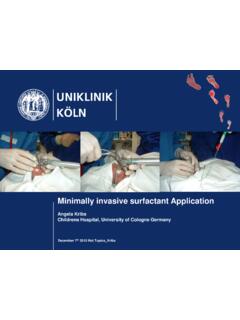
5 It has been hypothesized that avoidance of mechanical ventilation might lead to less bronchopulmonary dysplasia (4,5), as infants that failed initial continuous positive airway pressure (CPAP) therapy and needed subsequent mechanical ventilation showed higher bronchopulmonary dysplasia rates (6).In order to avoid the negative effects of mechanical ventila-tion, a new technique was recently introduced to administer surfactant endotracheally to spontaneously breathing preterm infants by placing a small feeding or arterial catheter through the vocal cords (7,8). This technique proved to be feasible in clinical practice with first attempt success rate above 80% (8 10).
6 This technique was referred to as minimally invasive surfactant therapy (8) or less - invasive surfactant administra-tion (LISA) (9). In a multicenter randomized controlled trial, LISA led to a reduction in the need for mechanical ventila-tion (11). Moreover, a single-center trial showed a reduction in bronchopulmonary dysplasia rates (10). We will further refer to this technique in this study as effects of classical surfactant bolus therapy on oxygenation, gas exchange, and pulmonary surfactant distribution have been studied extensively in experimental setups (12 14). However, this new less - invasive technique has not been studied in animal models.
7 As lung development in fetal and preterm sheep has the same course as in humans, we used the preterm sheep model to study the effects of LISA on oxygenation, gas exchange, pulmo-nary surfactant distribution, and lung Characteristics and OxygenationAll lambs survived the duration of the experiment (180 min). Heart rate and blood pressure remained within normal values. Basic characteristics are shown in Ta b l e 5 November 2013; accepted 3 February 2014; advance online publication 11 June 2014. of Pediatrics, Maastricht University Medical Center, Maastricht, The Netherlands; 2 Section of Neonatology, Department of Pediatric and Adolescent Medicine, University Hospital RWTH Aachen, Aachen, Germany; 3 Neonatology, Department of Pediatric and Adolescent Medicine, University Hospital, University K ln, K ln, Germany.
8 Correspondence: Boris W. Kramer of less - invasive surfactant administration on oxygenation, pulmonary surfactant distribution, and lung compliance in spontaneously breathing preterm lambsHendrik J. Niemarkt1, Elke Kuypers1, Reint Jellema1, Daan Ophelders1, Matthias H tten1,2, Maria Nikiforou1, Angela Kribs3 and Boris W. Kramer1 Pediatr Res1661702014 Pediatric 2014 International Pediatric Research Foundation, of LISA in preterm lamb modelNiemarkt et InvestigationArticles166 Pediatric ReSeARCh Volume 76 | Number 2 | August 2014 Copyright 2014 International Pediatric Research Foundation.
9 Of LISA in preterm lamb model ArticlesThe intubated lambs showed a swift increase in Pao2 val-ues shortly after intubation and surfactant administration (Figure 1). A similar but slower increase in Pao2 was observed in lambs that received LISA (Figure 1). Only at t = 30 min, Pao2 values were significantly higher in the intubated lambs compared with the lambs that received LISA ( vs. mmHg). When analyzing the spontaneously breathing lambs, Pao2 was significantly higher in the lambs that received LISA than in the lambs that only received CPAP at t = 150 and t = 180 min ( vs.)
10 MmHg and vs. mmHg, respectively).In addition, the oxygenation index (OI = FiO2 mean air-way pressure/Pao2) was calculated. Over all time points, the OI was similar between the intubated lambs and the lambs that received LISA ( vs. ) (Figure 2). At t = 10, t = 30, and t = 180 min, OI was significantly higher in the lambs that received exclusively CPAP compared with the lambs that received ExchangeWhen studying mean Paco2 over all time points, we found no significant differences in Paco2 between the groups (P = ; data not shown). surfactant DepositionTotal surfactant deposition in the lungs was higher in the lambs that were intubated than in the lambs that received LISA treatment.