Transcription of Ascend SL Safety Data Sheet - CDMS Home
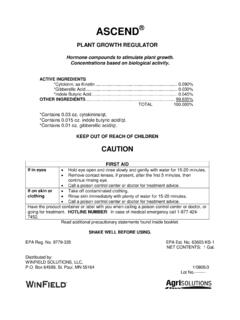
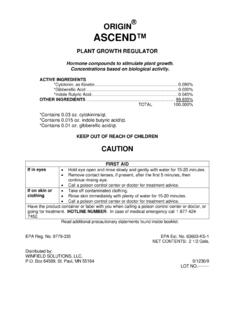
1 Ascend SL Safety data Sheet SECTION 1: IDENTIFICATION Product Name: Ascend SL EPA Registration #: 1381-253 Product ID/Unity #: 1557476, 1557477, 1557478 Common Name: Plant growth regulator Chemical Description: Giibberellic acid, kinetin, and indole butyric acid Recommended Uses: Agricultural Plant Growth Regulator See product label for complete list of uses and use sites. Restrictions for Use: See product label for information regarding restrictions on the use of this product. Manufactured For: MEDICAL EMERGENCY TELEPHONE NUMBER: 1-877-424-7452 (24hrs) WINFIELD SOLUTIONS, LLC P. O. Box 64589 Non-Emergency Business Inquiries: 1-855-494-6343 St. Paul, MN 55164-0589 Mon Fri 8am 5pm (Central Standard Time) FOR EMERGENCY, SPILL, LEAK, FIRE, EXPOSURE, OR ACCIDENT, CALL: CHEMTREC 1-800-424-9300 (24 hours) SECTION 2: HAZARDS IDENTIFICATION EMERGENCY OVERVIEW: Yellow liquid with no odor.
2 Based on currently available data , this product does not meet the regulatory definition of a hazardous substance. However, good industrial hygiene practices should be used in handling the product. POTENTIAL HEALTH EFFECTS: Eyes: May cause mild but temporary eye irritation. Skin: May cause mild but temporary skin irritation with prolonged contact. Inhalation: May cause mild irritation of the upper respiratory tract. Ingestion: May cause irritation of the gastric system. Preexisting Conditions: None known Chronic Health Effects: None known Carcinogenicity NTP: Not listed IARC: Not listed OSHA: Not listed OSHA HCS 2012 CLASSIFICATION: This product does not meet the definition of a hazardous chemical under OSHA s Hazard Communication Standard. SIGNAL WORD: CAUTION HAZARD STATEMENTS: None required Percent of product with unknown toxicity: 0% PRECAUTIONARY STATEMENTS: Prevention: See Section 8 for personal protective equipment.
3 Response: See Section 4 for first aid. Storage: See Section 7 for storage information. Disposal: See Section 13 for disposal information. NFPA HAZARD RATING TRANSPORT SUMMARY Not regulated by the Department of Transportation as a hazardous material; see Section 14 for additional information. 0 Least 1 Slight 1 Health 2 Moderate 0 Flammability 3 High 0 Reactivity 4 Severe Revision Date: 05 MAY 15 1 of 5 Ascend SL SECTION 4: FIRST AID MEASURES Inhalation: Remove person from contaminated area to fresh air and assist breathing as needed. Seek medical attention if irritation occurs. Ingestion: Seek medical attention or call a poison control center for treatment advice. Do not induce vomiting unless instructed to do so by a poison control center or doctor.
4 Do not give anything by mouth to an unconscious person. Eyes: Flush eyes with clean water for at least 15 minutes. Lift eyelids to facilitate irrigation. If present, remove contact lenses after 5 minutes and continue rinsing. Seek medical attention if irritation persists. Skin: Remove contaminated clothing and wash before re-using. Flush skin with water and then wash with soap and water. Seek medical attention if irritation persists. SECTION 5: FIRE FIGHTING MEASURES Suitable Extinguishing Media: Dry chemical, foam, carbon dioxide, water fog or water spray. Special Fire Fighting Procedures: Wear NIOSH/MSHA approved self-contained breathing apparatus and full bunker gear. Dike area to prevent runoff and contamination of water sources. Dispose of fire control water later. Avoid breathing vapors; keep upwind. Hazardous Combustion Products: Toxic gases may be formed in a fire situation. Carbon monoxide and other asphyxiates may form as well.
5 Unusual Fire and Explosion Hazards: Closed containers may explode from vapor expansion in high heat. SECTION 6: ACCIDENTAL RELEASE MEASURES Personal Precautions: Refer to Section 8 for personal protective equipment to be worn during containment and clean-up of a spill involving this product. Environmental Precautions: Do not allow spilled product to enter sewers or waterways. Methods for Containment: Contain spilled product by diking area with sand or earth. Methods for Clean-up: Cover contained spill with an inert absorbent material such as sand, vermiculite or other appropriate material. Avoid the use of combustible materials such as sawdust. Scoop, or sweep up material and place in a container for disposal. Do not place spilled material back in original container. Eliminate all ignition sources. Other Information: None known SECTION 7: HANDLING AND STORAGE Handling: RECOMMENDATIONS ARE FOR MANUFACTURING, COMMERCIAL BLENDING, AND PACKAGING WORKERS.
6 PESTICIDE APPLICATORS AND WORKERS must refer to the pesticide product label and Directions for Use attached to the product for Agricultural Use Requirements in accordance with the EPA Worker Protection Standard 40 CFR part 170. Ensure adequate ventilation. Immediately clean up spills that occur during handling. Keep containers closed when not in use. Practice good hygiene after using this material, especially before eating, drinking, smoking, using the toilet, or applying cosmetics. Storage: Store in cool, dry areas away from children, food and feed products in an area away from incompatible substances. Protect packaging from physical damage. Protect from exposure to fire. Maintain product above minimum storage temperature. See pesticide product label for additional storage information. Minimum Storage Temperature: 32 F Other Precautions: Consult Federal, state and local laws and regulations pertaining to storage. SECTION 3: COMPOSITION/INFORMATION ON INGREDIENTS Ingredient % (wt) CAS Reg.
7 # Kinetin 525-79-1 Indolebutyric acid 133-32-4 Gibberellic acid 468-44-0 & 510-75-8 *Ingredients not specifically listed are non-hazardous and/or are considered to be confidential business information under 29 CFR (i). See Section 8 for exposure limits. Revision Date: 05 MAY 15 2 of 5 Ascend SL SECTION 8: EXPOSURE CONTROLS/PERSONAL PROTECTION Exposure Guidelines Component: OSHA PEL ACGIH TLV NIOSH REL No components have established limits NOTE TO END USERS: PERSONAL PROTECTIVE EQUIPMENT (PPE) AND CLOTHING LISTED IN THIS SECTION IS FOR MANUFACTURING, COMMERCIAL BLENDING AND PACKAGING WORKERS. APPLICATORS AND HANDLERS SHOULD REFER TO THE PESTICIDE PRODUCT LABEL FOR PROPER PERSONAL PROTECTIVE EQUIPMENT (PPE) AND CLOTHING. Respiratory Protection: If conditions are poorly ventilated, use a NIOSH approved air-purifying respirator with cartridges/canisters approved for general particulates.
8 Engineering Controls: Local Exhaust: Provide general or local exhaust ventilation systems to maintain airborne concentrations below OSHA PELs or other specified exposure limits. Local exhaust ventilation is preferred. Protective Gloves: Wear chemically protective gloves to prevent exposure to skin. Eye Protection: To avoid contact with eyes, wear chemical Safety goggles or Safety glasses and full face shield. Contact lenses are not protective eye devices. Other Protective Clothing or Equipment: Wear long-sleeve shirt, long pants and shoes plus socks to prevent skin contact. Work/Hygienic Practices: Never eat, drink, nor use tobacco in work areas. Practice good hygiene after using this material, especially before eating, drinking, smoking, using the toilet, or applying cosmetics. SECTION 9: PHYSICAL AND CHEMICAL PROPERTIES Physical State: Liquid Specific Gravity (H2O=1): (typical) Vapor Pressure (mm Hg): Not determined Density (lbs/gallon): lbs/gallon (typical) Vapor Density (Air=1): Not determined Melting Point/Freezing Point: Not determined Solubility in Water (wt %): 100% Boiling Point/Range: Not determined Viscosity: 57 mm2/s pH (1% solution in water): Appearance and odor: Yellow liquid with no discernible odor Flash Point: >201 F SECTION 10: STABILITY AND REACTIVITY Reactivity: None known Chemical Stability: Product is stable at ambient temperature and pressure, under normal storage and handling conditions.
9 Possibility of Hazardous Reactions: Will not occur. Conditions to Avoid: Avoid excessive heat, freezing temperatures and sources of ignition. Incompatible Materials: Strong acids, strong bases and strong oxidizers Hazardous Decomposition Products: In a fire situation, carbon monoxide and other asphyxiates may form. SECTION 11: TOXICOLOGICAL INFORMATION ACUTE TOXICITY Eye Effects: May cause mild but temporary eye irritation. Animal test shows no irritation. Skin Effects: Irritation is not expected however, if irritation occurs it should clear up in less than 72 hours (rabbit). Not a skin sensitizer. LD50 >5050 mg/kg (rats) Acute Inhalation Effects: LC50 > mg/L (rats); no mortality was observed during the study and based upon component information, it is not anticipated that this product is acutely toxic by inhalation. Acute Oral Effects: LD50 >5,000 mg/kg (rats) Specific Target Organ Toxicity: None known CHRONIC TOXICITY Chronic Effects: None known Carcinogenicity: None known Continued on next page Revision Date: 05 MAY 15 3 of 5 Ascend SL Mutagenicity: None known Teratogenicity: None known Reproductive Toxicity: None known POTENTIAL HEALTH EFFECTS: Eyes: May cause mild but temporary eye irritation.
10 Skin: May cause mild but temporary skin irritation with prolonged contact. Inhalation: May cause mild irritation of the upper respiratory tract. Ingestion: May cause irritation of the gastric system. SECTION 12: ECOLOGICAL INFORMATION ENVIRONMENTAL SUMMARY: Not determined ECOTOXICITY data : Fish Acute and Prolonged Toxicity: Not determined Aquatic Invertebrate Acute Toxicity: Not determined Aquatic Plant Toxicity: Not determined Bird Acute and Prolonged Toxicity: Not determined Honeybee Toxicity: Not determined ENVIRONMENTAL EFFECTS: Soil Absorption/Mobility: Not determined Persistence and degradability: Not determined Bioaccumulative Potential: Not determined Other adverse effects: Not determined SECTION 13: DISPOSAL CONSIDERATIONS Waste: Dispose of in accordance with applicable Federal, state and local laws and regulations. Container: Triple rinse and recycle the container or dispose of in accordance with Federal, state and local laws and regulations.