Transcription of ASHRAE - Energy Efficient Kitchen Design
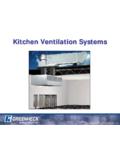
1 Energy Efficient Kitchen Ventilation Design1 Tyler SchillingGreenheck Fan CorporationLearning Objectives Kitchen Design objectives Kitchen control technology DCV application and design2 Design Objectives Comply with local and industry codes IMC Section 507 commercial Kitchen Hoods NFPA 96 - Standard for Ventilation Control and Fire Protection of commercial Cooking Operations ASHRAE - Energy Standard for Buildings Minimize Kitchen exhaust hoods shall comply with the requirements of this section.
2 Hoods shall be Type I or Type II and shall be designed to capture and confine cooking vapors and :1. Factory-built commercial exhaust hoods which are tested in accordance with UL 710, listed, labeled and installed in accordance with Section shall notbe required to comply with Sections , , , , , Section 507 commercial Kitchen Hoods45 Scope of UL These requirements cover exhaust hoods intended for placement over commercial cooking equipment. exhaust hoods with and without exhaust dampers are covered by these requirements.
3 All exhaust hoods are intended for use with fire extinguishing system units. notbe required to comply - Type I - Hood joints, seams and - Grease - Canopy size and - Capacity of Non-canopy size and - exhaust outletsIMC Section 507 commercial Kitchen Hoods Factory-build Kitchen exhaust hoods which are tested in accordance with UL 71067 Capacity of Hoods * commercial food service hoods shall exhaust a minimum net air in accordance with this section and section through The net quantity of exhaust air shall be calculated by subtracting any airflow supplied directly to a hood cavity from the total flow rate of a
4 Hood. Where any combination of heavy-duty, medium-duty and light-duty cooking appliances are utilized under a single hood, the exhaust rate required by this section for the heaviest duty appliance covered by the hood shall be used for the entire Using IMCCFM = ( exhaust Rate) (Linear Foot of Hood) exhaust rates:Light-duty 200 cfm/ln. ft (Ovens, steamers, kettles)Medium-duty 300 cfm/ln. ft (Electric ranges, griddles, fryers) Heavy-duty 400 cfm/ln. ft (Gas ranges, broilers, woks)Extra heavy-duty 550 cfm/ln.
5 Ft (Solid fuel cooking) The above are for wall canopy hoods Char-broiler = Heavy-duty (400 cfm per linear foot)400 cfm/ln. ft x 8 ft = 3,200 cfm9 Calculation Using IMC10 Alternate Calculation ExampleManufacturer Method Total required exhaust must equal contaminated airflow plus a minimum capture airflowQC= Contaminated air generated by the cooking equipmentQF= Quantity of air to contain surges, cross drafts and QC+ QF11 exhaust Air Volume Cooking appliances can be grouped into the following general categories, based upon Thermal Updraft Velocity characteristics.
6 Light-duty (ovens, steamers, ranges)50 fpm Medium-duty (griddles, fryers)85 fpm Heavy-duty (char-broilers)150 fpm Extra Heavy-duty (solid fuel)185 fpm12Qc Contaminated Air Quantity13 Typical Equipment BatteryEquipmentDimensionsArea (ft2)Updraft Velocity FactorContaminated Air (CFM)Gas Range24 x Char-Broiler30 x Griddle30 x Airflow =179014 exhaust Volume Calculating QFTotal Hood Area (96 x 40) / 144 = sq. ft(Total Hood Area - Total Appliance Area) x 50QF= ( ) x 50 = 417 cfmTotal exhaust Airflow QE= 1790 (QC) + 417 (QF)
7 = 2,207 cfmMethodExhaust CFMIMC3,200 Manufacturer Method2,207 Save on required exhaust rates by using manufacturer methods15 Comparison16 Kitchen Control Technology16 Constant Volume Control System enable Switch Temperature interlock Single speed Airflow determined by IMC or manufacturer method17 Two Speed Systems Poor man s demand control High cost two speed motor Manual control required Over/Under ventilation1819 Demand Control Ventilation Provide the correct level of ventilation for the actual cooking load Modulate exhaust fan(s)
8 And supply fan(s) General. commercial Kitchen exhaust hoods shall comply with the requirements of this section. Hoods shall be type 1 or type 2 and shall be designed to capture and confine cooking vapors and :1. Factory built commercial exhaust hoods which are built commercial cooking recirculating systems3. Net exhaust volumes for hoods shall be permitted to be reduced during no load cooking conditions, where engineered or listed multi-speed or variable speed controls automatically operate the exhaust system to maintain capture and removal of cooking effluents as required by this Made to IMC 2003 (Current in 2010)IMC 2003 Edition2021 ASHRAE and Demand-Controlled Ventilation (DCV) Systems for KitchensASHRAE adopts new language regarding demand-based ventilation system(s) for kitchens.
9 Section states the following: If a Kitchen /dining facility has a total Kitchen hood exhaust airflow rate greater than 5,000 cfmthen it shall have one of the following: At least 50% of all replacement air is transfer air that would otherwise be exhausted. In most applications, the transfer air would be from a rooftop unit in an adjacent dining area. Demand ventilation system(s) capable of at least 50% reduction in exhaust and replacement air system airflow rates, including the controls necessary to modulate airflow in response to appliance operation.
10 ASHRAE for the Design of high-performance green buildings Section Variable Speed Fan Control In addition to the requirements in [ ASHRAE ] Standard , commercial Kitchen type I and type II hoods shall have variable speed control for exhaust and make-up air fans to reduce hood airflow rates at least 50%during those times when cooking is not Not all manufacturers meet this requirement!22 airflow air velocity The air velocity through any duct shall be not less than m/min (500 ft / min) NFPA 96 Grease Duct23 NFPA 96 2008 Edition24 ASHRAE ResearchTest Results Duct Flux, g/ft Duct Velocity.