Transcription of Assessment Arrangements Explained - SQA
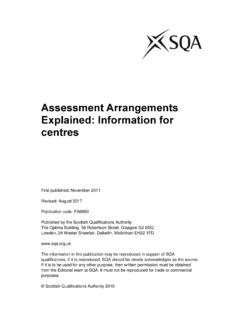
1 Assessment Arrangements Explained : Information for centres First published: November 2011 Revised: December 2021 Publication code: FA6860 Published by the Scottish Qualifications Authority The Optima Building, 58 Robertson Street, Glasgow G2 8DQ Lowden, 24 Wester Shawfair, Dalkeith, Midlothian EH22 1FD The information in this publication may be reproduced in support of SQA qualifications. If it is reproduced, SQA should be clearly acknowledged as the source. If it is to be used for any other purpose, then written permission must be obtained from the Editorial team at SQA. It must not be reproduced for trade or commercial purposes. Scottish Qualifications Authority 2021 Summary of changes Revision date Detail Author December 2021 Administration and IT guidance has been added AF December 2021 National 2 and National 3 ESOL units guidance has been added AF December 2021 Separate Accommodation guidance has been added AF Contents Introduction 1 Access to Assessment : the principles 3 Assessment Arrangements .
2 Contacting SQA 6 When to contact SQA 6 Examples of Assessment Arrangements 8 Adapted question papers 8 Assistance in aural assessments 10 Extra time 11 Internal assessments 11 External examination 11 Extension to deadlines 13 Use of ICT or digital question papers 14 Use of ICT to type/speak responses or to read while using the conventional question paper 14 Digital answer books 14 Use of digital question papers 15 Numerical support in Mathematics assessments 17 Practical assistant 18 Prompters 20 Reader 22 Referring a candidate s scripts to the principal assessor 26 Scribe 27 Separate Accommodation 30 Separate (individual) Accommodation 30 Separate (small group) Accommodation 30 Using sign language in SQA assessments 31 Supervised breaks or rest periods in a timed Assessment 32 Transcription with correction of spelling and punctuation 33 Transcription without correction 35 Who to contact for more information 36 1 Introduction This document contains information for teachers and lecturers and is about what to do when considering the provision of Assessment Arrangements for candidates who have a physical difficulty (including medical or sensory difficulty), a behavioural or mental health difficulty or a learning difficulty.
3 It details the principles that apply when determining a candidate s need for an Assessment arrangement and how and when to request an Assessment arrangement. It also describes some examples of Assessment Arrangements that can be provided in SQA assessments. You must read this document in conjunction with all other relevant Assessment Arrangements guidance on SQA s website, which can be found at: The purpose of Assessment Arrangements is to provide disabled candidates with an equal opportunity to demonstrate their attainment in an Assessment (ie to show the skills, knowledge and understanding they have achieved) without compromising the integrity of the Assessment . Candidates are individuals with a diverse range of needs and it is important that you consider the individual Assessment needs of your candidates when considering the most appropriate Assessment Arrangements .
4 For example: a candidate who is profoundly deaf, and who uses sign language, may need sign language support to access an Assessment task a candidate experiencing mental health difficulties, who is very lethargic first thing in the morning due to medication, may need the start time of an Assessment adjusted a candidate with dyslexia, who experiences difficulties with reading, may need a text reader and may also need extra time to complete an Assessment a candidate with ADHD (attention deficit hyperactivity disorder), who has persistent difficulties with concentrating, may need to undertake an examination in a separate room, or in a room with only a small number of candidates For candidates who are disabled, as defined under the provisions of the Equality Act 2010*, Assessment Arrangements such as those listed above might be the reasonable adjustments required to compensate for a substantial disadvantage, but there may be other unique adjustments that need to be considered to meet their individual needs.
5 However, it is important to recognise that some adjustments may not be possible for some qualifications. It is not possible to make an adjustment to the standard of the qualification where to do so would mean that it did not provide a reliable indication of the knowledge, skills and understanding of the candidate. * The Equality Act 2010 requires that SQA make reasonable adjustments where a candidate who is disabled within the meaning of the Act would be at a substantial disadvantage in comparison to a candidate who is not disabled. 2 Some candidates, defined as having additional support needs under the education (Additional Support for Learning) (Scotland) Act 2009 , may also need an Assessment arrangement to meet their identified physical (including medical or sensory), behavioural, mental health or learning difficulty.
6 In all cases, it is the individual Assessment needs of candidates that must be the basis for the provision of an Assessment arrangement. This means that you have a critical role in ensuring that the process of providing Assessment Arrangements is fair and operates with integrity. To this end, SQA requires that all centres have effective internal quality assurance systems and procedures in place to identify and verify candidates need for Assessment Arrangements . Your internal quality assurance system will be subject to SQA s own quality assurance procedures as detailed in the Quality Assurance of Assessment Arrangements : Information for Schools (publication code FA7266) or Quality Assurance of Assessment Arrangements : Information for Colleges (publication code FA7265) available here.
7 The education (Additional Support for Learning) (Scotland) Act 2004 (as amended) provides the legal framework underpinning the system for supporting children and young people in their school education . It is important to remember that the Act automatically deems that all looked after children and young people have additional support needs unless it is determined that they do not. It is therefore important that you consider whether a candidate who is looked after and has been identified as having additional support needs also has an identified physical (including medical or sensory), behavioural, mental health or learning difficulty and requires an Assessment arrangement. 3 Access to Assessment : the principles As the national awarding body for Scotland, SQA has a responsibility to ensure that Assessment leading to certification is rigorous and fair for all candidates, and that it allows candidates to demonstrate the skills, knowledge and understanding required for the qualification.
8 This is why it is important that Assessment Arrangements are only provided to those candidates identified as having a physical (including medical or sensory), behavioural, mental health or learning difficulty that prevents them from accessing an Assessment and demonstrating their attainment. The four key principles that underpin our Assessment Arrangements policy focus on the need to remove barriers for disabled candidates to provide them with an equal opportunity to access their assessments. Principle 1: Assessment Arrangements are intended to enable candidates to demonstrate their attainment, not to compensate for lack of attainment. Assessment Arrangements must be considered in the context of the distinction between a candidate s attainment and that of their ability to demonstrate their attainment under Assessment conditions.
9 They are agreed before an Assessment takes place and allow disabled candidates to access the Assessment and show the skills, knowledge and understanding they have acquired. For example, a candidate may have an identified reading difficulty and may require text-reading software to support decoding written text to access a History Assessment and show their skills, knowledge and understanding. Assessment Arrangements are not designed to compensate for a candidate not having acquired the key skills, knowledge and understanding of the qualification concerned. For example, where a candidate has not been physically able to develop the practical skills in a subject such as Practical Metalwork or where a candidate has not been able to develop any reading skills in a subject such as ESOL, Assessment Arrangements cannot be put in place to compensate for this.
10 4 Principle 2: Assessment Arrangements must not compromise the integrity of the qualification. Assessment Arrangements must be considered in the context of the Assessment standards or competence standards for each qualification. Assessment Arrangements must not compromise these standards or undermine the integrity of the Assessment or the credibility of the award. All relevant stakeholders, including candidates, must have confidence that the qualification that is awarded to a candidate provides a reliable indication of the knowledge, skills, understanding and competence of that candidate. For example, it is not possible for a candidate to use a human reader in a National Literacy unit , where independent reading skills are being explicitly assessed. The provision of a human reader would undermine the fundamental Assessment objectives for reading in the National Literacy unit and candidates would not be able to demonstrate the required level of skill.