Transcription of Assessment Fact Sheet: Performance Assessment using ...
1 Assessment Fact Sheet: Performance Assessment using Competency Assessment ToolsBackgroundA range of methods for competence Assessment exist. Within the realm of direct observation, interest in tools or checklists to assess discreet clinical skills remains prominent. Checklists have long been used in clinical settings and were designed to evaluate skills, specific procedures, work practices, communication and application of knowledge. Within these tools, Performance skills are generally translated into specific actions which can be ticked off, in boxes, during an Assessment . The main advantages for using checklists include ease of administration, scoring, and the provision of feedback.
2 Checklists uphold the historical preference for dichotomous-based reporting when assessing skills. Where at the end-point of the process of competency training and Assessment , the labels competent or not yet competent are attributed to behaviours as measured against set criteria. Such models have roots in the vocational education and training (VET) sectors, and promote non-competitive learning environments suitable for adult learners. However criticism of checklists suggests that they are limited in that they focus on psychomotor skills and provide only a snapshot of an individual s ,2 Competency tools using rating scales are a more complex and integrated version of assessing clinical skills and competence.
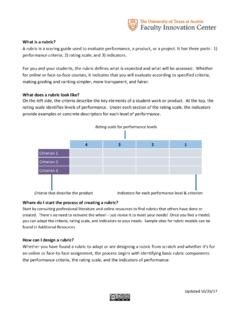
3 Such tools include a description of the skill and graduated clinical indicators which identify the degree to which an individual has exhibited the competency Assessment rating tools are in use throughout nursing settings. Bondy3 argued that a carefully developed criterion-referenced rating scale for clinical evaluation of individual Performance can be more reliable and valid than a number of competency scales have been developed including but not limited to Bloom s Taxonomic Scales; the Dreyfus Model for Skill Acquisition; and Benner s: From Novice to Expert Model. However it is apparent within the literature that no one Assessment tool or scale is superior due to a lack of validity and reliability testing.
4 The EdCaN Competency Assessment Tools are the product of a review of the literature, validation survey and small scale designA limited review of the literature has guided the construction design of the Assessment tools and the strategies for testing validity, reliability and feasibility of Assessment tools. Each competency Assessment tool comprises three major components: criteria indicators and a graduated literature supports the inclusion of a set of criteria upon which competence Assessment can be measured. Tool development usually begins with the identification of the essential skill items which combine to characterise the overall skill of performing a task or role.
5 The items chosen are generally observerable behaviours or minimal elements of clinical practice. Authors (either researchers or expert clinicians), focus groups or panels of experts can be employed to devise the item lists. Alternatively items can be sourced from existing documents or standards, such as: specialist nurse standards advanced practice/ specialist level nursing competency statements national guidelines for literature supports the use of rubrics or indicators to assist with consistent Assessment and evaluation of Performance , precisely pinpointing what constituted the decision for grade/ scale . Rubrics provide specific descriptions of the responses for each criteria and match proficiency levels and quality ratings .
6 Developmental learning theories can be used to inform the fact sheet provides the following: background information about the development and design of the competency Assessment tools educational theory underpinning competency Assessment tools methods of recording Performance in competency Assessment instructions to guide assessors/ educators when using the EdCaN Competency Assessment Tools for clinical skills. Table 1: The Cognitive Domain Taxonomy and Description6 Category/ Level Description1. Knowledge2. Comprehension3. Application4. Analysis5. Synthesis6. EvaluationGraduated scaleThe use of a scale facilitates the identification of the degree of skill or mastery.
7 Adaptation or combination of commonly used scales such as Blooms Taxonomy and the Bondy rating scale is frequent. A scale seeks to summarise the differences in the use of time, space, equipment and expenditure of energy across the development continuum. Educational theory underpinning the competency Assessment toolsThe provision of safe and effective care to people affected by cancer requires a nursing workforce with well-developed problem solving skills, sound underpinning knowledge, and accuracy and proficiency in practical skills. To ensure nurses are competent to perform their role, competency Assessment tools are required that provide valid and reliable measures of a nurses clinical Performance .
8 Such competency Assessment tools must be developed from sound theoretical and evidence based principles. The EdCaN Competency Assessment Tools for clinical skills draw on Bloom s Cognitive Domain Taxonomy and the five-point Bondy rating scale to provide frameworks for guiding the design of the tools and associated scoring matrices. Bloom s taxonomy of educational objectives is a system for categorising educational objectives according to a hierarchy of behaviours. The concept of taxonomy refers to the nature of the knowledge, skills and attitudes to be learned, in ranked order, with simple behaviours being listed first and more complex behaviours listed thereafter.
9 According to this theory, learners must successfully achieve lower level behaviours, before they are able to adequately learn behaviours at the higher levels. Moreover, Bloom s taxonomy is divided into three broad domains: cognitive, affective and psychomotor. While the three domains are described as separate entities, they are, interdependent and can be experienced simultaneously. The cognitive domain is known as the thinking domain. Learning in this domain involves the acquisition of information and refers to the learner s intellectual abilities, mental capabilities and thinking Objectives in this domain are divided into six levels. These levels increase in complexity, from knowledge as the baseline level, through comprehension, application, analysis, synthesis, to evaluation as the highest The levels are described in Table as the acquisition & remembering of previously learned material.
10 This may involve the recognition and recall of a wide range of material, from specific facts to complete theories, but all that is required is the bringing to mind of the appropriate information. Defined as the ability to grasp the meaning of material. Involving translating, paraphrasing, summarizing & interpreting to the ability to use learned material. This involves selecting, relating, transferring and applying rules, methods, concepts, principles, laws and to the ability to break down a concept/ material into parts. Involving, explaining, identifying, distinguishing, organizing and to the ability to put parts together to form a new whole. Involving constituting, combining, specifying & with the ability to judge the value of material.