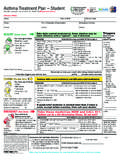
Transcription of Asthma at work - Your charter
1 Asthma at work your charter sets out 5 measures to significantly reduce Asthma and its impact in the workplace. It is supported by a coalition of employers, employees and healthcare charter is founded on the belief that no one should have to work in an environment that makes them ill. By endorsing this charter our partners agree to the 5 measures in order to help ensure the highest levels of health and safety in the workplace. charter partners will: Asthma at work your Charter1 Protect employees from the causes of occupational Asthma and conditions that trigger symptoms of pre-existing Asthma at work .
2 2 Provide a programme of health surveillance and access to up to date information on preventing occupational Asthma . 3 Ensure immediate investigation and prompt diagnosis, management and protection for people who develop symptoms of occupational Asthma . 4 Ensure all employees know what to do if a colleague experiences an Asthma attack. 5 Ensure employees understand how to avoid putting themselves and others at s takes lead on protecting colleagues from risk of occupational asthmaSam, 24, started working in the in-store bakery at Sainsbury s five years ago.
3 He first noticed that his breathing was becoming heavy when he was cycling to work , he was also wheezing and had an irritating cough. His GP diagnosed bronchitis and gave him an inhaler. It was not thought to be related to work at the time, however Sam noticed that his symptoms got better when he was away from work and worse after company s occupational health surveillance programme identified that he might have occupational Asthma , and as a result a number of pro-active measures were taken. Through a telephone conversation with an Occupational Health Adviser (OHA), blood tests and a visit to a respiratory specialist it was identified that Sam was allergic to flour.
4 The specialist felt that the evidence strongly suggested that Sam had occupational Asthma and confirmed this with some breathing tests. Once the cause of his symptoms had been identified, Sam agreed to be transferred to an alternative position outside the bakery. I was very relieved that a cause had been found for my wheezing and that it wouldn t get worse, says Sam. I have had no problems since and my health has improved an enormous amount. Shortly after he left the bakery, the importance of procedures to reduce dust was made clear to both bakers and their managers.
5 The situation has improved significantly and in many bakeries totally enclosed equipment is now being installed on a rolling basis. easy measuresto reduce the impact ofasthma in the Visit for: Updated guidelines and statistics Advice and supportAsthma UK AdvicelineAsk an asthmanurse specialist0800 121 62 44 5pm, Monday FridayPartners of Asthma at work your CharterPP0570809 Asthma UK 2009 Registered charity number in England 802364 and in Scotland SCO39322 Top triggers of Asthma at workAsthma UK asked employees with pre-existing Asthma what things at work made their Asthma worse and these are the top things.
6 Dust stress chemicals fumes perfumes/air freshenersWhat to do in an Asthma attack:1 Use your reliever Sit up and loosen any tight If no immediate improvement during an attack, continue to take one puff of your reliever inhaler every minute or until symptoms improve. 4 If your symptoms do not improve in five minutes or if you are in doubt call 999 or a doctor Continue to take one puff of your reliever inhaler every minute until help employees from the causes of occupational Asthma and conditions that trigger symptoms of pre-existing Asthma at work .
7 It is important that both the employer and employee understand what the causes of occupational Asthma are. charter partners understand that a healthy work environment is in everybody s interest. It is also recognised that it would be impossible to protect all employees from all possible triggers, so it is recommended that employees approach their managers to discuss what makes their Asthma worse and when. Employers have a legal responsibility to protect the health and safety of their employees. There is also a strong business case to make sure that employees are healthy, happy, and here.
8 13 Provide a programme of health surveillance and access to up-to-date information on preventing occupational there are materials and substances that cause Asthma in the workplace, employers should have a programme of health surveillance that may include a questionnaire and lung function tests. Health surveillance is important, because spotting occupational Asthma early offers the best chance of achieving a cure. Everyone operating in a business with a risk of occupational Asthma should have information on prevention, identification and all employees know what to do if a colleague experiences an Asthma attacks are serious and can be fatal.
9 Most fatal Asthma attacks happen to adults and the majority of deaths are preventable. Employers should encourage people with Asthma to tell their nearest first aider and trusted colleagues about their condition and what to do if they have an Asthma attack. charter partners understand that Asthma attacks can happen to employees, visitors and customers and will provide staff with the information they need, for example, making sure Asthma UK s Asthma Attack Cards are kept in every first aid employees understand how to avoid putting themselves and others at risk.
10 Asthma affects each person differently. There is a wide range of triggers and although some are common to many people there will be a large number who are also sensitive to less-common triggers. Employers can respond more effectivelyif an employee understands their Asthma and how to manage it. People who know what triggers their Asthma can protect themselves more effectively. The Asthma UK Adviceline can also help people to understand their Asthma . Ring the Asthma UK Adviceline on 0800 121 62 445 Causes of occupational asthmaThese are some of the most common causes of occupational Asthma : isocyanates (typically found in vehicle spray-painting and foam making) flour and grain dust (baking) wood dust solder/colophony (mainly found in the electrical and electronics industries).