Transcription of athematics Year 1 - ACARA
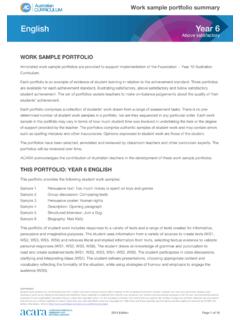
1 MathematicsYear 1 Satisfactory2014 EditionPage 1 of 29 Work sample portfolio summaryWORK SAMPLE PORTFOLIOA nnotated work sample portfolios are provided to support implementation of the Foundation year 10 Australian portfolio is an example of evidence of student learning in relation to the achievement standard. Three portfolios are available for each achievement standard, illustrating satisfactory , above satisfactory and below satisfactory student achievement. The set of portfolios assists teachers to make on-balance judgements about the quality of their students portfolio comprises a collection of students work drawn from a range of assessment tasks. There is no pre-determined number of student work samples in a portfolio , nor are they sequenced in any particular order. Each work sample in the portfolio may vary in terms of how much student time was involved in undertaking the task or the degree of support provided by the teacher. The portfolios comprise authentic samples of student work and may contain errors such as spelling mistakes and other inaccuracies.
2 Opinions expressed in student work are those of the portfolios have been selected, annotated and reviewed by classroom teachers and other curriculum experts. The portfolios will be reviewed over time. ACARA acknowledges the contribution of Australian teachers in the development of these work sample portfolios. THIS portfolio : year 1 MATHEMATICSThis portfolio provides the following student work samples: Sample 1 Number: Skip counting Sample 2 Number: One half Sample 3 Number: Money mind map Sample 4 Geometry: 2D Sample 5 Statistics: Our fruit today Sample 6 Number: I dropped my counters Sample 7 Number: What is the number? Sample 8 Number: Growing patterns Sample 9 Statistics: Familiar events Sample 10 Measurement: Time Sample 11 Geometry: Direction Sample 12 Measurement: CapacityCOPYRIGHTS tudent work samples are not licensed under the creative commons license used for other material on the Australian Curriculum website. Instead, you may view, download, display, print, reproduce (such as by making photocopies) and distribute these materials in unaltered form only for your personal, non-commercial educational purposes or for the non-commercial educational purposes of your organisation, provided that you retain this copyright notice.
3 For the avoidance of doubt, this means that you cannot edit, modify or adapt any of these materials and you cannot sub-license any of these materials to others. Apart from any uses permitted under the Copyright Act 1968 (Cth), and those explicitly granted above, all other rights are reserved by ACARA . For further information, refer to ( ).MathematicsYear 1 Satisfactory2014 EditionPage 2 of 29 Work sample portfolio summaryThis portfolio of student work shows an ability to describe the properties of 2D shapes (WS4), represent addition and subtraction (WS4, WS6) and skip count (WS1). The student models and compares representations of a half (WS2) and recognises Australian coins and their value (WS3). The student uses concrete objects to describe locations (WS11) and position, and to continue a pattern (WS8). The student describes, collects and displays data (WS5, WS9). The student uses informal units to order objects based on capacities (WS12) and shows how two-digit numbers can be partitioned (WS7).
4 The student tells the time to the half hour (WS2, WS10). COPYRIGHTS tudent work samples are not licensed under the creative commons license used for other material on the Australian Curriculum website. Instead, you may view, download, display, print, reproduce (such as by making photocopies) and distribute these materials in unaltered form only for your personal, non-commercial educational purposes or for the non-commercial educational purposes of your organisation, provided that you retain this copyright notice. For the avoidance of doubt, this means that you cannot edit, modify or adapt any of these materials and you cannot sub-license any of these materials to others. Apart from any uses permitted under the Copyright Act 1968 (Cth), and those explicitly granted above, all other rights are reserved by ACARA . For further information, refer to ( ).MathematicsYear 1 SatisfactoryWork sample 12014 EditionPage 3 of 29 Number: Skip countingYear 1 Mathematics achievement standardThe parts of the achievement standard targeted in the assessment task are highlighted.
5 By the end of year 1, students describe number sequences resulting from skip counting by 2s, 5s and 10s. They identify representations of one half. They recognise Australian coins according to their value. Students explain time durations. They describe two-dimensional shapes and three-dimensional objects. Students describe data count to and from 100 and locate numbers on a number line. They carry out simple additions and subtractions using counting strategies. They partition numbers using place value. They continue simple patterns involving numbers and objects. Students order objects based on lengths and capacities using informal units. They tell time to the half hour. They use the language of direction to move from place to place. Students classify outcomes of simple familiar events. They collect data by asking questions and draw simple data of taskStudents were given a number line. They chose a number to start and then demonstrated how they would skip count to reach another number.
6 Work sample 1 MathematicsYear 1 Satisfactory2014 EditionPage 4 of 29 CopyrightStudent work samples are not licensed under the creative commons license used for other material on the Australian Curriculum website. Instead, a more restrictive licence applies. For more information, please see the first page of this set of work samples and the copyright notice on the Australian Curriculum website ( ).AnnotationsDemonstrates skip counting by 5s and 10s. Describes a number sequence using skip counting by a number line to demonstrate skip counting by : Skip countingMathematicsYear 1 Satisfactory2014 EditionPage 5 of 29 Work sample 2 Number: One halfYear 1 Mathematics achievement standardThe parts of the achievement standard targeted in the assessment task are highlighted. By the end of year 1, students describe number sequences resulting from skip counting by 2s, 5s and 10s. They identify representations of one half. They recognise Australian coins according to their value.
7 Students explain time durations. They describe two-dimensional shapes and three-dimensional objects. Students describe data count to and from 100 and locate numbers on a number line. They carry out simple additions and subtractions using counting strategies. They partition numbers using place value. They continue simple patterns involving numbers and objects. Students order objects based on lengths and capacities using informal units. They tell time to the half hour. They use the language of direction to move from place to place. Students classify outcomes of simple familiar events. They collect data by asking questions and draw simple data of taskStudents were given a number of different items and were asked to show how they would use them to demonstrate one half. They were asked to relate their knowledge of half to half-hour time on an analog 1 Satisfactory2014 EditionPage 6 of 29 CopyrightStudent work samples are not licensed under the creative commons license used for other material on the Australian Curriculum website.
8 Instead, a more restrictive licence applies. For more information, please see the first page of this set of work samples and the copyright notice on the Australian Curriculum website ( ).AnnotationsFolds a triangular object to model one a rectangular object to model sample 2 Number: One halfMathematicsYear 1 Satisfactory2014 EditionPage 7 of 29 CopyrightStudent work samples are not licensed under the creative commons license used for other material on the Australian Curriculum website. Instead, a more restrictive licence applies. For more information, please see the first page of this set of work samples and the copyright notice on the Australian Curriculum website ( ).AnnotationsDemonstrates how folding a whole can create two equal parts or two understanding of the concept of one half using length to compare parts directly by placing one on top of the other and aligning the a collection of objects into two equal parts or time to the hour on an analog the minute hand in the correct position to show half-hour time on an analog clock but incorrectly positions the hour sample 2 Number: One halfMathematicsYear 1 Satisfactory2014 EditionPage 8 of 29 Number: Money mind mapYear 1 Mathematics achievement standardThe parts of the achievement standard targeted in the assessment task are highlighted.
9 By the end of year 1, students describe number sequences resulting from skip counting by 2s, 5s and 10s. They identify representations of one half. They recognise Australian coins according to their value. Students explain time durations. They describe two-dimensional shapes and three-dimensional objects. Students describe data count to and from 100 and locate numbers on a number line. They carry out simple additions and subtractions using counting strategies. They partition numbers using place value. They continue simple patterns involving numbers and objects. Students order objects based on lengths and capacities using informal units. They tell time to the half hour. They use the language of direction to move from place to place. Students classify outcomes of simple familiar events. They collect data by asking questions and draw simple data of taskA unit on money and financial mathematics was taught for a period of two weeks in conjunction with number and place value.
10 Students had experienced mind maps and a class shop in other learning selected an Australian coin, described it and identified what could be bought with it. For the second part of the task students were given $ to spend at the class shop and had to calculate as many different combinations of items they could buy as sample 3 MathematicsYear 1 Satisfactory2014 EditionPage 9 of 29 CopyrightStudent work samples are not licensed under the creative commons license used for other material on the Australian Curriculum website. Instead, a more restrictive licence applies. For more information, please see the first page of this set of work samples and the copyright notice on the Australian Curriculum website ( ).Number: Money mind mapWork sample 3 AnnotationsDraws a representation of an Australian a feature of coins that makes it possible to idenitfy a real-life example of a purchase equivalent to the value of a that total amounts can be made using different 1 Satisfactory2014 EditionPage 10 of 29 CopyrightStudent work samples are not licensed under the creative commons license used for other material on the Australian Curriculum website.