Transcription of AUGMENTED REALITY + VIRTUAL REALITY
1 XXXX AR & VR: PRIVACY AND AUTONOMY CONSIDERATIONS IN EMERGING, IMMERSIVE DIGITAL WORLDS 1 APRIL 2021 Privacy & Autonomy Considerations in Emerging, Immersive Digital WorldsAUGMENTED REALITY + VIRTUAL REALITYAUTHORED BYJoseph JeromeDirector, Platform Accountability and State Advocacy, Common Sense Media Jeremy GreenbergPolicy Counsel, Future of Privacy ForumACKNOWLEDGMENTSThe Future of Privacy Forum would like to thank the following individuals for their review of this work: Edward Britan, Vice President, Associate General Counsel, Head of Global Privacy, Salesforce; Diane Hosfelt, Research Engineer, Mozilla; Elizabeth Hyman, President & CEO, XR Association; Alina Kadlubsky, Lead Strategist, The Cyber XR Coalition; Riccardo Masucci, Global Director of Privacy Policy, Intel Corporation; Kavya Pearlman, Founder & CEO, XR Safety Initiative (XRSI); and Stephanie Strelau, Associate General Counsel, Magic you to Caroline Hopland, FPF Policy Intern, for her contributions to this work.
2 AR & VR: PRIVACY AND AUTONOMY CONSIDERATIONS IN EMERGING, IMMERSIVE DIGITAL WORLDS 1 TABLE OF CONTENTSPART IVirtual REALITY and AUGMENTED REALITY Technologies Can Create Immersive VIRTUAL Worlds or Display Digital Objects in Physical Environments _____5 PART IIXR is Increasingly Used for a Variety of Applications, Each Presenting Unique Benefits and Challenges _____10 PART IIIC urrent and Future XR Risks Include: The Vast Tracking of Consumers and Bystanders Including Their Sensitive Information Manipulation and Abuse of Digital Identities, Cyberharassment, and More _____15 PART IVA Mix of Technical and Policy Solutions Will Maximize Benefits While Mitigating Risks _____222 FUTURE OF PRIVACY FORUM | APRIL 2021 VIRTUAL REALITY (VR) and AUGMENTED REALITY (AR)
3 Applications can enhance entertainment, gaming, learning, and other experiences by immersing users in a digital world or adding images of digital objects to individuals perceptions of their physical surroundings. VR most commonly employs headsets that rely on stereoscopic displays, spatial audio, and motion-tracking sensors to simulate a wholly VIRTUAL environment. AR layers VIRTUAL elements onto physical environments, typically via smartphones or displays mounted on specialized eyeglasses. VR and AR collectively fall under the umbrella term of XR.
4 Many XR technologies use headsets, but others employ advanced hardware from heads-up displays (HUDs) on car windshields to full-sized VIRTUAL environments that feature haptic clothing, artificial wind, and dozens of cameras. Nearly all XR technologies rely on detailed information about users, their surroundings, and sometimes nearby , XR technologies are used in fields including gaming, military training, architectural design, education, social skills training, medical simulations, and psychological treatment, among others.
5 These technologies provide substantial benefits to individuals and society. But XR technologies typically cannot function without collecting sensitive personal information data that can create privacy risks. Some VR and AR systems rely on biometric identifiers and measurements, real-time tracking of individuals location, and precise maps of the physical world including the interiors of homes, offices, and medical facilities. XR systems also raise novel questions about how immersive technologies might increase or mitigate the risks of online harassment or and organizations are increasingly adopting XR hardware and software.
6 In order to promote the benefits and mitigate the risks of these emerging, immersive technologies, FPF recommends: Policymakers should carefully consider how existing or proposed data protection laws can provide consumers with meaningful rights and companies with clear obligations regarding XR data; Hardware makers should consider how XR data collection, use, and sharing can be performed in ways that are transparent to users, bystanders, and other stakeholders; XR developers should consider the extent to which sensitive personal data can be processed locally and kept on-device; XR developers should ensure that sensitive personal data is encrypted in transit and at rest; Platforms and XR experience providers should implement rules about VIRTUAL identity and property that mitigate, rather than increase, online harassment, digital vandalism, and fraud; Platforms and XR experience providers should establish clear guidelines that mitigate physical risks to XR users and bystanders.
7 Researchers should obtain informed consent prior to conducting research via XR technologies and consider seeking review by an Institutional Review Board (IRB) or Ethical Review Board (ERB) if consent is impractical; Platforms and XR experience providers should provide a wide-range of customizable avatar features that reflect the broader community, encouraging representation and inclusion; and Platforms and XR experience providers should consult with the larger community of stakeholders including, industry experts, advocates, policymakers, XR users, and non-XR users, and integrate community feedback into decisions about software and hardware design and data collection, use, sharing and user SUMMARYXXXX AR & VR.
8 PRIVACY AND AUTONOMY CONSIDERATIONS IN EMERGING, IMMERSIVE DIGITAL WORLDS 3 After decades of development, demonstrations, and improvements to hardware and software, immersive technologies are increasingly implemented in education and training, gaming, multimedia, navigation, and communication. Emerging use cases will let individuals explore complicated moral dilemmas or experience a shared digital overlay of the physical world in real time. As current technologies are more widely adopted and emerging technologies mature, VIRTUAL REALITY (VR) and AUGMENTED REALITY (AR) applications will likely converge into one extended REALITY (XR) category.
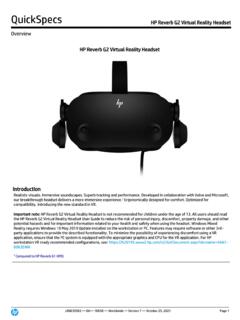
9 AR and VR need not be cabined to a single wearable device full-sized VIRTUAL environments already exist, as do interactive heads-up displays and AR software on mobile phones. The most common type of hardware is a consumer-grade wearable headset, known as a head-mounted display (HMD); more powerful, less expensive HMDs are the most likely path to widespread adoption of immersive digital realities. HMDs are not as ubiquitous as mobile phones, gaming consoles, or laptop computers, but HMDs offer increasingly sophisticated XR experiences, with substantial support from leading companies and technologies rely upon the collection of huge amounts of information and the processing of sensitive data, including users biometric data, unique device identifiers, location, information about the interior of homes and businesses, and Without this data, XR technologies cannot function safely and effectively.
10 At the same time, these sensitive data categories have become flashpoints in ongoing data privacy controversies, prompting vigorous debate, regulation, and proposed limits on the ways organizations may collect, use, and share As XR technologies become more popular, developers and XR platforms will gain access to rich new sources of information about individuals. Further, the social mores and norms for VIRTUAL worlds and AUGMENTED physical space are only developing. HMDs raise many questions about privacy, free expression, and evolving digital norms.