Transcription of Auschem - SDS - ShellSol A150 (130731)
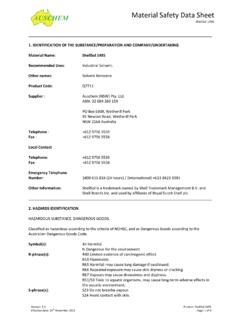
1 Material Safety Data Sheet ShellSol a150 Product: ShellSol a150 Page: 1 of 9 Version: Effective Date: 31st July 2013 1. IDENTIFICATION OF THE SUBSTANCE/PREPARATION AND COMPANY/UNDERTAKING Material Name: ShellSol a150 Recommended Uses: Industrial Solvent. Other names: ENVIROMENTALLY HAZARDOUS SUBSTANCE, LIQUID, Product Code: Q7493 Supplier : Auschem (NSW) Pty. Ltd. ABN: 32 084 260 159 PO Box 6309, Wetherill Park 91 Newton Road, Wetherill Park NSW 2164 Australia Telephone : +612 9756 5559 Fax : +612 9756 5558 Local Contact Telephone: +612 9756 5559 Fax: +612 9756 5558 Emergency Telephone Number: 1800 651 818 (24 hours) / (International) +613 8823 3095 Other Information: ShellSol is a trademark owned by Shell Trademark Management and Shell Brands Inc.
2 And used by affiliates of Royal Dutch Shell plc. 2. HAZARDS IDENTIFICATION HAZARDOUS SUBSTANCE. DANGEROUS GOODS. Classified as hazardous according to the criteria of NOHSC, and as Dangerous Goods according to the Australian Dangerous Goods Code. Symbol(s): Xn Harmful. N Dangerous for the environment. R-phrase(s): R40 Limited evidence of carcinogenic effect. R65 Harmful: may cause lung damage if swallowed. R66 Repeated exposure may cause skin dryness or cracking. R67 Vapours may cause drowsiness and dizziness. R51/53 Toxic to aquatic organisms, may cause long-term adverse effects in the aquatic environment. S-phrase(s): S23 Do not breathe gas/fumes/vapour/spray S24 Avoid contact with skin. S36/37 Wear suitable protective clothing and gloves.
3 Material Safety Data Sheet ShellSol a150 Product: ShellSol a150 Page: 2 of 9 Version: Effective Date: 31st July 2013 S61 Avoid release to the environment. Refer to special instructions/Safety data sheets. S62 If swallowed, do not induce vomiting: seek medical advice immediately and show this container or label. S2 Keep out of the reach of children. Health Hazards: Vapours may cause drowsiness and dizziness. Slightly irritating to respiratory system. May cause moderate irritation to skin. Repeated exposure may cause skin dryness or cracking. Moderately irritating to eyes. Harmful: may cause lung damage if swallowed. Limited evidence of carcinogenic effect. Signs and Symptoms: Respiratory irritation signs and symptoms may include a temporary burning sensation of the nose and throat, coughing, and/or difficulty breathing. Breathing of high vapour concentrations may cause central nervous system (CNS) depression resulting in dizziness, light-headedness, headache, nausea and loss of coordination.
4 Continued inhalation may result in unconsciousness and death. Skin irritation signs and symptoms may include a burning sensation, redness, swelling, and/or blisters. Defatting dermatitis signs and symptoms may include a burning sensation and/or a dried/cracked appearance. Eye irritation signs and symptoms may include a burning sensation, redness, swelling, and/or blurred vision. If material enters lungs, signs and symptoms may include coughing, choking, wheezing, difficulty in breathing, chest congestion, shortness of breath, and/or fever. Safety Hazards: Combustible liquid. In use, may form flammable/explosive vapour-air mixture. Electrostatic charges may be generated during pumping. Electrostatic discharge may cause fire. Environmental Hazards: Expected to be toxic to aquatic organisms. May cause long-term adverse effects in the aquatic environment.
5 SUSMP Schedule: 6 3. COMPOSITION/INFORMATION ON INGREDIENTS Material Formal Name: Solvent naphtha (petroleum), heavy aromatic CAS No.: 64742-94-5 INDEX No.: 649-424-00-3 EINECS No.: 265-198-5 Hazardous Components Chemical Name CAS EINECS Symbol(s) R-phrase(s) Conc. Naphthalene 91-20-3 202-049-5 Xn, N R22; R40; R50/53 <= %W 1,3,5-Trimethyl benzene 108-67-8 203-604-4 Xi, N R10; R37; R51/53 < %W 1,2,4-Trimethyl benzene 95-63-6 202-436-9 Xn, N R10; R20; R36/37/38; R51/53 < %W Additional Information: Refer to chapter 16 for full text of EC R-phrases. 4. FIRST AID MEASURES Material Safety Data Sheet ShellSol a150 Product: ShellSol a150 Page: 3 of 9 Version: Effective Date: 31st July 2013 Inhalation: Remove to fresh air.
6 If rapid recovery does not occur, transport to nearest medical facility for additional treatment. Skin Contact: Remove contaminated clothing. Flush exposed area with water and follow by washing with soap if available. Eye Contact: Flush eyes with water while holding eyelids open. Rest eyes for 30 minutes. If redness, burning, blurred vision, or swelling persist, transport to the nearest medical facility for additional treatment. Ingestion: If swallowed, do not induce vomiting: transport to nearest medical facility for additional treatment. If vomiting occurs spontaneously, keep head below hips to prevent aspiration. If any of the following delayed signs and symptoms appear within the next 6 hours, transport to the nearest medical facility: fever greater than 101 F ( C), shortness of breath, chest congestion or continued coughing or wheezing.
7 If vomiting occurs spontaneously, keep head below hips to prevent aspiration. Advice to Physician: Potential for chemical pneumonitis. Call a doctor or poison control centre for guidance. Causes central nervous system depression. Dermatitis may result from prolonged or repeated exposure. 5. FIRE FIGHTING MEASURES Clear fire area of all non-emergency personnel. Specific Hazards: Carbon monoxide may be evolved if incomplete combustion occurs. Will float and can be reignited on surface water. The vapour is heavier than air, spreads along the ground and distant ignition is possible. Extinguishing Media: Foam, water spray or fog. Dry chemical powder, carbon dioxide, sand or earth may be used for small fires only. Do not discharge extinguishing waters into the aquatic environment.
8 Unsuitable Extinguishing Media: Do not use water in a jet. Protective Equipment for Firefighters: Wear full protective clothing and self-contained breathing apparatus. Additional Advice: Keep adjacent containers cool by spraying with water. Hazchem Code: 3Z - For fire fighting, use foam (alcohol resistant foam may be required. Risk of explosion. Breathing apparatus, firefighting gear and chemically impervious protective gloves should be worn. Prevent, by any means available, spillage from entering drains or water courses. 6. ACCIDENTAL RELEASE MEASURES Observe all relevant local and international regulations. Protective measures: Avoid contact with spilled or released material. Immediately remove all contaminated clothing. For guidance on selection of personal protective equipment see Chapter 8 of this Material Safety Data Sheet.)
9 For guidance on disposal of spilled material see Chapter 13 of this Material Safety Data Sheet. Shut off leaks, if possible without personal risks. Remove all possible sources of ignition in the surrounding area. Use appropriate containment (of product and fire fighting water) to avoid environmental contamination. Prevent from Material Safety Data Sheet ShellSol a150 Product: ShellSol a150 Page: 4 of 9 Version: Effective Date: 31st July 2013 spreading or entering drains, ditches or rivers by using sand, earth, or other appropriate barriers. Attempt to disperse the vapour or to direct its flow to a safe location for example by using fog sprays. Take precautionary measures against static discharge. Ensure electrical continuity by bonding and grounding (earthing) all equipment. Monitor area with combustible gas indicator. Clean Up Methods: For small liquid spills (< 1 drum), transfer by mechanical means to a labelled, sealable container for product recovery or safe disposal.
10 Allow residues to evaporate or soak up with an appropriate absorbent material and dispose of safely. Remove contaminated soil and dispose of safely. For large liquid spills (> 1 drum), transfer by mechanical means such as vacuum truck to a salvage tank for recovery or safe disposal. Do not flush away residues with water. Retain as contaminated waste. Allow residues to evaporate or soak up with an appropriate absorbent material and dispose of safely. Remove contaminated soil and dispose of safely. Additional Advice: See Chapter 13 for information on disposal. Notify authorities if any exposure to the general public or the environment occurs or is likely to occur. 7. HANDLING AND STORAGE General Precautions: Avoid breathing vapours or contact with material. Only use in well ventilated areas.