Transcription of BACKGROUND INFORMATION EMS System description …
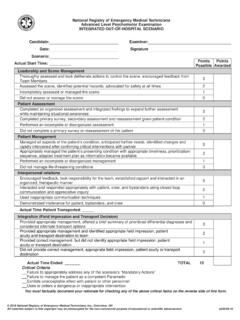
1 BACKGROUND INFORMATION EMS System description (including urban/rural setting) Suburban EMS that responds to both emergency and non-emergency calls Vehicle Type/response capabilities 2 person paramedic level transporting service Proximity to and level/type of facilities 30 minutes to the attending physician s office 15 minutes to community hospital DISPATCH INFORMATION Nature of the call Woman can t walk, requests transport to physician s office, non-emergent Location Well kept walk-up single family dwelling Dispatch Time 1512 hours Weather 68 F spring day Personnel on scene Daughter who is serving as primary care giver SCENE SURVEY INFORMATION Scene considerations 10 cement steps up to the front door No access for stretcher from any other doorway Patient location 1st floor, back bedroom, narrow hallways & doorways Visual appearance Patient sitting in bed with multiple pillows holding her in an upright position, pale in color, does not respond to your presence in the room Age, gender, weight 58 year old female.
2 200 pounds Immediate surroundings (bystanders, family members present) Clean, neat, well-kept surroundings Daughter is only family member present, PATIENT ASSESSMENT Chief Complaint Altered level of consciousness History of present illness Daughter states My Mother just passed out a couple of minutes ago from the pain. Patient woke this morning with a painful left leg that has increased in pain, unable to walk without severe pain. Daughter states that her mother, Has a small sore on her left inner thigh that has gotten bigger over the past few hours and her doctor wants to see her in his office.
3 Patient responses, symptoms, and pertinent negatives Patient opens her eyes to loud verbal stimulus but does not verbally respond PAST MEDICAL HISTORY Past Medical History Adult onset diabetic controlled with diet and oral medication, hypertension, hernia repair years ago Medications & Allergies Glucophage bid, Lasix 20 mg qid, diltiazem qid, and Colace qid NKA Social/family concerns Patient lives alone after death of husband two years ago, daughter comes to her home each day to help her mother with daily chores EXAMINATION FINDINGS Initial Vital Signs BP 100/palpation P 130, rapid and weak R 8 Respiratory Lung sounds are dimished bilaterally Cardiovascular Tachycardia, hypotensive Gastrointestinal --- Genitourinary --- Musculoskeletal --- Neurologic Opens her eyes to loud verbal stimulus and withdraws to pain Utters incomprehensible sounds Pupils equal and responds sluggishly to light Integumentary Large ecchymotic area over the patient s entire left inner thigh extending into the groin, pelvis, and left lower abdomen Area is hot to touch with crepitation under the skin Skin is pale, hot.
4 And moist to touch Hematologic --- Immunologic --- Endocrine Blood glucose 370 mg/dL Psychiatric --- PATIENT MANAGEMENT Initial stabilization Assisted ventilation with high flow oxygen Treatments Assisted ventilation with high flow oxygen IV enroute Monitoring ECG sinus tachycardia, SpO2 85% Additional Resources Consider transportation to facility with immediate surgical capabilities and hyperbarics Patient response to interventions No change TRANSPORT DECISION Lifting and moving patient Place in Reeves stretcher to ambulance stretcher Mode Rapid Facilities Emergency department CONCLUSION Field Impression Septic shock Rationale for Field Impression Rapidly extending extremity infection, febrile, hypotension, and tachycardia, with altered LOC Related pathophysiology What is the basis for the septic shock in this case?
5 Severe bacterial infection Verbal Report MANDATORY ACTIONS Rapid identification of life-threat and immediate transportation to the emergency department High flow oxygen POTENTIALLY HARMFUL/DANGEROUS ACTIONS ORDERED/PERFORMED Delayed transportation for on scene interventions Taking the patietnt to the doctors office. BACKGROUND & DISPATCH INFORMATION FOR CANDIDATE You are a paramedic on a transporting paramedic unit. You are working with a paramedic partner in a suburban EMS System . You are thirty (30) minutes away from the attending physician s office and fifteen (15) minutes from the community hospital.
6 At 1512 hours, you are dispatched to a residence for a non-emergent transport of a woman to her doctor s office. It is a clear spring day with a temperature of 68 F. A woman who identifies herself as the patient s daughter meets you at the door.