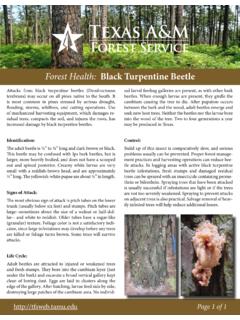
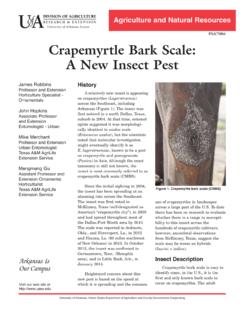
Transcription of BACKYARD BARK BEETLES FOR FLORIDA MASTER …
1 BACKYARD bark BEETLES FOR FLORIDA MASTER naturalist PROGRAM The BACKYARD bark BEETLES is a citizen science project that provides a rare opportunity for the public to participate in real-world scientific research. Participants help to advance our understanding of bark and ambrosia BEETLES , which will help us to protect FLORIDA s forests and the species that depend on them. Why is this project important for the FLORIDA MASTER naturalist Program? The project aims to increase public awareness and understanding about this group of BEETLES that are exceptionally important in FLORIDA but poorly known by the public. Our State not only holds the greatest diversity of ambrosia BEETLES in the country but is the recipient of the greatest number of introduced species.
2 Native species are an important component of FLORIDA s biodiversity and ecosystem function. However, invasive species often attack live trees and can sometimes wipe out whole populations of trees and have become one of the most important threats to our forest. As some species also can attack timber and crops, they are a threat to our state economy too. The project was designed to be accessible to any citizen, from kids to nature enthusiast and as such it is a perfect tool for FMNP students to share their knowledge with family and friends or in formal environmental education. How does the project fit FMNP module classes? Here are some ideas on how the project can be used as a hands-on teaching tool for the Upland Systems Module of the program.
3 The project can be associated with the following themes: Processes - Biological Interactions Ambrosia BEETLES are important to forest decomposition and nutrient recycling. These BEETLES colonize dead trees en masse, and by drilling through the bark deep into the wood, they open up the tree tissues for symbiotic as well as general wood degrading fungi. Activity: place a trap, near a dead tree and wait to see how many BEETLES you catch! Symbiosis Ambrosia BEETLES live in nutritional symbiosis with fungi and bacteria. While colonizing trees these BEETLES inoculate and cultivate the fungus as their source of nutrition. Activity: Discuss what kind of symbiosis this is. More information about these BEETLES can be found in Biological diversity With about 3,200 species, ambrosia BEETLES are more diverse than any of the other fungus-growing insect groups.
4 Activity: Place a trap, catch BEETLES , have them identified by an expert and see how many different species you cached. You can also place traps under different types of trees or in different forests and compare the diversity. Exotic and feral species FLORIDA only holds the greatest diversity of native ambrosia and bark BEETLES in the country and is the recipient of the greatest number of introduced species (around 35 species have been detected). Nobody knows why, but when they get introduced to a non-native area, some ambrosia beetle species from tropical and subtropical regions of the world, start attacking and colonizing live trees. Activity: Place a trap, catch BEETLES , have them identified by an expert and see how many species are native vs invasive.
5 The role of human activities in spreading invasive species Ambrosia and bark BEETLES have been spread through the movement of wood that is infested with BEETLES , for instance by untreated wooden packing material such as pellets or by the movement of firewood. Activity: Discuss with your group what can FLORIDA MASTER naturalist do to help prevent the spread of these invasive BEETLES ? Impacts of invasive species on pineland communities and hardwood forest These BEETLES are especially important pest of pines and oaks. For example, the southern pine beetle (Dendroctonus frontalis) is the most damaging insect pest in the southern forests of the country. Activity: Place a trap, catch BEETLES , have them identified and see how many pests you find!
6 Representative beetle Dendroctonus frontalis, one of the species listed on the module is a bark beetle . Activity: Place a trap and see if you can catch this beetle ! Final project The BACKYARD bark beetle is an excellent resource to be used as a final project by your students. They can assess species diversity in different areas, identify pests in areas where they have not been found, prepare an educational booklet, and so much more! We identify for free! One of the main components of the project is that we identify the BEETLES you found for free! We are sure many FLORIDA MASTER naturalist would benefit from knowing what is out there in their BACKYARD , the park they work for, their kid s schools and much more! * Bateman C. and J. Hulcr. 2014. A guide to FLORIDA s common bark and ambrosia BEETLES .
7 EDIS FOR321 Join our project, help us understand these important and amazing creatures, and have a unique hands-on resource to teach the new generations of FLORIDA MASTER naturalist