Transcription of Baird Parker Agar Base
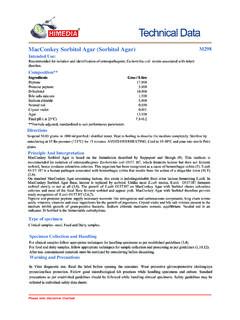
1 Please refer disclaimer Parker agar BaseM043 Intended Use: Baird Parker agar base is recommended for the isolation and enumeration of coagulase positive staphylococci from food and clinical **IngredientsGms / Peptone B# pH ( at 25 C) **Formula adjusted, standardized to suit performance parametersDirectionsSuspend grams in 950 ml distilled water. Heat to boiling to dissolve the medium completely. Sterilize by autoclaving at 15 lbs pressure (121 C) for 15 minutes. Cool to 50 C and aseptically add 50 ml concentrated Egg Yolk Emulsion (FD045) and 3 ml sterile Potassium Tellurite solution (FD047) or 50 ml Egg Yolk Tellurite Emulsion (FD046). For additional selectivity, if desired add rehydrated contents of 1 vial of BP Sulpha Supplement (FD069).
2 Alternatively 1 vial of Fibrinogen Plasma Trypsin Inhibitor Supplement (FD195) may be used per 90 ml medium in place of Egg yolk Tellurite Emulsion (FD046) for identification of coagulase, positive Stapylococci. Mix well and pour into sterile Petri And InterpretationBaird Parker agar was developed by Baird Parker (1, 2) from the Tellurite-glycine formulation of Zebovitz et al (3) for isolation and enumeration of Staphylococci in food and other material since it allows a good differentiation of coagulase positive strains. A high correlation has been found between the coagulase test and the presence of clear zone of lypolysis in this medium, which is due to the lecithinase of Staphylococci that breakdown, the egg yolk.
3 On the other hand, studies show that almost 100% of coagulase positive Staphylococci are capable of reducing tellurite, which produces black colonies, whereas other Staphylococci cannot always do so. The medium was found to be less inhibitory to Staphylococcus aureus than other media at the same time being more selective (4, 5, 6). Subsequently the use of Baird - Parker agar was officially adopted by AOAC International (7) and is recommended in the USP for use in the performance of Microbial Limit Tests (8). Recently, ISO committee has also recommended this medium for the isolation and enumeration of Staphylococci (9).The identity of Staphylococcus aureus isolated on Baird - Parker agar must be confirmed with a coagulase reaction.
4 Baird - Parker agar can also be used to detect coagulase activity by adding fibrinogen plasma (11). Fibrinogen Plasma Trypsin Inhibitor supplement (FD195) dissolved in 10 ml sterile distilled water added to 90 ml sterile molten media kept at 45-50 C. On this medium coagulase positive colonies appear white to grey-black surrounded by an opaque zone due to coagulase activity within 24-48 hours incubation at 35 C. Reduction in tellurite is necessary because of absence of egg yolk emulsion. This results in translucent agar and white to grey coloured colonies of Staphylococci. For quantitative results select 20-200 colonies. Count Staphylococcus aureus like colonies and test them for coagulase reaction. Report Staphylococcus aureus per gram of food.
5 Smith and Baird - Parker (10) found that the addition of 50 mg/l Sulphamethazine in the medium, suppresses the growth and swarming of Proteus species.# - Equivalent to Beef extractHiMedia LaboratoriesTechnical DataPlease refer disclaimer , HM peptone B and yeast extract are sources of nitrogen, carbon, sulphur and vitamins. Sodium pyruvate not only protects injured cells and helps recovery but also stimulates Staphylococcus aureus growth without destroying selectivity. Lithium chloride and potassium tellurite inhibit most of the contaminating microflora except Staphylococcus aureus. The tellurite additive is toxic to egg yolk-clearing strains other than and imparts a black colour to the colonies. Glycine, pyruvate enhances growth of Staphylococcus.
6 With the addition of egg yolk, the medium becomes yellow, opaque. The egg yolk additive, in addition to provide enrichment, aids in the identification process by demonstrating lecithinase activity (egg yolk reaction). A clear zone and grey-black colonies on this medium are diagnostic for coagulase positive Staphylococci. Upon further incubation, an opaque zone is developed around colonies, which can be due to lipolytic testing the medium, inoculate the material to be examined ( ml per plate of diameter 90-100 mm), incubate at 37 Cand take the first reading after 24-26 hours. The colonies of Staphylococcus aureus are black and shiny, with a fine white rim,surrounded by a clear zone. Incubate at 37 C for another 24 hours and perform the coagulase test on the colonies with the abovecharacteristics, which have developed during the further incubation period.
7 Plates should be used on the same day of preparationor within 48 hours, to avoid the loss of definition in the precipitated zones. The basal medium, without the egg yolk or thetellurite, is perfectly stable. Colonies of some contaminating organisms may digest the coagulase halo reaction. Other bacteriamay grow on this media but biochemical test will differentiate coagulase positive Staphylococci from the other of specimenClinical samples : Pus, blood ; Food samples ; Pharmaceutical samplesSpecimen Collection and HandlingFor clinical samples follow appropriate techniques for handling specimens as per established guidelines (15,16). For food and dairy samples, follow appropriate techniques for sample collection and processing as per guidelines (12,13,14).
8 After use, contaminated materials must be sterilized by autoclaving before and PrecautionsIn Vitro diagnostic use only. Read the label before opening the container. Wear protective gloves/protective clothing/eye protection/face protection. Follow good microbiological lab practices while handling specimens and culture. Standardprecautions as per established guidelines should be followed while handling clinical specimens. Safety guidelines may bereferred in individual safety data the medium is recommended for detection of coagulase positive Staphylococcus aureus, other bacteria may Further biochemical test have to be performed for and EvaluationPerformace of the medium is expected when used as per the direction on the label within the expiry period when stored atrecommended ControlAppearanceCream to yellow homogeneous free flowing powderGellingFirm, comparable with agar and Clarity of prepared mediumBasal medium: Yellow coloured clear to slightly opalescent gel.
9 After addition of Egg Yolk Emulsion and TelluriteEmulsion: Yellow coloured opaque gel forms in Petri of w/v aqueous solution at 25 C. pH : LaboratoriesTechnical Data Please refer disclaimer ResponseCultural response was observed after an incubation at 35-37 C for 24-48 hours. Recovery rate is considered as 100% forbacteria growth on Soyabean Casein Digest ResponseOrganismGrowthRecovery Colour ofcolonyLecithinase Cultural responseStaphylococcus aureus ATCC 6538 (00032*)luxuriantgrey-blackshinyPositive ,opaque zonearound thecolony>=50 %Staphylococcus aureus ATCC 25923 (00034*)luxuriantgrey-blackshinyPositive ,opaque zonearound thecolony>=50 %Proteus mirabilis ATCC25933good - luxuriant >=50% brown - black NegativeMicrococcus luteus ATCC10240poor - goodshades ofbrown-black(very small)Negative30 -40 %Staphylococcus epidermidis ATCC 12228 (00036*)
10 Poor - goodblackNegative30 -40 %Bacillus subtilis ATCC 6633none - poordark brownmattNegative0 -10 %Escherichia coli ATCC 8739(00012*)none- poorlarge brownblackNegative0 -10 %Escherichia coli ATCC25922 (00013*)none- poorlarge brownblackNegative0 -10 %Escherichia coli NCTC 9002none- poorlarge brownblackNegative0 -10 %Storage and Shelf LifeStore below 30 C in a tightly closed container and the prepared medium at 2 - 8 C. Use before expiry date on the label. Onopening, product should be properly stored dry, after tightly capping the bottle in order to prevent lump formation due to thehygroscopic nature of the product. Improper storage of the product may lead to lump formation. Store in dry ventilated areaprotected from extremes of temperature and sources of ignition Seal the container tightly after use.