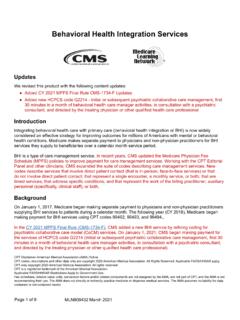
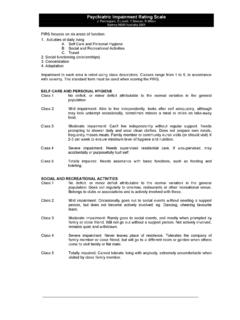
Transcription of BAM What is it? Brief Description
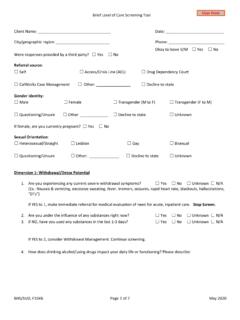
1 BAM. What is it? Brief Description : The Brief Addiction Monitor (BAM) is a 17-item, multidimensional, progress-monitoring instrument for patients in treatment for a substance use disorder (SUD). The BAM includes items that assess risk factors for substance use , protective factors that support sobriety, and drug and alcohol use (items 4-7G). The BAM produces composite scores for the three aforementioned domains. The instrument can be used in treatment planning, progress monitoring, and group or individual psychotherapies for SUD. The BAM-R, or continuous response BAM, retrospectively examines the patient's past 30-days allowing responders to give the actual number of days rather than intervals of days ( , 4-8, 9-15.)
2 Days). The BAM-IOP is intended to assess on a weekly basis as it covers only the prior 7 days. When considering a diagnosis, the clinician will still need to use clinical interviewing skills to determine whether the symptoms are causing clinically significant distress or impairment and those symptoms are not better explained or attributed to other conditions ( substance use, medical conditions, bereavement, etc.). Why should I use it? Clinical Utility Measurement based care emphasizes the use of standardized assessments, and other tests to help personalize care and guide treatment decisions.
3 O Just as a primary care provider would routinely check glucose levels to better inform their treatment plan for a patient's diabetes, routinely administering rating scales to monitor improvement or a change in mental health symptoms is considered best practice in providing optimal care. Routinely using these tools to measure longitudinal changes and track treatment progress are associated with superior client outcomes when compared to usual care o Assessments alert clinicians to lack of progress, guides treatment decisions, identifies potential intervention targets.
4 And assists in differential diagnosis o Assessments prompt changes in interventions if needed when things are not working or can prompt stepdown in care after a patient's functioning has improved The data can be used by the clinician to engage the client in therapeutic process, overall validating them as an active partner in their health care and mental wellness It can improve communication between providers and facilitate collaboration among different services How easy is it to do? Administration How is it administered? Where & when can it be done? Self-administered by the patient Waiting area prior to session (preferred) Beginning, during, or end session By interviewer in person or via At home prior to appointment telephone How is data collected?
5 How long does it take? Paper and pencil About 5 minutes to complete BHL Software Tablets or other electronic device BAM Assessment Resources developed by the VISN 4 MIRECC. Please contact with any questions or comments. BAM. How do I use this? Scoring and Interpretation Patients provide the numbers of days/nights on a Likert-scale ranging from 0-4 in the BAM-IOP and 0-30 in the BAM-R regarding their risk behaviors, protective behaviors, and substance use. Other items require categorical responses each of which has a corresponding numerical score. For example on Item 1 of the BAM-R, Excellent=0, Very Good=8, Good=15, Fair=22, Poor=30, while on the BAM and BAM-IOP Excellent=0, Very Good=1, Good=2, Fair=3, Poor=4.
6 Examining scores from individual items is the most clinically relevant use of this measure. Clinicians are strongly encouraged to attend to the item-level data because they have direct implications for treatment planning. They identify specific areas of need or resources for the patient's recovery. Each functional domain has an associated composite score which serves as cross-sectional marker of clinical status. Use = sum of Items 4, 5, & 6 (Scores from 0 to 12 on the BAM-IOP and 0-90 on the BAM- R; higher scores meaning more Use). Item 7 (7A-7G) are not scored as part of the subscales but provide elaboration for item 6.
7 Risk = sum of Items 1, 2, 3, 8, 11, & 15 (Scores from 0 to 24 on the BAM-IOP and 0-180. on the BAM-R; higher scores meaning more Risk). Protective = Sum of Items 9, 10, 12, 13, 14, & 16 (Scores from 0 to 24 on the BAM-IOP. and 0-180 on the BAM-R; higher scores meaning more Protection). Item 17 can be used as an overall assessment of treatment progress, but is not scored on any of the specific subscales Note that the BAM does not generate a psychometrically refined total score. The developers caution that its three factor scores (Use, Risk, and Protective) need additional psychometric evaluation.
8 However, patients and providers find it an appropriate set of items to inform initial treatment planning and for ongoing measurement based care. How could this help me with my patients? Treatment Planning By Total Score of Functional Domain Note: The examples provided below reference the date range reflected in the BAM-R (30 days) but content still applicable to BAM-IOP (7 days). Determining the veteran's strengths: The presence (or higher frequency occurrence) of any of the BAM Protective items indicates relative strengths/resources the veteran brings to the treatment setting.
9 These are indicated by the corresponding health factors for BAM questions 9, 10, 12, 13, 14, & 16. FOR EXAMPLE . John Doe reports that he is extremely confident that he can remain abstinent from alcohol and drug use in the next 30 days (BAMQ9).. Indicating the presence of a problem: The BAM's alcohol and drug consumption items (4 through 7G) and several BAM Risk and Protective items (8, 9, & 11) may be included as indicators of problematic drug and/or alcohol use. Note that the presence of the Risk items (8 & 11) and/or absence of the Protective item (9) can be related to problematic substance use.
10 BAM Assessment Resources developed by the VISN 4 MIRECC. Please contact with any questions or comments. BAM. FOR EXAMPLE . Problem #2 (Active): John Doe complains that his cocaine use has gotten way out of hand' as evidenced by: John stated he used cocaine on 16 of the past 30 days (BAMQ7c). John reported that he has been considerably bothered by drug craving in the past 30. days (BAMQ8). John reports slight confidence to be abstinent from drugs in the next 30 days (BAMQ9). John reports that in 16 to 30 of the past 30 days he has been in situations or with associates that put him at risk for drug use (BAMQ11).