Transcription of Basic Concepts of Chemical Bonding
1 Basic Concepts of Chemical BondingCover to EXCEPT1. Omit Energetics of Ionic bond Formation Omit Born-Haber Cycle 2. Omit Dipole MomentsELEMENTS & COMPOUNDS Why do elements react to form compounds ? What are the forces that hold atoms togetherin molecules ? andions in ionic compounds ?Electron configuration predict reactivity ElementElectron configurationsMg (12e) 1S22S22P63S2 ReactiveMg2+(10e) [Ne]Stable Cl(17e) 1S22S22P63S23P5 ReactiveCl-(18e) [Ar] Stable CHEMICALCHEMICALCHEMICALCHEMICALBONDSBON DSBONDSBONDSBONDSBONDSBONDSBONDS attractive force holding atoms togetherSingle bond :involves an electron H2 Double bond :involves two electron O2 Triple bond .
2 Involves three electron N2 TYPES OF CHEMICALTYPES OF CHEMICALTYPES OF CHEMICALBONDSBONDSBONDSBONDSBONDSBONDSBO NDSBONDSI onicPolar CovalentTwo ExtremesCovalentThe Two ExtremesIONIC BONDIONIC BONDIONIC BONDIONIC bond results from the transferof electrons from a metal to a BONDCOVALENT BONDCOVALENT BONDCOVALENT bond results from the sharingof electrons between the atoms. Usually found between COVALENT POLAR COVALENT POLAR COVALENT POLAR COVALENT bondis In-between the IONIC bond [ transferof electrons ] and the COVALENT bond [ shared electrons]The pair of electrons in a polar covalent bond are not shared OF ELECTRONS1.
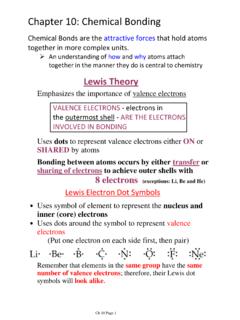
3 How Many Electrons ?2. Electron Configuration3. Orbital Numbers5. LEWIS SYMBOLSLEWIS SYMBOLSLEWIS SYMBOLSLEWIS SYMBOLSLEWIS SYMBOLSLEWIS SYMBOLSLEWIS SYMBOLSLEWIS SYMBOLSLEWIS SYMBOLS1. Electrons are represented as DOTSDOTSDOTSDOTS2. Only VALENCEVALENCEVALENCEVALENCE electrons are usedAtomic Hydrogen is H Atomic Lithium is Li Atomic Sodium is Na All of Group 1 has only one dotThe Octet RuleAtomsgain, lose, or share electronsuntil they are surrounded by 8 valence electrons(s2 p6)All noble gases[EXCEPT HE]have s2 : There are exceptions to the octet The Ionic BondI.
4 The Ionic Bondresults from the transferof electrons..Na + Cl : Na+ :Cl: -..Na has lost an electron to become Na+and chlorine has gained the electron to become Cl-II. Covalent BondingII. Covalent Bondingresults from the sharingof electrons between the example H + H H H or H :HEach pair of shared electrons constitutes one Chemical + Cl Cl ClBonding & Non Bonding ElectronsBondingElectrons: electrons between elementsHow many Bonding electrons inHydrogen ? Chlorine ?NonBondingElectrons: those not used in bondingHow many Non Bonding electrons inHydrogen ?
5 Chlorine ?Multiple BondsOne shared pair of electrons single bond H2H - HTwo shared pairs of electrons double bond O2::O = O::Three shared pairs of electrons triple bond N2: N N :H HO ON NCovalent BondingCovalent BondingWhen two atoms of the same kindbond, neither of them wants to lose or gain an electron Therefore, they must share electrons Each pair of shared electrons constitutes one Chemical of Covalent BondsStrengths of Covalent Bonds We know that multiple bonds are shorter than single bonds. We know that multiple bonds are stronger than single bonds.
6 As the number of bonds between atoms increases, the atoms are held closer and more tightly POLAR COVALENT BONDSIn a Polar Covalent bond , electrons are NOT equal sharing of those Polar Covalent bonds, the electrons are located closer to one atom than the sharing of electrons results in polar + F -There is more electron density on F than on there are two different ends of the molecule, HF has a di H bond Lewis dot formula C for carbon HLewis dot formula H C H for methaneHElectronegativityThe ability of one atomsin a moleculeto attract electrons to (Cs) to (F)Group 1H EXCEPTION{HIGH } Fig {LOW}DipoleThe difference in electronegativity leads to a polar covalent bond .
7 H + F -There is more electron density on F than on there are two different ends of the molecule, HF has a di StructuresTwo or more alternative Lewis structures for a inability to described a molecule with a single Lewis IN OZONERESONANCE IN OZONERESONANCE IN OZONEIn ozone the extreme possibilities have one double and one single bond . The resonance structure has two identical bonds of intermediate characterOOOOOOR esonance In Nitrate IonIn Nitrate Ion [NO3-]the extreme possibilities have one double and two single bonds O O ON N NO O O O O OThe resonance structure has three identical bonds of intermediate the LEWIS STRUCTURE forHFNF3H2OH2O2 MgCl2CH4C2H6 Resonance In Nitrite Ion(NO2 )-( O N O )-Where does the double bond go ?
8 | O= N O| | O N= O|Formal ChargeThe difference between the valence electrons in an isolated atom and the number of electrons assigned to that atom in a Lewis of number of number ofFC = valence - nonbonding - bondingelectrons electronselectronsFormal ChargeExample 1:: O = C = O:: vs :::O C OValence e-6 4 6 6 4 6- e-for atom- 6 - 4 - 6 - 7 - 4- 5 Formal Charge 0 0 0 -1 0 +1 Correct formula for (NCO)-1?Structure 1 Structure 2 Structure 3[:::N - C O:]-[::N = C = O::]-[:N C O:::]-V e-5 4 6 5 4 6 5 4 6- e--7 -4 -5 -6 -4 -6 -5 -4 -7FC -2 0 +1 -1 0 0 0 0 -1 Structure 3 is correct since negative charge is on the oxygen atom (most electronegative)Formal Charge1.
9 Neutral molecules: Formal charges add to zero2. Ions: Formal charges add to charge on ion3. Smallest formal charge is preferable4. Negative formal charge placed on most electronegative element