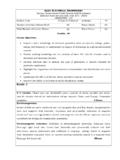
Transcription of BASIC ELECTRONICS & COMMUNICATION ENGINEERING
1 JBOS / EC I/II Semester BASIC ELECTRONICS & COMMUNICATION ENGINEERING Course Code 21 ELN14/24 CIE Marks 50 Teaching Hours / Week (L: T:P:S) 2:2:0 SEE Marks 50 Total Hours of Pedagogy 40 Total Marks 100 Credits 03 Exam Hours 3 Course Objectives: 1. Preparation: To prepare students with fundamental knowledge/ overview in the field of ELECTRONICS and COMMUNICATION ENGINEERING . 2. Core Competence: To equip students with a BASIC foundation in electronic ENGINEERING fundamentals required for comprehending the operation and application of electronic circuits, logic design, embedded systems, and COMMUNICATION systems.
2 3. Professionalism & Learning Environment: To inculcate in first-year ENGINEERING students an ethical and professional attitude by providing an academic environment inclusive of effective COMMUNICATION , teamwork, ability to relate ENGINEERING issues to a broader social context, and life-long learning needed for a successful professional career. Teaching-Learning Process (General Instructions) These are sample Strategies; which teachers can use to accelerate the attainment of the various course outcomes.
3 1. Lecturer method (L) does not mean only the traditional lecture method, but a different type of teaching method may be adopted to develop the outcomes. 2. Arrange visits to nearby PSUs such as BHEL, BEL, ISRO, etc., and small-scale hardware industries to give brief information about the ELECTRONICS manufacturing industry. 3. Show Video/animation films to explain the functioning of various analog and digital circuits. 4. Encourage collaborative (Group) Learning in the class 5.
4 Ask at least three HOTS (Higher-order Thinking) questions in the class, which promotes critical thinking 6. Adopt Problem Based Learning (PBL), which fosters students Analytical skills, develop thinking skills such as the ability to evaluate, generalize, and analyze information rather than simply recall it. 7. Topics will be introduced in multiple representations. 8. Show the different ways to solve the same problem and encourage the students to come up with their own creative ways to solve them.
5 9. Discuss how every concept can be applied to the real world - and when that's possible, it helps improve the students' understanding. Module I Electronic Circuits: Power Supplies Block diagram, Rectifiers, Reservoir and smoothing circuits, Full-wave rectifiers, Bi-phase rectifier circuits, Bridge rectifier circuits, Voltage regulators, Output resistance and voltage regulation, Voltage multipliers. Amplifiers Types of amplifiers, Gain, Input and output resistance, Frequency response, Bandwidth, Phase shift, Negative feedback, Multi-stage amplifiers.
6 JBOS / EC Operational amplifiers - Operational amplifier parameters, Operational amplifier characteristics, Operational amplifier configurations, Operational amplifier circuits. Oscillators Positive feedback, Conditions for oscillation, Ladder network oscillator, Wein bridge oscillator, Multivibrators, Single-stage astable oscillator, Crystal controlled oscillators. (Only Concepts, working, and waveforms. No mathematical derivations) Text 1: Chapters 6, 7, 8 and 9 Teaching-Learning Process Chalk and talk method, PowerPoint Presentation, YouTube videos, Animation of input and output waveforms of the op-amp circuits.
7 Practical Topics: Problems on voltage regulators, op-amp parameters, oscillators. Self-study topics: BJT amplifier types, comparison of BJT & FET. Module II Logic Circuits Logic gates, Bistables, R-S Bistables, D-type Bistables, J-K Bistables. Text 1: Chapter 10 Data representation, Data types, Data storage, A microcontroller system . Text 1: Chapter 11 Realization using BASIC gates and truth table the Half Adder (Text 4: ) and Full Adder (Text 4: Table & Fig. ), Multiplexer (Text 4: ) and decoder (Text 4: ).
8 Shift registers, Register type operation and truth table (Text 4: , ), Counters and asynchronous counters (Text 4: , ) Text 4: Fig. , Fig. , , , , , , (No simplification of Boolean algebra, no K-maps. Only logic circuit, working and truth table) Teaching-Learning Process Chalk and talk method, PowerPoint Presentation, YouTube videos, Animation of truth table and timing waveforms of the logic circuits especially flip flops, adders, shift registers, and counters. Practical Topics: Problems on data representation and types.
9 Self-study topics: Waveforms of counters, shift registers. Module III Embedded Systems Definition, Embedded systems vs general computing systems, Classification of Embedded Systems, Major application areas of Embedded Systems, Elements of an Embedded system , Core of the Embedded system , Microprocessor vs Microcontroller, RISC vs CISC, Harvard vs Von-Neumann. Text 2: , , , , Fig. , , , , Sensors and Interfacing Instrumentation and control systems, Transducers, Sensors. Text 1: Chapter 15 Actuators, LED, 7-Segment LED Display, Stepper Motor, Relay, Piezo Buzzer, Push Button Switch, Keyboard.
10 Text 2: , to except COMMUNICATION Interface, UART, Parallel Interface, USB, Wi-Fi, GPRS. Text 2: , , , , , Teaching-Learning Process Chalk and talk method, Power Point Presentation, YouTube videos Pictures of sensors, actuators, microcontrollers (with manufacturer names) Self-study topics: Block diagrams of the architectures of RISC, CISC, Harvard and Von-Neumann, Actuator types, LCD, Touch screen displays JBOS / EC Module IV Analog and Digital COMMUNICATION Modern COMMUNICATION system scheme, Information source, and input transducer, Transmitter, Channel or Medium Hardwired and Softwired, Noise, Receiver, Multiplexing, Types of COMMUNICATION systems.