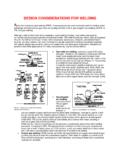
Transcription of BASIC MANUAL METAL ARC WELDING (MMAW)
1 BASIC MANUAL METAL ARC WELDING (MMAW)Learning ResourceMetals and EngineeringENG722 ENG722 BASIC MANUAL METAL Arc WELDING (MMAW) Learning Resource Copyright and Terms of Use Department of Training and Workforce Development 2016 (unless indicated otherwise, for example Excluded Material ). The copyright material published in this product is subject to the Copyright Act 1968 (Cth), and is owned by the Department of Training and Workforce Development or, where indicated, by a party other than the Department of Training and Workforce Development. The Department of Training and Workforce Development supports and encourages use of its material for all legitimate purposes.
2 Copyright material available on this website is licensed under a Creative Commons Attribution (CC BY ) license unless indicated otherwise (Excluded Material). Except in relation to Excluded Material this license allows you to: Share copy and redistribute the material in any medium or format Adapt remix, transform, and build upon the material for any purpose, even commercially provided you attribute the Department of Training and Workforce Development as the source of the copyright material. The Department of Training and Workforce Development requests attribution as: Department of Training and Workforce Development (year of publication).
3 Excluded Material not available under a Creative Commons license: 1. The Department of Training and Workforce Development logo, other logos and trademark protected material; and 2. Material owned by third parties that has been reproduced with permission. Permission will need to be obtained from third parties to re-use their material. Excluded Material may not be licensed under a CC BY license and can only be used in accordance with the specific terms of use attached to that material or where permitted by the Copyright Act 1968 (Cth). If you want to use such material in a manner that is not covered by those specific terms of use, you must request permission from the copyright owner of the material.
4 If you have any questions regarding use of material available in this product, please contact the Department of Training and Workforce Development. Training Sector Services Telephone: 08 6212 9789 Email: Website: Published by and available from:Department of Training and Workforce Development1 Prospect Place West Perth WA 6005 Tel: (08) 6212 9700 Fax: (08) 9227 8393 Email: photographs reproduced with permission, from the 2006 edition of the BOC Industry Reference MANUAL , BOC Australia Limited, Sydney. Photograph used on cover 2007 JupiterImages CorporationFirst published 2008 VET (WA) Ministerial Corporation 2008 This resource includes content from: METAL Fabrication Volume 2, Part 1: Fabrication & WELDING Theory, Department of Training and Workforce DevelopmentMetal Fabrication Volume 3, Part 1: Fabrication & WELDING Theory, Training PublicationsEngineering: Fabrication & WELDING Theory, Technical Publications TrustEngineering: WELDING Theory 1, Training PublicationsWelding Metallurgy, Training PublicationsEngineering.
5 WELDING Technology Aluminium/Stainless Steel (Resource Book), Training PublicationsMetals & Engineering Training Package: MANUAL METAL Arc WELDING , Department of Training and Workforce DevelopmentEngineering: WELDING 5 Certification Theory, Department of Training and Workforce DevelopmentMetals & Engineering Training Package: Weld Using Gas METAL Arc WELDING Process, Department of Training and Workforce DevelopmentAll rights reserved. No part of this publication may be reproduced, stored in a retrieval system or transmitted in any form or by any means, electronic, mechanical, photocopying, recording or otherwise, without the prior written permission of the Department of Training and Workforce every effort has been made to ensure the accuracy of the information contained in this publication, no guarantee can be given that all errors and omissions have been excluded.
6 No responsibility for loss occasioned to any person acting or refraining from action as a result of the material in this publication can be accepted by the Department of Training and Workforce 978-1-74205-048-5iiMetals FabricationBasic MMAW&ContentsChapter 1 Arc WELDING safety .. 1 Chapter 2 Electricity and WELDING machines .. 31 Chapter 3 Weld preparation and workmanship .. 57 Chapter 4 MANUAL METAL arc WELDING (MMAW) .. 73 Appendix Competency mappingii11 Metals FabricationBasic MMAW&Chapter 1 Arc WELDING safetyIntroductionTo achieve safe working conditions in the METAL fabrication and WELDING industry, all personnel should be able to recognise the hazards which apply to their particular occupation.
7 WELDING operators must also know the correct operating procedures for the operator can be subjected to many safety hazards associated with the industry. As with any other industrial worker, they may be injured through incorrect lifting practices, falling or tripping, or incorrect use of hand tools and machines. The operator will also encounter particular hazards associated with clean, tidy workplace, free from combustible materials, is an essential requirement for the safety of WELDING , others working in the vicinity of WELDING operations are at risk from hazards such as electrocution, fumes, radiation, burns or flying slag and noise.
8 They too must be protected if their health and safety is not to be put at this chapter you will look at the of hazardselectric shockfumesradiationfire and explosionburnsPersonal protective equipment (ppe)The working environmentconfined spaces/hazardous locationscutting or WELDING in or near hazardous locations working on tanks and containersFirst aid for operatorsbasic objectivesbasic immediate first aid for some common operator injuries. Chapter 1 Arc WELDING safety2 Types of hazardsThe major hazards associated with arc WELDING are:electric shockFig Electric shockfumesFig Fumes 33 Metals FabricationBasic MMAW&radiationFig Radiationfire and explosionFig Fire and Burns Chapter 1 Arc WELDING safety4 Electric shockElectrical principles and requirements for arc WELDING machines will be discussed in depth in Chapter 2 Electricity and WELDING machines, however at this stage it is necessary to clarify some BASIC electrical (V)the force which makes current flowvoltage is essentially electrical pressurecurrent (A)the flow of electrons and is measured in amperesopen circuit voltage (OCV)
9 The voltage between WELDING terminals when the machine is switched on but WELDING is not in progressresistancethe hindrance of a conductor to the passage of current, ie a force which opposes the flow of electricityconductora material that permits the easy flow of electricityinsulatora material that will not convey an electric currentElectric shock may only cause a minor tingling sensation or it may cause muscle spasms, or paralysis and this may cause an operator to grip onto the source of electricity. In the worst case scenario this may contribute to the WELDING operator s arc WELDING processes a number of potential electrocution sources can be primary input lead is either 415 V or 240 V and should never be tampered with, altered, or repaired except by a licensed electrician.
10 The output circuit of an arc welder is controlled at a safe voltage but this safe voltage can also kill if given ideal conditions. The ancillary circuits of most welders are also at a safe voltage of either 32 V or 24 V, although some machine manufacturers also use 110 V on older control FabricationBasic MMAW&The prevention of electrical shock from WELDING equipment relies on three major That the OCV of WELDING machines is low enough to prevent easy passage of current through the arc WELDING machines are capable of supplying a wide range of current, they generally operate within the following voltage range:Arc voltage: 16 36 VTo maximise safety for the WELDING operator, OCV is restricted to.