Transcription of BASKETBALL - Lyons Township High School
1 BASKETBALL History BASKETBALL was invented during the School year of 1891-92 at Springfield College in Springfield, Massachusetts. Dr. James A. Naismith conceived the idea of attaching peach baskets at opposite ends of the gym on the track that encircled the playing floor. This is where the height of 10 feet for the basket was arrived at. BASKETBALL derives its name from the original ball and basket used in the first games. The game was introduced in YMCA s across America and also to foreign countries. BASKETBALL became part of the Olympic Games in 1936. Nature of the Game BASKETBALL is played by two teams of five players each. The object of the game is to score more points than your opponent. The ball is passed, thrown, bounced, batted, or rolled from one player to another. A player in possession of the ball must maintain contact with the floor with one foot (pivot foot), unless the player is shooting, passing, or dribbling.
2 Physical contact with an opponent can result in a foul if the contact impedes the desired movement of the player. Safety/Etiquette 1. Clear the gymnasium and immediate playing area of movable obstructions and cover or pad those obstructions that cannot be moved. 2. No rough play or horseplay will be tolerated. 3. Be careful/aware of the walls during practice or play. 4. When possible make use of breakaway rims and pad the underside of the backboards. 5. No loose or hanging jewelry should be worn by competitors. Remove rings, bracelets and wristwatches. 6. Only gym shoes with sufficient traction should be worn. 7. Always be alert of play, even if you are standing on the sidelines. 8. Whenever possible during the drills or game play, participants of common ability levels should play against each other.
3 9. Good sportsmanship should be displayed by all. 10. Take periodic rest and water breaks. Care of Equipment/Facilities 1. Balls are stored in portable bins and should be carefully returned to the bins at the end of each period of use. Do not kick the basketballs or throw them from a distance into the storage bins. 2. Balls should be checked often for proper inflation levels. 3. Do not sit on or throw the basketballs against the gym walls. 4. Do not hang on the rims or nets. 5. The playing floor should be swept and cleaned regularly. Basic Rules 1. Players: Five players per team on the floor at a time with unlimited substitutions. Usually players fill the standard positions of 2 forwards, 2 guards, and 1 center. The names of these may be changed depending on the offense played.
4 2. Offense: Team or individual patterns of play that are used to get the ball into scoring position. There are two basic types of offensive attacks: the slow deliberate attack and the fast break attack. 3. Defense: Players may choose to play either a man to man defense (person to person) or zone. In man to man each player is assigned a specific person to guard/play defense on. In a zone defense, players are assigned a specified area to guard. The object of defense is to try to take the ball away from your person or the person in your assigned zone area to force them to turn over the ball, or force them to take a low percentage shot. 4. Scoring: Field Goals = 2 or 3 points. Free Throws = 1 point. 5. Timeouts: Timeouts are one minute or 30 seconds in length and can be requested during a dead ball or anytime by the team in possession of the ball.
5 Each team gets a total of five timeouts for the entire game. 6. Timing: high School varsity games play 8 minute quarters. Time stops each time an official blows the whistle indicating a dead ball. There is one minute between quarters and 10 minutes at the half. A player has 10 seconds to shoot a free throw. A player has 5 seconds to inbound the ball. Running time is used in physical education and intramural situations. The clock does not stop on dead balls. Play 1. The game is started with a jump ball in the center circle between two opponents. 2. A player is out of bounds when touching the floor on or outside the boundary line. 3. The ball is out of bounds when it touches a player who is out of bounds or any other person, the floor, or any object on or outside a boundary, or the supports of the backboard.
6 4. If the ball is caused to go out of bounds by the last player touching it, it is awarded out of bounds for a throw-in by the opposing team. 5. While the ball is alive, an offensive player cannot remain for more than 3 seconds in that part of the free-throw lane between the end line, the free-throw line, and the free-throw lane lines. 6. If an offensive ball handler, while in the front court, is closely guarded by the defense for 5 seconds, a violation is called and the defense is awarded the ball. 7. If two opponents are both firmly holding the ball, a jump ball is called. A jump ball results in an alternating possession which is kept track of at the official table. 8. In physical education, intramurals, or pick up games, a jump ball is awarded to the defender. 9. Violations include: causing the ball to go out of bounds, double dribbling, running with the ball, kicking the ball, striking the ball with the fist, interfering with the BASKETBALL , illegal throw-in (taking more than 5 seconds or stepping on the line), being closely guarded for 5 seconds while in possession of the ball in the front court, and the three second lane rule.
7 10. After one team makes a field goal or free throw, the other team puts the ball in play from out of bounds under the basket at which the goal was made. Each team possessing the ball is required to advance it past the half-court line within 10 seconds after gaining possession. 11. Fouls: Personal: involving pushing, charging, tripping, holding, body contact - After the fifth personal foul on a player, the player is disqualified from the game. - The offended player is awarded: one free throw if the foul occurred during a field goal attempt and the basket was made. two free throws if the foul occurred during a field goal attempt and the basket was missed. no free throw, but the ball is awarded to the offended player s team out of bounds. After the seventh TEAM personal foul in the half, the person fouled will be given a bonus free throw.
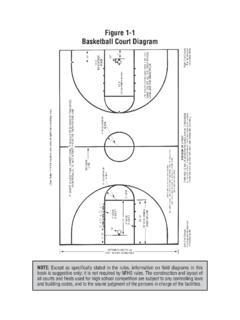
8 If you make the first bonus free throw you receive a second free throw. If you miss the first bonus free throw, the ball should be played like a missed field goal. After the tenth TEAM personal foul in the half, the person fouled will be given two free throws commonly referred to as the Super Bonus. Intentional: foul involving intent to foul as opposed to trying to play the ball which awards the person fouled two free throws and team possession of the ball after the free throws. Technical: involving delay of game, unsportsmanship like conduct, illegal entry, and excessive timeouts with the offended team being awarded two free throws and the ball out of bounds. BASKETBALL Court BASIC SKILLS DRIBBLING the process of bringing or moving the ball place to place around the court using the finger pads to tap the ball.
9 1. Touch the ball with your fingertips, not your palms. 2. Get in a low stance. 3. Bounce the ball off the ground firmly, extend through your elbow. 4. Keep your hand on top of the ball. 5. Keep the ball low, below your waist. 6. Keep your head up, eyes up. 7. Protect the ball from the defender. 8. Don t pick up your dribble unless you are ready to pass or shoot. 9. Avoid dribbling violations such as traveling, double dribble, and carrying. 1 o Dribble a 2 SHOOTING Practice the method for shooting 3 B = Balance Keep your feet shoulder width apart, with your dominate foot slightly ahead of your non-dominate foot. E = Eyes Focus on the rim. E = Elbow Dominate hand s elbow should be aligned with your torso in a 90 angle so you are looking at the back of your wrist. F = Follow Through Flick your wrist after releasing the ball.
10 Imagine reaching into a cookie jar up on a high shelf. 4 5 Other shooting tips: Rest the ball on the finger tips not in the palm of the hand. Your non-dominate hand acts only as a guide to the ball. This hand doesn t assist in shooting the ball. If shooting from a greater distance you must jump in order to recruit power from your legs. PASSING an alternative way to move the ball around the court that is not comprised of the act of dribbling. There are three common passes in BASKETBALL . 1. Chest pass the ball is thrown from your chest to your teammate s chest with no bounce or arc. 2. Bounce pass- The ball is thrown from your chest and is bounced once before entering your teammate s hands near their chest area. This pass is the most difficult pass to defend. 3. Overhead pass The ball is passed from over your head into your teammate s chest.