Transcription of Batching Mixing Transporting Handling Concrete
1 The specification, production, and delivery of concreteare achieved in different ways. The basic processes andcommon techniques are explained here. ASTM C 94 pro-vides standard specifications for the manufacture anddelivery of freshly mixed Concrete . Standards of theConcrete Plant Manufacturers Bureau, Truck Mixer Manu-facturers Bureau, and Volumetric Mixer ManufacturersBureau can be found on the National Ready MixedConcrete Association s website at options for ordering or specifying Concrete aredescribed in ASTM C 94:1.
2 Option A is performance based. It requires the purchaserto specify the compressive strength only, while the con-crete producer selects the mixture proportions needed toobtain the required compressive Option B is prescription based. The purchaser specifiesmixture proportions, including cement, water andadmixture Option C is a mixed option. It requires the concreteproducer to select the mix proportions with the min-imum allowable cement content and compressivestrength specified by the purchaser. BATCHINGB atching is the process of measuring Concrete mix ingre-dients by either mass or volume and introducing theminto the mixer.
3 To produce Concrete of uniform quality, theingredients must be measured accurately for each specifications require that Batching be done by massrather than by volume (ASTM C 94 or AASHTO M 157).Water and liquid admixtures can be measured accuratelyby either volume or mass. Volumetric Batching (ASTM C685 or AASHTO M 241) is used for Concrete mixed in con-tinuous generally require that materials bemeasured for individual batches within the followingCHAPTER 10 Batching , Mixing , Transporting , andHandling Concretepercentages of accuracy: cementitious material 1%,aggregates 2%, water 1%, and admixtures 3%.
4 Equipment should be capable of measuring quanti-ties within these tolerances for the smallest batch regu-larly used as well as for larger batches (Fig. 10-1). Theaccuracy of scales and Batching equipment should bechecked periodically and adjusted when chemical admixtures should be charged intothe mixture as aqueous solutions. The volume of liquid, ifsignificant, should be subtracted from the batched quan-tity of Mixing water. Admixtures that cannot be added insolution can be either batched by mass or volume asdirected by the manufacturer.
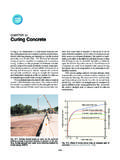
5 Admixture dispensersshould be checked frequently since errors in dispensingadmixtures, particularly overdoses, can lead to seriousproblems in both fresh and hardened 10-1. Control room for Batching equipment in a typicalready mixed Concrete plant. (69894)179 HOMEPAGE with a swinging discharge chute. Many stationarymixers have timing devices, some of which can be setfor a given Mixing time and locked so that the batchcannot be discharged until the designated Mixing timehas attention should be paid to the requiredmixing time.
6 Many specifications require a minimummixing time of one minute plus 15 seconds for everycubic meter (yard), unless mixer performance testsdemonstrate that shorter periods are acceptable and willprovide a uniform Concrete mixture. Short Mixing timescan result in nonhomogenous mixtures, poor distributionof air voids (resulting in poor frost resistance), poorstrength gain, and early stiffening problems. The mixingperiod should be measured from the time all cement andaggregates are in the mixer drum, provided all the wateris added before one-fourth of the Mixing time has elapsed(ACI 304R-00).
7 Under usual conditions, up to about 10% of themixing water should be placed in the drum before thesolid materials are added. Water then should be addeduniformly with the solid materials, leaving about 10% tobe added after all other materials are in the drum. Whenheated water is used in cold weather, this order ofcharging may require some modification to prevent pos-sible rapid stiffening when hot water contacts the this case, addition of the cementitious materials shouldbe delayed until most of the aggregate and water haveintermingled in the drum.
8 Where the mixer is chargeddirectly from a batch plant, the materials should be addedsimultaneously at such rates that the charging time isabout the same for all materials. If supplementarycementing materials are used, they should be added afterthe cement. If retarding or water-reducing admixtures are used,they should be added in the same sequence in thecharging cycle each time. If not, significant variations inthe time of initial setting and percentage of entrained airmay result. Addition of the admixture should be com-pleted not later than one minute after addition of water tothe cement has been completed or prior to the start of thelast three-fourths of the Mixing cycle, whichever occursfirst.
9 If two or more admixtures are used in the same batchof Concrete , they should be added separately; this isintended to avoid any interaction that might interfere withthe efficiency of any of the admixtures and adverselyaffect the Concrete properties. In addition, the sequence inwhich they are added to the mix can be important too. Ready Mixed ConcreteReady mixed Concrete is proportioned and mixed off theproject site and is delivered to the construction area in afreshly mixed and unhardened state. It can be manufac-tured by any of the following methods: Mixing CONCRETEAll Concrete should be mixed thoroughly until it is uni-form in appearance, with all ingredients evenly distrib-uted.
10 Mixers should not be loaded above their ratedcapacities and should be operated at the Mixing speedrecommended by the manufacturer. Increased outputshould be obtained by using a larger mixer or additionalmixers, rather than by speeding up or overloading theequipment on hand. If the blades of a mixer become wornor coated with hardened Concrete , Mixing action will beless efficient. These conditions should be Concrete has been adequately mixed, samples takenfrom different portions of a batch will have essentially thesame density, air content, slump, and coarse-aggregatecontent.