Transcription of BBA (CBCS)
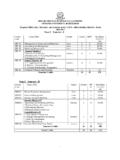
1 1 BBA (CBCS)Syllabus(2019 2020)FACULTY OF MANAGEMENTO smania UniversityHyderabad Telangana 500 0072019iBBA Course Structure and Syllabus As per CBCS Guidelines with Effect from 2019- 20201 STYEAR SEMESTER I Course CodeCourse TitleHPWC reditsExam 1 English (First Language) - 144 MIL 1 MIL 144 AECC 1 Environmental Science 22 DSC 101 Principles of Management553 U + 20 IDSC 102 Basics of Marketing553 U + 20 IDSC 103 Business Economics553 U + 20 ITotal Semester Credits2525 SEMESTER IICourse CodeCourse TitleHPWC reditsExam (First Language) - 244 MIL 2 MIL 244 AECC 2 Basic Computer Skills22 DSC 201 Organisational Behaviour553 U + 20 IDSC 202 Business Statistics 553 U + 20 IDSC 203 Financial Accounting 553 U + 20 ITotal Semester Credits2525 BBA (CBCS) Syllabus 2019 2020 OUii2ND YEAR SEMESTER IIIC ourse CodeCourse TitleHPWC reditsExam (First Language) - 333 MIL 3 MIL 333 SEC 1a) Personality Development - Ib) Advanced Computers221 U + 10 ISEC 2a) Basic Quality Managementb) Business Policy and Strategy221 U + 10 IDSC 301 Human Resource Management553 U + 20 IDSC 302 Information Technology for Business 4 T + 1 P53 U + 20 P + 20 IDSC 303 Financial management 553 U + 20 ITotal Semester Credits24/2525 SEMESTER IVCourse CodeCourse TitleHPWC reditsExam (First Language) - 433 MIL 4 MIL 433 SEC 3a) Business Correspondence and Communication b) Personality Development - II221 U + 10 ISEC 4a) Start Up Managementb)
2 Business Intelligence & Data Visualization 221 U + 10 IDSC 401 Business Law and Ethics553 U + 20 IDSC 402 Market Research553 U + 20 IDSC 403 management Science 553 U + 20 ITotal Semester Credits2525 BBA (CBCS) Syllabus 2019 2020 OUiii3RD YEAR SEMESTER VCourse CodeCourse TitleHPWC reditsExam (First Language) - 533 MIL 5 MIL 5 33GE-1 Mobile Commerce443 U + 20 IDSE 501a) Financial Markets and Services (F)b) Brand management (M)c) Organization Development (HR)553 U + 20 IDSE 502a) Analysis of Investment in Financial Assets (F)b) Retail management (M)c) Performance Appraisal and Counseling (HR) 553 U + 20 IDSE 503a) Insurance Services (F)b) customer relationship management (M)c) Compensation management (HR)553 U + 20 ITotal Semester Credits24/2525 SEMESTER VICourse CodeCourse TitleHPWC reditsExam (First Language) 633 MIL 6 MIL 6 33GE-2 Business Analytics434 U + 20 IDSE 601a)Banking (F)b) Buyer Behaviour (M)c) Leadership and Change management (HR)553 U + 20 IDSE 602a) Risk Analysis And management (F)b) Advertising and Sales Promotion (M)c) Talent and Knowledge management (HR)553 U + 20 IDSE 603a) International Finance (F)b) Rural Marketing (M)c) Employees Relations (HR) 553 U + 20 IDSE 604 Project Report & Viva-Voce44 VivaGradeTotal Semester Credits 2929 Total All Semester Credits148/150150 BBA (CBCS) Syllabus 2019 2020 OUivELS: English Language Skill; SLS: Second Language Skill; AECC: Ability Enhancement Compulsory Course.
3 SEC: Skill Enhancement Course; DSC: Discipline Specific Course; DSE: Discipline Specific Elective; GE: Generic Elective; T: Theory; P: Practical; I: Internal Exam; U: University Exam; PR: Project Report; VV: Viva-Voce Examination; F:Finance; M: Marketing; HR: Human Resource management . Note: If a student should opt for a in SEC in III semester, the student has to opt for a only in IV semester and So is the case with b and c . In the case of DSE also the rule applies. OSMANIA UNIVERSITYPROPOSED SCHEME FOR CHOICE BASED CREDIT SYSTEMS (CBCS) IN BBA (GENERAL ) PROGRAMME SUMMARY OF CREDITSSl. CategoryNo. of CoursesCredits Per CourseCredits1 English Language64 Report & 39154 management 21102 Credits Under NON CGPANSS/NCC/Sports/Extra CurricularUp to 6 (2 in each year)Summer InternshipUp to 4 (2 in each after I & II years)Note : 1) IT lab will be evaluated through a practical ) At the end of third year there will be a comprehensive viva-voce on subjects & project undertaken during six semester and evaluation of project ) Grade (A/B/CD) is awarded to both the project viva-voce and project report as per University - SEMESTER BBA (CBCS) Syllabus 2019 2020OU2 COURSE NO.
4 AECC -1 ENVIRONMENTAL SCIENCEUNIT - I : ECOSYSTEM, BIODIVERSITY & NATURAL RESOURCES : ( 15 hrs. ) , Scope & Importance of Environmental of Ecosystem Abiotic & Biotic components Producers, Consumers, Decomposers, Food chains, Food webs, Ecological pyramids) of an Ecosystem :Energy flow in the Ecosystem (Single channel energy flow model) of Biodiversity , Genetic, Species & Ecosystem diversity , Hot-spots of Biodiversity, Threats to Biodiversity , Conservation of Biodiversity (Insitu & Exsitu ) & Non renewable resources, Brief account of Forest , Mineral & Energy(Solar Energy & Geothermal Energy) Conservation, Rain water harvesting & Watershed II : ENVIRONMENTAL POLLUTION , GLOBAL ISSUES & LEGISLATION : (15 hrs.) , Effects & Control measures of Air Pollution, Water Waste Warming & Ozone layer effects of Fire- management floods, earthquakes & legislation :-(a) Wild life Protection Act (b) Forest Act (c) Water Act (d) Air and Child of Information technology in environment and human healthFIELD STUDY: (5 hrs.
5 Pond Ecosystem Forest EcosystemSUGGESTED BOOKS :1. Environmental Studies - from crisis to cure by R. Rajagopalan (Third edition) Oxford University Text book of Environmental Studies for undergraduate courses (second edition) by Erach Bharucha3. A text book of Environmental Studies by and Dr. Meera Asthana4. Environmental Studies (2019), R Venkateswara Rao, HPH BBA (CBCS) Syllabus 2019 2020OU3 COURSE NO. DSC - 101 PRINCIPLES OF MANAGEMENTOBJECTIVE: The general objective of this course is to provide a broad and integrative ,thecoursefocuseson thebasicareasofthemanagementprocessandfu nctionsfromanorganizationalviewpoint. The coursealso attempts toenable studentsto understandthe role, challenges, and opportunitiesofmanagementincontributingt othesuccessfuloperationsandperformanceof - I : INTRODUCTIONTOMANAGEMENT:Meaning,definit ion,concept,scopeandprinciplesof management ; Evolution of management thought - management theories- classical, behaviour, system, contingency and contemporary perspectives on management .
6 management art or science and management as profession. Process and levels of (POSDCORB) - II: PLANNING IMPORTANCE :Planning Importance, objectives, process, policies and procedures, types of planning, Decision making - Process of decision making, Types of decision, Problems - III :ORGANIZING:Meaning,importance,principle soforganizing,spanofmanagement, Patterns of organization formal and informal organizations, Common organizational structures; departmentalization, Authority- delegation, centralization and decentralization, Responsibility lineandstaffrelationship;UNIT-IV : STAFFING : Sources of recruitment, Selection process, Training, Directing, Controlling Meaning and importance, Function, span of control, Process and types of Control, Motivation, Co-ordination Need and types and techniques of co -ordination - Distinctionbetweencoordinationandco -operation- Requisitesforexcellentco -ordination- : EMERGING ISSUES IN management :Total Quality management , Technology management , Talent and KnowledgeManagement, Leadership, Organizational change and Development,CorporateSocialresponsibilit ySUGGESTED BOOKS , ,&DeCenzo.
7 Pearson Koontz & Heinj Weihrich, (2018) Essentials of management , 10th Edition, TataMcGraw-HillEducation, (2018)Principles of management ,HimalayaPublishingHouse, Prasad, Principle and Practice of management , Sultan Chand and Sons, ,SharmaandBhalla;PrinciplesofBusinessMan agement;KalyaniPublications; Tripathi & Reddy, (2015) Principles of management , 5th Edition, Tata McGraw-HillEducation, , Principles and Practices of management and Organizational Behaviour, 2016 1sted, Sage Subba Rao, Principles of management , (2018), HPH. BBA (CBCS) Syllabus 2019 2020OU4 COURSE NO. DSC - 102 BASICS OF MARKETINGOBJECTIVE : To provide an exposure to the students pertaining to the nature and Scope of marketing,whichtheyareexpectedtopossessw hentheyentertheindustryaspractitioners.
8 - I :INTRODUCTIONOFMARKETING :Nature,ScopeandImportanceofMarketing,Ev olutionof Marketing;Coremarketingconcepts;Producti onconcept,Productconcept,Sellingconcept, :MicroandMacroEnvironmentUNIT-II : MARKET SEGMENTATION :Target Market and Product Positioning: Levels of Market Segmentation, Bases for Segmenting Consumer Markets, Bases for Segmenting Industrial : NEW PRODUCT DEVELOPMENT : Introduction,Meaningof a NewProduct. Needand Limitations for Development of a New Product, Reasons for Failure of a New Product, - IV :PRODUCT&PRICINGDECISIONS :ConceptofProduct,ProductLifeCycle(PLC), PLC marketingstrategies,ProductClassificatio n,ProductLineDecision,ProductMixDecision , PricingDecisions:ConceptofPrice,PricingM ethodsandPricingStrategiesUNIT-V : PROMOTION MIX : Concept of Promotion Mix, Factors determining promotion mix, PromotionalTools TypesofAdvertisement,SalesPromotion,Publ icRelations&Publicity andPersonalSelling;Distribution:Designin gMarketingChannelsChannelfunctions,Types BOOKS ,Garyarmstrong, ,EUHaque, PrinciplesofMarketing ,2018,18thEd, ,ChrisFill,Kellypage, MarketingManagement ,2018,15 Ed.
9 , ,P.,Armstrong,G.,Agnihotri, ,&UlHaq,E.:PrinciplesofMarketing: ASouthAsianPerspective, Sreeramulu, Basics of Marketing, (2019), , ,S.:MarketingManagement:GlobalPerspectiv e-Indian, 2019 Sage Publishing , RajanSaxena, MarketingManagement ,2009, best, Market BasedManagement ,2009,1st BBA (CBCS) Syllabus 2019 2020OU5 COURSE NO. DSC - 103 BUSINESS ECONOMICSOBJECTIVE: The Purpose of this course is to apply micro economic concepts and tools for analyzingbusinessproblemsandmakingaccura tedecisionpertainingtothebusinessfirms. Theemphasisisgiventotoolsandtechniquesof microeconomicsUNIT - I :BUSINESSECONOMICSNATUREANDSCOPE :Introduction to business economics, characteristics, nature and scope concept of opportunities Cost, Incremental cost. Time perspective, Discounting and equi-marginal principleUNIT II :DEMAND CONCEPTS&ELASTICITYOFDEMAND :Concept of Demand Determinates of demand , law of demand, exception to the law of demand,elasticityofdemand,typesofdemande lasticity, ofSupply,DeterminantsofSupply,LawofSuppl y, III :PRODUCTIONANDCOSTCONCEPTS :Theoryofproduction,production function,input outputcombination,short runproduction laws,lawofdiminishingmarginalreturnstosc ale,ISO-quantcurves,ISO-costcurvesUNIT IV: BUDGETLINE :Costconcepts,costclassification,shortru ncostcurvesandlongruncostcurves,Experien ce curve.
10 Economiesanddiseconomiestothescale, V : MARKETSTRUCTURESANDPRICING :Conceptofmarket,structures,perfectcompe titionmarketandpricedetermination,monopo ly and abnormal profits, monopolistic completion market price determination, price discrimination. Oligopoly, features of oligopoly, syndicating in oligopoly, kinked demand curve, BOOKS ,(2015)PrincipalofMicro Economics (7th Edn) D N Mithani, (2018) Managerial Economics Theory and Appliocation, & Maheswari, Managerial Economics, Juptan Publication, New (2008)Economics International (15th Edn) (1979)ModernMircroEconomics(5th Edn) (MicroEconomics(7th Edn)PearsonPublishers. BBA (CBCS) Syllabus 2019 2020OU6II - SEMESTER BBA (CBCS) Syllabus 2019 2020OU7 COURSE NO.)