Transcription of BD FACSMicroCount
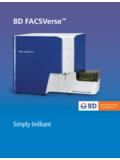
1 A comprehensive solution for rapid enumeration of microbesBD FACSM icroCount3 The BD FACSM icroCount system offers a comprehensive solution for rapid enumeration of microbes. The integrated system consists of an instrument and reagents to support quality manufacturing FACSM icroCount SolutionThe BD FACSM icroCount system can provide results in minutes instead of days for most samples. It detects a wide range of microorganisms including bacteria, yeast, mold, spirochetes, Mycoplasma, and parasite cysts. Test results show excellent correlation with traditional methods. Designed for ease of use, the system automatically adds up to three reagents to the sample, mixes, and performs qualitative (pass/fail) and quantitative (counts/mL) this degree of automation, the BD FACSM icroCount system provides greater consistency than traditional test methods by eliminating manual steps that can lead to variable results.
2 The system enables organizations to achieve new levels of operational efficiency and continuous manufacturing process improvements, including reduced production cycle times and inventory levels, and improved warehouse utilization. The system also enables a swift, cost-effective response to contamination events. The BD FACSM icroCount system can address quality testing requirements for manufacturers of pharmaceutical products, personal care products, beverages and probiotics, as well as home cleaning products. BD training, technical application support, and field service teams are dedicated to helping customers achieve optimal instrument performance, ease of use, and streamlined workflow. Available to advise on a variety of quality testing requirements, the BD support teams are fully committed to the success and satisfaction of their BD FACSM icroCount flow cytometer uses sophisticated fluidics, laser optics, electronic detectors, analog-to-digital converters, and a dedicated computer to measure microbes in a variety of matrices.
3 An equal level of sophistication and attention to detail is designed into the user interface and software to make the BD FACSM icroCount simple to use. The instrument can be set up to measure microbes using pre-defined tests or user-defined assays. Four predefined methods in the BD FACSM icroCount software automate testing of performance standards, E. coli, product screening, and in-process water tests. The system automates sample processing by programming sample injection, reagent additions, mixing, and data collection parameters. Predefined methods can be optimized to fit unique manufacturer requirements and standard operating procedures. The BD FACSM icroCount cytometer can load up to 42 samples at a time from four sample trays. Both trays and tray blocks are magnetized so that trays are automatically detected when loaded in the instrument. Samples are prepared for analysis by labeling microbes with a nucleic acid specific fluorescent dye.
4 The patented BRAG3* labeling compound is used in conjunction with the nucleic acid dye as a viability stain. It decreases fluorescence intensity of membrane-compromised cells and diminishes background counts due to extraneous Delivers Rapid and Consistent Results *Dependent on selected method parametersProduct ScreeningWater AnalysisMicrofermentationAssay FormatQualitativeQuantitativeQuantitativ eSample mL default Variable volume mLVariable volume mLThroughput/Hour20 samples12 15 samples12 15 samples*ReagentsUp to 2Up to 3Up to 3 Reagent Volumes200 LNucleic Acid Dye100 L BRAG3100 LNucleic Acid Dye100 L BRAG3 Buffer, 100 LVariable ranges method specified*Reaction Time/Reagent90 seconds175 secondsMethod specified*How the system works*US Patent 7, 205,100*Using the BD FACSM icroCount, most personal care, OTC pharmaceuticals, and household cleansers take 24 hours.
5 Exception: toothpaste (30 hours), fiber capsules (48 hours).ApplicationTime to Result BD FACSM icroCountProduct Screening*24 hoursWater Screening5 minutesDirect Swab/Environmental5 minutesDirect EnumerationUnder 8 minutesBioburdenUnder 10 minutes55 EASE OF USEF igure A-1 Hydrodynamic focusing of t he s ample core t hrough the flow cellSheathFluidSheathFluidLaser BeamSampleThe BD FACSM icroCount system reduces the time to result over traditional methods, yielding reductions in production cycles and cost savings. These time savings can translate directly to additional savings from reductions in inventory and warehouse BD FACSM icroCount system has 3 standard sample trays that load up to 12 samples and fit into positions 2, 3, or 4 of the tray block. The other tray can load up to 6 samples and fits into position 1 of the tray block. This tray can be used for priority ports dispense up to three reagents as specified in predefined or custom-designed software setups.
6 Hydrodynamic Focusing of the Sample Core through the Flow CellHydrodynamic focusing guides the microbes in a single-file stream to intercept the laser beam. Once the microbes pass through the laser beam, the optics system collects fluorescence and side scatter information and the data is displayed in real time as an intensity plot or counts/mL. ANALYSIS6 The BD FACSM icroCount system handles up to 20 samples per hour for qualitative analysis (presence/absence) and up to 15 samples per hour for quantitative analysis ( enumeration ). Unlike other systems, the BD FACSM icroCount can count live or dead cells, which can be valuable in fermentation BD FACSM icroCount software creates an electronic record of each sample, identifying it by date and end time. Data can be evaluated for individual samples or compared to other data sets. Results can be viewed in graphical or tabular data displays to speed analysis.
7 Graphical displays include intensity, fluorescence, side scatter, and counts vs. time. Data analysis can be performed while the instrument is running new Sample Analysis for Qualitative and Quantitative ResultsHow the system worksTypes of Microorganisms Gram-positive bacteria Gram-negative bacteria Mycoplasmas Spirochetes Anaerobes Spores bacterial and mold Parasite cysts Filamentous bacteria, yeasts, and moldMicroorganisms Enumerated Aeromonas caviae Aeromonas hydrophila Aspergillus niger spores Bacillus atrophaeus Bacillus atrophaeus spores Bacillus pumilus Bacillus pumilus spores Bacillus subtilis Bacillus subtilis spores Bordetella bronchiseptica Brachyspira hyodysenteriae Burkholderia cepacia Campylobacter jejuni Candida albicans Candida glabrata Citrobacter freundii Clostridium perfringens Cryptococcus spp.
8 Cryptosporidium parvum oocysts Enterobacter aerogenes Enterobacter cloacae Enterococcus casseliflavus Enterococcus durans Enterococcus faecium Enterococcus faecalis Enterococcus gallinarum Enterococcus hirae Enterococcus mundtii Erysipelothrix rhusiopathiae Escherichia coli Escherichia coli O157:H7 Escherichia coli O25:HN Escherichia coli O15:NM Escherichia coli O1:NM Escherichia coli O7:NM Escherichia coli O78:NM Escherichia coli ON:H8 Escherichia coli ON:NM Escherichia coli O8:HN7 7A robotic arm moves samples and syringes inside the instrument. A pneumatic gripper on the arm, controlled by a pneumatic air line, holds samples and syringes. A vortexer, located to the back of the instrument, mixes samples. Geobacillus stearothermophilus Geobacillus stearothermophilus spores Giardia lamblia cysts Haemophilus parasuis Haemophilus somnus Halobacterium salinarum Klebsiella pneumoniae Lactobacillus acidophilus Lactobacillus casei Lactobacillus delbrueckii Lactobacillus lindneri Lactobacillus plantarum Lactococcus lactis Lawsonia intracellularis Leptospira pomona Listeria grayi Listeria innocua Listeria ivanovii Listeria monocytogenes Listeria seeligeri Listeria welshimeri Micrococcus candicans Micrococcus luteus Moraxella bovis Mycoplasma bovis Mycoplasma hyopneumoniae Nannocystis exedens Oxalobacter formigenes Pantoea agglomerans Pasteurella multocida Pediococcus acidilactici Pediococcus damnosus Proteus mirabilis Pseudomonas aeruginosa Pseudomonas fluorescens Pseudomonas
9 Putida Ralstonia pickettii Raoutella terrigena Saccharomyces cerevisiae Salmonella adelaide Salmonella anatum Salmonella choleraesuis Salmonella dublin Salmonella enteriditis Salmonella hadar Salmonella heidelberg Salmonella iverness Salmonella schalwijk Salmonella typhimurium Salmonella worthington Serratia marcescens Shigella boydii Staphylococcus aureus Staphylococcus epidermidis Staphylococcus saprophyticus Stenotrophomonas maltophila Streptococcus bovis Streptococcus equinus Streptococcus pyogenes Tsukamurella paurometabola8 The BD FACSM icroCount reliably screens raw material and finished products for microbial contamination to help manufacturers monitor product quality. By delivering pass/fail results for the presence or absence of microbial contamination within 24 to 48 hours, the system offers significant benefits over traditional methods that typically require holding raw materials in quarantine for several days.
10 The BD FACSM icroCount system can screen bacteria, yeast, and mold in a single test with results that correlate with traditional plating methods. This application uses the BD FACSM icroCount Product Screening Media Kit to enrich the sample with bacteria, yeast, and mold for rapid growth. In traditional plating methods, bacteria screening is separate from the screening for mold and yeast. Thus, the extra speed of the BD FACSM icroCount method offers additional time savings. The qualitative product screening application uses a defined method to increase output to 20 samples per hour, the fastest operating mode of the system. This application employs a default sample volume of mL and uses only two reagents for reaction times of approximately 90 seconds per reagent, allowing preparation of multiple samples at screening cuts the time needed to release products, which directly translates to savings from reduced manufacturing cycle times and inventory levels, and improved warehouse utilization.