Transcription of Before, During, and After Reading Strategies
1 1 CCRS Reading Anchor 1: Read closely to determine whatthe text says explicitly and to make logical inferences from it; cite specific textual evidence when writing or speaking to support conclusions drawn from the text. Reading Achor 2: Determine central ideas or themes of a textand analyze their development; summarize the key supporting details and Predictors of Later Success Reading readiness: usually a combination of alphabetknowledge, concepts of print, vocabulary, and phonological awareness Concepts about print: knowledge of print conventions ( , left right, front back) and concepts(book cover, author, text) Oral language: the ability to produce or comprehend spoken language, including vocabularyand grammarObjective: At the end of this session, participants will be able to Share two before Strategies to use with their children Share two Strategies to use while Reading with their children Share two After or follow-up Strategies to use with their childrenMaterials.
2 Chart paper and markers Appropriate books for the age level of children Copies of before , during , and After Reading Strategies chart handout Copies of Reading Aloud to Infants/Toddlers parent handout Copies of Reading Aloud to Preschoolers parent handout Copies of Reading Strategies for All ChildrenWelcome/Ice Breaker: Greet parents as they come in. Build rapport and break the ice. Make three columns on chart paper, and/or pass out the before , during , and After ReadingStrategies , during , and After Reading StrategiesWorkshop Topic:PARENT EDUCATION WORKSHOPS2 Say, before you came to school today (or this Parent Time, or Parent Workshop) what did youhave to do to get ready? (chart responses on chart paper, or have parents jot responses on theirown paper) Continue with, Now that you are here, what kinds of things are we doing?
3 (chart/jot thoseresponses as well) And finally, when we finish here today, what will you do? (besides go home!)Help parents understand that there is a cycle to so many things that we do. We plan or prepare, we do things, and we reflect or wrap-up when we are finished. Reading is like that as well. Let s think about the Strategies we use before , during , and After Review: What we know about meaningful parent-child interactions and Reading : Parents benefit from information about children s Reading development to help children reach thedesired outcomes and attain school success. Parents benefit from guidance and support about Reading Strategies so they can be intentional withtheir interactions with children at home and in their everyday lives.
4 Parents benefit from experiences that provide the time to practice Reading Strategies and maketime for meaningful interactions daily. As parents skill levels increase, so does the likelihood of children s Activity: Meaningful interactions for parents and children when Reading require some intentional planning and knowledge of Reading Strategies . These Strategies can vary across the age groups. The before , during , and After Strategies are a bank of Strategies to be used in specific ways to help support Reading Ideas and Practice (Content and Strategies ): Help parents plan before Reading with children, no matter the age of the child. Here are some ideas and Strategies to help parents plan before Reading with children: When Reading books with lots of new and novel words, tell parents it s great to look up those wordsin a dictionary or research them online, so they can talk about the words with children and explaintheir meaning.
5 This helps both parents and children expand their vocabulary. Parents who are taking adult education classes can practice Reading new children s books aloud toeach other in the adult education classroom with their peers. When adults read children s books tolearn how to better read to their children, they are often more engaged in the Reading process. For parents with low literacy skills, encourage them to tell the story orally, rather than read. Theycan look at the pictures and talk about what they see. Parents learning English can make up storiesby the pictures and share them with their children in their home language. Model Reading for children. Encourage parents to let their children see them Reading books, thenewspaper, magazines, and the mail every day.
6 This will help children understand that Reading is apart of our everyday s face it, with infants, toddlers, and preschoolers, what happens before , during , and After Reading is generally facilitated by the parents. With elementary children and older, the child is actively involved with the Reading and Strategies . It is important for parents to understand these Strategies for the older child so that they can support the child at home with Reading assignments and homework. Infant/Toddler Content or StrategiesInfants enjoy books with bright pictures, like faces, animals, and familiar objects. Books with simplewords are best for short attention spans. Toddlers enjoy books about people and everyday life, andunderstand books with pictures and some print.
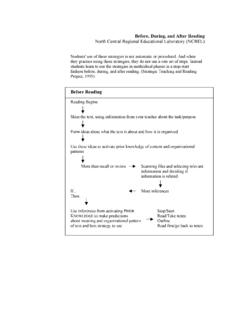
7 Both infants and toddlers learn best when they3can handle books, so choose board, cloth, or books with plastic pages. Children this age also enjoy books with textures to feel, flaps to lift, and the like. See the handout: Reading Aloud to Infants/Toddlers for specific Strategies Preschool Content or Strategies Preschoolers enjoy books of all genres, but they particularly like story books with great illustrations. Choose books for preschoolers that provide topics to talk about whether it s the story or the pictures! When using dialogic Reading Strategies with preschoolers, it helps if parents plan. See the handout: Reading Aloud to Preschoolers Elementary/Middle School Content or Strategies Some before , during , and After (BDA) Strategies for older children include ideas like the following: before Reading Preview the Reading material Make connections to information you already have or know Make a prediction of what will be covered in the Reading Ask questions what do you want to know about this?
8 during Check your knowledge What connections have you made? Do you have additional predictions? More questions? Make inferences Summarize what you ve readAfter Evaluate Make further connections Predict what might happen now Are your questions answered? What else? Make inferences Summarize and recall the main pointsSee the handout: Reading Strategies for Older Children. Also check out these additional BDA Strategies located on the Pennsylvania Department of Education website: Language Arts/ before during After Reading :Provide a selection of children s books for parents. Perhaps provide books that are relevant for the ages of children in the families.
9 Have parents choose a book and then using the before , during , and After Reading Strategies handout and the relevant parent handouts for their children s ages, choose and practice some of the Strategies with a partner. You may want to model or demonstrate some of these Strategies for the parents as you to Parent and Child Together (PACT) Time : Infant/Toddler Content or Strategies Read aloud daily. Choose one or two new Strategies from the parent handout to try out with your child each week. Practice them until they are second nature. Preschool Content or Strategies Start engaging your child with the book and the Strategies that you choose to use. As children grow older, allow them to take over some of the before , during , and After responsibilities.
10 Prompt preschoolers with open-ended questions to spark their curiosity and wonder. Provide props and extension activities to move the ideas of the story beyond the book. For example, After Reading the book Bunny Cakes, perhaps make a cake with your child using gummy worms and licorice. School-Age/Middle School Connections As a parent, become comfortable and familiar with two to three BDA Strategies and use them to help support the child during homework or at-home Reading assignments. Use the Strategies in other parts of your day with children, too, for solving problems or planning events or up/Closure: Ask parents what two Strategies they will try this the information about before , during , and After strategiesWhat else do parents need to know about this topic?