Transcription of BEGINNER NOVICE OPTIONAL TITLING CLASS
1 BEGINNER NOVICE OPTIONAL TITLING CLASS (effective July 1, 2010) Section 1. BEGINNER NOVICE CLASS . The BEGINNER NOVICE CLASS shall be for dogs that have not won the BN title. The BEGINNER NOVICE CLASS is an OPTIONAL TITLING CLASS that may be offered by clubs at obedience events. Judges for this CLASS must be approved to judge NOVICE or higher classes. If eligible as defined in these regulations, dogs entered in BEGINNER NOVICE A or BEGINNER NOVICE B may also be entered in any other obedience classes. Section 2. BEGINNER NOVICE A CLASS . To be eligible for BEGINNER NOVICE A, a handler must own the dog entered, or be a member of the owner s household or immediate family, and may not have previously handled any dog that has earned any AKC Obedience title.
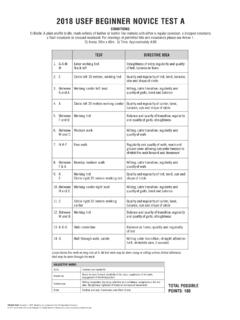
2 Owners may enter more than one dog in this CLASS . No dog may be entered in both BEGINNER NOVICE A and BEGINNER NOVICE B at any trial. BEGINNER NOVICE B CLASS . The owner or any other person may handle dogs in this CLASS to earn a BN title. Owners may enter more than one dog in this CLASS . No dog may be entered in both BEGINNER NOVICE A and BEGINNER NOVICE B at any trial. Section 3. BEGINNER NOVICE Exercises and Scores. The exercises and maximum scores in the BEGINNER NOVICE classes: 1. Heel on Leash 40 points 2. Figure Eight 40 points 3. Sit for Exam 40 points 4. Sit Stay 40 points 5.
3 Recall 40 points Maximum Total Score 200 points Section 4. BEGINNER NOVICE Title. The letters BN may be added after the name of each dog that has been certified by two different judges to have received qualifying scores in BEGINNER NOVICE classes at three licensed or member obedience trials. That dog will receive a BEGINNER NOVICE certificate from the AKC. Suggested judging rate of ten dogs per hour. Section 5. Heel on Leash. The principal feature of this exercise is the ability of the dog and handler to work as a team. The orders for this exercise will be Forward and Exercise Finished.
4 Rally signs will be used for this exercise. Signs to be used are Right turn, Left turn, About turn, Slow, Normal, Fast and Halt/Sit. Fast 43 Obedience Regulations means that the handler must run, and the handler and dog must move forward at a noticeably accelerated speed. Turns will be used only when the handler is moving at a normal speed. Both change of pace signs must be followed by a normal sign. Turn signs may be placed in any sequence and may be repeated. Two of each turn sign must be available for the judge s use. The Halt/Sit sign will be used once at the end of the exercise.
5 The judge should standardize the heeling pattern for all dogs in the CLASS . The leash may be held in either hand or in both hands, but the hands must be held in a natural position. Any tightening or jerking of the leash and use of any extra commands and/or signals will be penalized. The handler will enter the ring with the dog on a loose leash and stand with the dog sitting in the heel position. The judge will ask if the handler is ready before giving the order, Forward. The handler may give a command or signal to heel and will walk briskly and naturally with the dog on a loose leash.
6 The dog should walk close to the handler s left side without swinging wide, lagging, forging, or crowding. The dog must not interfere with the handler s freedom of motion at any time. At the Halt/Sit sign, the handler will stop. The dog shall sit straight and promptly in the heel position without command or signal and shall not move until the handler again moves forward. The judge will order, Exercise finished at the completion of this exercise. Section 6. Heel on Leash, Scoring. If a handler is constantly controlling the dog by tugging on the leash, constantly talking to the dog or is adapting to the dog s pace, that dog must receive a non-qualifying (NQ) score for this exercise.
7 Minor deductions shall be made for lagging, heeling wide, forging, crowding, poor sits, failure to sit at a halt, and other heeling imperfections. Deductions should also be made for a handler who guides the dog with the leash or does not walk at a brisk pace. A one time single phrase of praise or encouragement, by the handler to the dog, will be allowed without penalty. (Good, yes, nice, super, great, and atta boy/girl, are some examples of praise that would be allowed.) Minor deductions will be made for additional commands or signals to heel or for failure of dog or handler to speed up noticeably for the fast or slow down noticeably for the slow.
8 While scoring this exercise, the judge should be near enough to observe any signals or commands given by the handler to the dog without interfering with either. Section 7. Figure Eight. The principal feature of this exercise is the ability of the dog and handler to work as a team. The orders for this exercise are: Forward, Halt, and Exercise Finished. 44 Obedience Regulations For the Figure Eight, the handler will stand and the dog will sit in heel position facing the judge, midway between the two stewards, who will be standing 8 feet apart. The Figure Eight will be performed on leash; the handler may go around either steward first.
9 After the judge asks, Are you ready? and gives the order, Forward, the handler and dog will walk briskly around and between the two stewards twice. There will be no about turn, fast or slow, but the judge must order at least one halt during this exercise and another halt at the end. After each halt, it is permissible for the handler to give a command or signal to heel before moving forward again. A one time single phrase of praise or encouragement, by the handler to the dog, will be allowed without penalty. Section 8. Figure Eight, Scoring. Scoring is the same as the Heel on Leash exercise.
10 Section 9. Sit For Exam. The principal feature of this exercise is that the dog sits in position before and during the examination without displaying resentment. Orders are: Sit your dog and leave when you are ready, Back to your dog and Exercise finished. This exercise is to be performed with the dog on a 6 foot leash. On the judge s order, the handler will command the dog to sit. The handler will then stand with the dog sitting in the heel position, give the command and/or signal to stay, walk straight forward about 6 feet to the end of the leash, turn and face the dog.