Transcription of Behavioral Interview Questions - Wayne State …
1 Career Services Wayne State University 1001 F/AB Behavioral Interview Techniques The STAR Approach Situation or Task Describe the situation that you were in or the task that you needed to accomplish. You must describe a specific event or situation, not a generalized description of what you have done in the past. Be sure to give enough detail for the interviewer to understand. This situation can be from a previous job, from a volunteer experience, or any relevant event. Action you took Describe the action you took and be sure to keep the focus on you. Even if you are discussing a group project or effort, describe what you did -- not the efforts of the team.
2 Don't tell what you might do, tell what you did. Results you achieved What happened? How did the event end? What did you accomplish? What did you learn? Use examples from internships, classes and school projects, activities, team participation, community service, hobbies and work experience -- anything really -- as examples of your past behavior. In addition, you may use examples of special accomplishments, whether personal or professional, such as scoring the winning touchdown, being elected president of your Greek organization, winning a prize for your artwork, surfing a big wave, or raising money for charity.
3 Wherever possible, quantify your results. Numbers always impress employers. Remember that many Behavioral Questions try to get at how you responded to negative situations; you'll need to have examples of negative experiences ready, but try to choose negative experiences that you made the best of or -- better yet, those that had positive outcomes. Here's a good way to prepare for behavior-based interviews: Identify six to eight examples from your past experience where you demonstrated top behaviors and skills that employers typically seek. Think in terms of examples that will exploit your top selling points.
4 Half your examples should be totally positive, such as accomplishments or meeting goals. The other half should be situations that started out negatively but either ended positively or you made the best of the outcome. Vary your examples; don't take them all from just one area of your life. Use fairly recent examples. If you're a college student, examples from high school may be too long ago. Accenture, in fact, specifies that candidates give examples of behaviors demonstrated within the last year. Try to describe examples in story form and/or PAR/SAR/STAR.
5 To cram for a Behavioral Interview right before you're interviewed, review your resume. Seeing your achievements in print will jog your memory. In the Interview , listen carefully to each question , and pull an example out of your bag of tricks that provides an appropriate description of how you demonstrated the desired behavior. With practice, you can learn to tailor a relatively small set of examples to respond to a number of different Behavioral Questions . Career Services Wayne State University 1001 F/AB How to Behave in a Behavior-Based Interview Lombardi, who earned a master's degree in industrial organizational psychology from West Chester University, wrote his thesis on behavior-based interviewing.
6 Now he's a college relations specialist at Kulicke & Soffa Industries Inc., based in Willow Grove, Pennsylvania, and he says his background has helped him understand an interviewing technique that has become increasingly popular and, according to both his research and popular opinion, more effective than traditional techniques. "It seemed like the more structure and the more thought that was put into an Interview , the better it was," he says. Lombardi says behavior-based Questions are generally designed to determine if a candidate possesses certain "key competencies.
7 " "When I start any Behavioral Interview , I explain the process," Lombardi says. "I say, 'I'm going to be asking you for specific examples. I will be asking you for details, including names of people, dates, and outcomes.' I really like talking to people about lengthy projects they've had to do--how their role evolved, how they handled time deadlines, pressures, and unexpected situations, and especially how they handled any 's got that kind of experience." Lombardi says that the best way for students and new graduates to prepare for a behavior-based Interview is to dig up old research papers, to think hard about any difficulties encountered in summer and part-time jobs, and to recount the steps it took to successfully complete school projects and projects that were part of internships or co-ops.
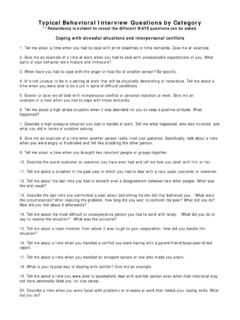
8 "What I would recommend is for them to just kind of think through situations that have occurred, projects they've worked on, specific experiences they've had," he says. "They should be able to talk about that in detail and be very specific. They should reread that term lot of it is just common sense." Following is a list of typical behavior-based Questions , courtesy of Lombardi and The Ultimate Job Search Kit by Damir Joseph Stimac. Competencies sought by the interviewer are listed in parentheses: 1. Describe a situation in which you had to use reference materials to write a research paper.
9 What was the topic? What journals did you read? (research/written communication) 2. Give me a specific example of a time when a co-worker or classmate criticized your work in front of others. How did you respond? How has that event shaped the way you communicate with others? (oral communication. 3. Give me a specific example of a time when you sold your supervisor or professor on an idea or concept. How did you proceed? What was the result? (assertiveness) 4. Describe the system you use for keeping track of multiple projects. How do you track your progress so that you can meet deadlines?)
10 How do you stay focused? (commitment to task) 5. Tell me about a time when you came up with an innovative solution to a challenge your company or class was facing. What was the challenge? What role did others play? (creativity and imagination) 6. Describe a specific problem you solved for your employer or professor. How did you approach the problem? What role did others play? What was the outcome? (decision making) 7. Describe a time when you got co-workers or classmates who dislike each other to work together. How did you accomplish this? What was the outcome?