Transcription of Benign Paroxysmal DISORDERS Positional Vertigo (BPPV)
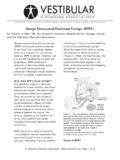
1 :: 08 / DISORDERS1 WHAT IS bppv ? Benign Paroxysmal Positional Vertigo (or bppv ) is the most common cause of Vertigo , a false sensation of spinning. 1 Benign it is not life-threatening Paroxysmal it comes in sudden, brief spells Positional it gets triggered by certain head positions or movements Vertigo a false sense of rotational movement DISORDERS5018 NE 15th Ave. Portland, OR 97211 1-800-837-8428 CRYSTALSWhen otoconia get out of place, you experience spinning Vertigo . DID THIS ARTICLE HELP YOU?SUPPORT VEDA @ Paroxysmal Positional Vertigo ( bppv )By Sheelah Woodhouse, BScPTFig.
2 1: Inner ear anatomy. Otoconia migrate from the utricle, most commonly settling in the posterior semicircular canal (shown), or more rarely in the anterior or horizontal semicircular canals. The detached otoconia shift when the head moves, stimulating the cupula to send false signals to the brain that create a sensation of Vertigo . Vestibular DISORDERS Association. Image adapted by VeDA with permission from T. C. :: 08 / DISORDERS2 WHAT HAPPENS DURING A bppv EPISODE? bppv is a mechanical problem in the inner ear. It occurs when some of the calcium carbonate crystals (otoconia) that are normally embedded in gel in the utricle become dislodged and migrate into one or more of the 3 fluid-filled semicircular canals, where they are not supposed to be.
3 When enough of these particles accumulate in one of the canals they interfere with the normal fluid movement that these canals use to sense head motion, causing the inner ear to send false signals to the in the semi-circular canals does not normally react to gravity. However, the crystals do move with gravity, thereby moving the fluid when it normally would be still. When the fluid moves, nerve endings in the canal are excited and send a message to the brain that the head is moving, even though it isn t. This false information does not match with what the other ear is sensing, with what the eyes are seeing, or with what the muscles and joints are doing, and this mismatched information is perceived by the brain as a spinning sensation, or Vertigo , which normally lasts less than one minute.
4 Between Vertigo spells some people feel symptom-free, while others feel a mild sense of imbalance or disequilibrium. It is important to know that bppv will NOT give you constant dizziness that is unaffected by movement or a change in position. It will NOT affect your hearing or produce fainting, headache or neurological symptoms such as numbness, pins and needles, trouble speaking or trouble coordinating your movements. If you have any of these additional symptoms, tell your healthcare provider immediately. Other DISORDERS may be initially misdiagnosed as bppv .
5 By alerting your healthcare provider to symptoms you are experiencing in addition to Vertigo they can re-evaluate your condition and consider whether you may have another type of disorder, either instead of or in addition to IS AFFECTED? bppv is fairly common, with an estimated incidence of 107 per 100,000 per year 2 and a lifetime prevalence of percent 3. It is thought to be extremely rare in children but can affect adults of any age, especially seniors. The vast majority of cases occur for no apparent reason, with many people describing that they simply went to get out of bed one morning and the room started to spin.
6 However associations have been made with trauma, migraine, inner ear infection or disease, diabetes, osteoporosis, intubation (presumably due to prolonged time lying in bed) and reduced blood flow. There may also be a correlation with one s preferred sleep side 4. WHERE SHOULD I SEEK HELP?Your family doctor may suspect bppv from the symptoms you are describing, since it is very commonly triggered by things like rolling over in bed, getting in and out of bed, tipping the head to look upward, bending over, and quick head movements.
7 However, they may or may not be familiar with the testing or treatment of bppv , or may only be familiar with management of the most common form of bppv but not the rarer variants. General practitioners typically refer patients to a medical professional specifically trained to deal with vestibular DISORDERS , most commonly a vestibular rehabilitation therapist (typically a specially trained physical therapist, but occasionally an occupational therapist or audiologist) or an ENT (ear, nose & throat specialist) who focuses on vestibular DISORDERS .
8 Sadly, some doctors are not aware that highly effective treatment is available and tell patients that they just have to live with the condition and hope that it reduces or resolves on its own, which is not in line with best practice IS IT DIAGNOSED?Normal medical imaging ( an MRI) is not effective in diagnosing bppv , because it does not show the crystals that have moved into the semi-circular canals. However, when someone with bppv has their head moved into a position that makes the dislodged crystals move within a canal, the error signals cause the eyes to move in a very specific pattern, called nystagmus.
9 The relationship between the inner ears and the eye muscles are what normally allow us to stay focused on our environment while the head is moving. Since the dislodged crystals make the brain think a person is moving when they re not, it mistakenly causes the eyes to move, which makes it look like the room is spinning. The eye movement is the clue that something must be happening mechanically to move the fluid in the inner ear canals when it shouldn t be. The nystagmus will have different characteristics that allow a trained practitioner to identify which ear the displaced crystals are in, and which canal(s) they have moved into.
10 Tests like the Dix-Hallpike :: 08 / DISORDERS3or Roll Tests involve moving the head into specific orientations, which allow gravity to move the dislodged crystals and trigger the Vertigo while the practitioner watches for the tell-tale eye movements, or are two types of bppv : one where the loose crystals can move freely in the fluid of the canal (canalithiasis), and, more rarely, one where the crystals are thought to be hung up on the bundle of nerves that sense the fluid movement (cupulolithiasis). With canalithiasis, it takes less than a minute for the crystals to stop moving after a particular change in head position has triggered a spin.