Transcription of Bio 102 Practice Problems Mendelian Genetics and Extensions
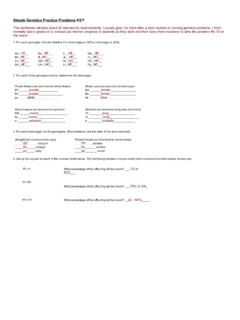
1 Bio 102 Practice Problems Mendelian Genetics and Extensions Short answer (show your work or thinking to get partial credit): 1. In peas, tall is dominant over dwarf. If a plant homozygous for tall is crossed with one homozygous for dwarf: a. What will be the appearance (phenotype) of the F1 plants ? T=tall, t=dwarf F1: all tall (Tt) b. What will be the phenotypes of the F2, and what fraction of the offspring will have each phenotype? F2 will be tall (TT and Tt) and dwarf (tt) c. What will be the phenotypes and fractions if an F1 plant is crossed with its tall parent? This cross is now Tt TT, so offspring are all tall but TT and Tt d. What will be the phenotypes and fractions if an F1 plant is crossed with its short parent? This cross is Tt tt, so offspring are tall (Tt) and dwarf (tt) 2. A tall plant crossed with a dwarf one produces offspring, of which about half are tall and half are dwarf.
2 What are the genotypes of the two parents? We know that the dwarf parent is tt. If the tall parent were TT, all the offspring would be tall (Tt). So, the tall parent must be Tt, giving the cross Tt tt and Tt and tt offspring. 3. If the tall parent in problem #3 is , what is the probability that the first offspring will be tall? This cross is Tt Tt, so of the offspring should be tall. For any one offspring, the probability of being tall is therefore 3 in 4 or 75%. 4. In cattle, hornless (called "polled," represented by P) is dominant over horned (p). A polled bull is bred to three cows, A, B and C. Which cow A, which is horned, a polled calf is produced. With cow B, also horned, a horned calf is produced. Wich cow C, which is polled, a horned calf is produced. a. What are the genotypes of the four parents (cows A, B, C and the bull)?
3 Cows A and B are horned, and horned is a recessive trait, so they must both be homozygous recessive, pp. The bull is horned, but is capable of producing a horned calf (with cow B), so we know he can't be homozygous dominant. Therefore, he must be heterozygous, Pp. Cow C is polled but is capable of producing a horned calf, so she also must have a p allele and be heterozygous, Pp. So, Bull = Pp, Cow A = pp, Cow B = pp, Cow C = Pp b. If a large number of offspring could be obtained from each mating, what would you expect the phenotypes of the offspring to be, and in what ratios? Crosses A and B are the same: Pp pp, expect polled (Pp) and horned (pp) Cross C: Pp Pp, expect polled (PP and Pp) and horned (pp) 5. Two black female mice are crossed with a brown male. In several litters, female #1 produced 9 black offspring and 7 browns.
4 Female #2 produced 57 blacks. a. What can you determine about the inheritance of black and brown coat color from these data? Black must be dominant, because not one of the 57 offspring of female #2 showed the brown trait, which is pretty unlikely if brown is dominant (even if the brown male is heterozygous). b. What are the genotypes of the parents? Female #2 is likely to be homozygous dominant (BB), so that when mated to a homozygous recessive male (bb), all the offspring are black (Bb). Female #1 is likely to be heterozygous (Bb), so that when mated to a homozygous recessive male (bb), about half the offspring are black (Bb) and half are brown (bb). 6. In guinea pigs, rough coat (R) is dominant over smooth (r), and black coat (B) is dominant over white (b). If a rough black animal is crossed with a smooth white one: a. What will be the appearance of the F1 progeny?
5 The F2? The rough black animal is RRBB; the smooth white is rrbb. The F1 will therefore be all RrBb, all rough and black. The F2 cross is RrBb RrBb, so in the offspring we expect: 9/16 rough and black (RRBB, RrBB, RRBb and RrBb) 3/16 rough and white (RRbb and Rrbb) 3/16 smooth and black (rrBB and rrBb) 1/16 smooth and white (rrbb) b. What will be the offspring of a cross between the F1 and the rough black parent? This cross is RrBb RRBB; every ofspring will get at least one R and one B, so all will be rough and black ( RRBB, RrBB, RRBb, RrBb) c. What will be the offspring of a cross between the F1 and the smooth white parent? This cross is RrBb rrbb, so we expect: RrBb, rough black Rrbb, rough white rrBb, smooth black rrbb, smooth white 7. In the F2 generation in problem #10, what proportion of the rough black offspring would be homozygous for both genes?
6 Just as there is only one way to get a double homozygous recessive (rb gamete meets rb gamete), there is only one way to get a double homozygous dominant (RB gamete meets RB gamete). So, only 1/16 of the total offspring will be homozygous dominant for both genes, or 1/9 of the rough black offspring. 8. A rough black guinea pig bred with a rough white one gives 28 rough black, 31 rough white, 11 smooth black and 10 smooth white. What are the genotypes of the parents? Notice that there are 59 total rough and 21 total smooth, about 3:1; there are 39 total black and 41 total white, about 1:1. Therefore, it is likely that for rough/smooth, the cross is Rr Rr ( rough, smooth), and for black/white, it is Bb bb ( black, white). Putting these together, the parents are RrBb Rrbb 9. Two rough black guinea pigs bred together have two offspring: one rough white and one smooth black.
7 If these parents had more offspring, what phenotypes and proportions would you expect? Since these animals have the dominant black and rought traits but can have white and smooth offspring, both must be heterozygous for both genes. Therefore, the cross is RrBb RrBb and 9/16 rough black, 3/16 rough white, 3/16 smooth black and 1/16 smooth white are expected. 10. In humans, spotted skin (S) is dominant to (s), and woolly hair (W) is dominant to (w). List the genotypes and phenotypes of children to be expected from a marriage of a man whose genotype is Ssww and a woman whose genotype is ssWw. Ssww ssWw should give SsWw (spotted, woolly), Ssww (spotted, ), ssWw ( , woolly), and ssww ( , ) 11. Two fruit flies are mated. They have the following offspring: 140 flies and 48 flies with bright orange eyes. a. Which allele is dominant for the eye color gene: red or orange?
8 This looks very close to the expected results of a monohybrid cross between two heterozygous parents. Very nearly of the offspring are and are This suggests that the flies have the dominant phenotype. b. What were the genotypes of the parents? If R = red (dominant) and r = orange (recessive), then because there are offspring, we know both parents had to have a recessive orange allele to give. Since both of the parents are red, they must both have been heterozygous: Rr. c. Diagram the cross. Rr Rr RR and Rr = red; rr = orange 12. A fruit fly with long (normal) wings and red eyes is crossed with one that has short wings and brown eyes. Both of these parents are from lines. Two of their offspring are then crossed, and the F2 generation is as follows: 45 brown, long 16 brown, short 139 red, long 51 red, short a.
9 Based on this information, is there one gene that controls both eye color and wing length, or are these two traits due to two separate genes? There must be two separate genes. If only one gene produced both long wings and red eyes, then we'd always find red and long together. This is not the case: the traits seem to follow the law of independent assortment, so there must be two separate genes. b. Which alleles are dominant? This looks like a typical dihybrid cross (9:3:3:1). The red, long flies are very nearly 9/16 of the total, so red is dominant over brown and long is dominant over short. c. What were the genotypes of the parents? The original parents were (homozygous), so if R=red and r=brown, and L=long and l=short, then the parents must have been RRLL (red, long) and rrll (brown, short). d. Would the results have been different if one parent were red, short and the other brown, long (assuming they were still ) Now, the genotypes would have to be RRll (red, short) and rrLL (brown, long).
10 BUT, the F1 would still be heterozygous for both genes: RrLl! So the F1 and F2 crosses would still come out the same. 13. A pea plant with wrinkled yellow seeds is crossed with one that has round, green seeds. One of the F1 offspring is tescrossed with a wrinkled, green plant. What fraction of their offspring should have round, yellow seeds? Round and yellow are the dominant traits, so let R=round, r=wrinkled and Y=yellow, y=green. Now, the parents must have been rrYY (wrinkled, yellow) and RRyy (round green). Their F1 offspring will be RrYy and have the round, green phenotype. A testcross is a cross with a homozygous recessive, so the testcross is RrYy rryy. The four gametes produced by the round, green plant will be RY, Ry, rY and ry; the only one that will lead to round, yellow offspring is RY (which when combined with an ry gamete from the tester will give RrYy).