Transcription of Biogeochemical Cycles Webquest
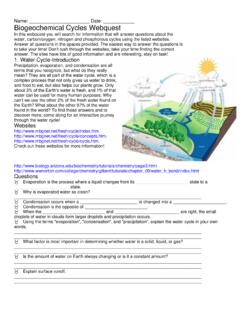
1 Name: _____ Date: _____ Biogeochemical Cycles Webquest In this Webquest you will search for information that will answer questions about the water, carbon/oxygen, nitrogen and phosphorous Cycles using the listed websites. Answer all questions in the spaces provided. The easiest way to answer the questions is to take your time! Don t rush through the websites, take your time finding the correct answer. The sites have lots of good information and are interesting, stay on task! 1. Water cycle Introduction Precipitation, evaporation, and condensation are all terms that you recognize, but what do they really mean? They are all part of the water cycle , which is a complex process that not only gives us water to drink, and food to eat, but also helps our plants grow.
2 Only about 3% of the Earth s water is fresh, and 1% of that water can be used for many human purposes. Why can t we use the other 2% of the fresh water found on the Earth? What about the other 97% of the water found in the world? To find these answers and to discover more, come along for an interactive journey through the water cycle ! Websites Check out these websites for more information! Questions Evaporation is the process where a liquid changes from its _____ state to a _____ state. Why is evaporated water so clean? _____ Condensation occurs when a _____ is changed into a _____. Condensation is the opposite of _____. When the _____ and _____ are right, the small droplets of water in clouds form larger droplets and precipitation occurs.
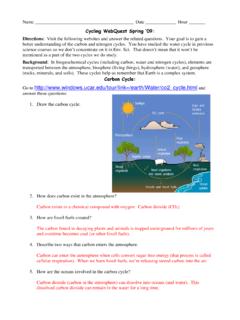
3 Using the terms "evaporation", "condensation", and "precipitation", explain the water cycle in your own words. _____ What factor is most important in determining whether water is a solid, liquid, or gas? _____ Is the amount of water on Earth always changing or is it a constant amount? _____ Explain surface runoff. _____ 2. Carbon/Oxygen cycle Introduction Carbon is an element that is found in all organisms, fossil fuels, soil, the ocean, and the atmosphere. We take part in the carbon cycle by breathing CO2 into the air; autotrophs participate by removing atmospheric CO2 for use in building leaves, stems and other organs through the process of photosynthesis.
4 As we burn more and more fossil fuels, such as oil and coal, we release large amounts of carbon dioxide into the atmosphere-more than can be removed by oceans and photosynthetic organisms. Within the atmosphere, this extra CO2 traps heat. As more CO2 accumulates, the Earth becomes warmer through a process known as the greenhouse effect. Websites Check this website out for more information! Questions Why do plants and other photosynthetic organisms need CO2 from the atmosphere? _____ How can carbon move from land to bodies of water? _____ Describe the way human impact has leads to increased levels of CO2 in the atmosphere. _____ What is the greenhouse effect? _____ How much carbon is stored in the atmosphere as CO2?
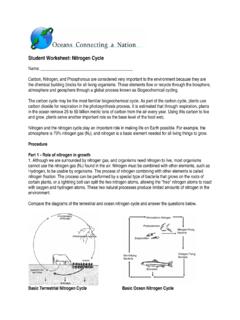
5 _____ What is detritus? _____ How can human use of fossil fuels be detrimental to the environment? _____ Describe one of the many paths a carbon molecule can take through the carbon cycle . _____ 3. nitrogen cycle Introduction The nitrogen cycle represents one of the most important nutrient Cycles found in terrestrial ecosystems. nitrogen is used by living organisms to produce a number of complex organic molecules like amino acids, proteins, and nucleic acids. The majority of nitrogen is found in the atmosphere, where it exists as a gas (mainly N2). Other major reserves of nitrogen include organic matter in soil and the oceans. Despite its large quantity in the atmosphere, nitrogen is often the most limiting nutrient for plant growth.
6 This problem occurs because most plants can only take up nitrogen in two solid forms: ammonium ion (NH4+ ) and the ion nitrate (NO3- ). Specialized bacteria fix nitrogen , converting it to a form that can be used by organisms. By fixing nitrogen , these bacteria are a critical link between atmospheric nitrogen and life on Earth. Websites Check out this website for more information! Questions How is nitrogen important in our lives? _____ Why are nitrogen -fixing bacteria contributions to the nitrogen cycle so important? _____ nitrogen gas makes up _____ of the air we breathe. nitrogen _____ converts _____ to _____ for organisms to use. Another useable form of nitrogen , NH4+ can be converted to _____ by _____ for organisms to use.
7 Plants use both _____ and _____ to incorporate nitrogen into DNA, protein, and other molecules. Explain how animals get their needed amounts of nitrogen . _____ Explain how nitrogen Cycles through the land and ocean ecosystems. _____ How does the human impact of fertilizers impact the nitrogen cycle ? _____ Once in plants and animals, explain how does nitrogen return to the atmosphere? _____ 4. Phosphorous cycle Introduction Phosphorus is an important chemical for plants and animals. It is part of DNA, certain fats in cell membranes, bones, teeth and shell of animals. Phosphorus circulates through water, the Earth's crust, and living organisms. It is not in the atmosphere and is most likely to enter food chains following the slow weathering of rock deposits.
8 Some of the released phosphates become dissolved in soil water which is taken up by plant roots. Phosphorus is therefore the main limiting factor for plant growth in most soils and aquatic ecosystems. Animals obtain phosphorus by eating plants and/or herbivores. Dead organisms and animal wastes return phosphorus to the soil, to streams, and eventually to ocean floors as rock deposits. Websites Check out these websites for more information! Questions Explain why phosphates are a critical part of life. _____ How is the phosphorus cycle different from other Biogeochemical Cycles ? Explain. _____ The largest reservoir of phosphorus is in _____ rock. Explain how phosphorus travels through the cycle from rock to omnivores.
9 _____ Why are excessive concentrations of phosphorus sometimes considered a pollutant? _____ How do humans contribute to these excessive levels of phosphorus? _____ Phosphorus is mainly stored in the _____ _____. How does the soil-based view of the phosphorus cycle compare/contrast with the global-view of the phosphorus cycle ? _____