Transcription of Birkat Kohanim
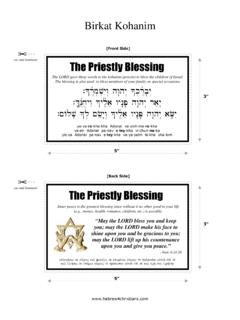
1 Hebrew for Christians by John J. Parsons 1 Birkat Birkat Kohanim - The priestly Blessing Speak to Aaron and his sons: In this way shall you bless the people of Israel. - Numbers 6:23 THE priestly BLESSING is found in Numbers 6:23-27. Traditionally, the priests blessed the people every morning after the sacrifice at the Temple. Today, many synagogues end their service with this blessing as a benediction. When recited, the kohen (priest) raises his hands with the palms facing outward and the thumbs of his outspread hands touching.
2 The four fingers on each hand are split into two sets of two fingers each (thus forming the letter Shin, an emblem for Shaddai): Note that the LORD does not command the Kohanim (priests) to bless the people using their own words, but rather provides the exact formulation for the blessing, prefacing the instruction with the words: Thus shall you bless. This reveals that the blessing comes from the LORD Himself, and the priests are but the means for transmitting His gracious will. This is further indicated by the verse that immediately follows the Birkat Kohanim : So shall they put my name upon the people of Israel, and I will bless them (Num 6:27).
3 Hebrew for Christians by John J. Parsons 2 Birkat In the blessing that follows, the text in brackets is said (in an undertone) in response to the priest s recitation: Did you know? Orthodox Jews do not look at the Kohanim (priests) while they are saying the blessing, for two reasons: 1. One is not supposed to look at anything during the blessing. Instead one should look at the ground and concentrate on the blessing. Looking at the Kohanim could be distracting. 2. When the Holy Temple stood in Jerusalem, the Divine Presence would shine on the fingers of the Kohanim as they would bless the Jews, and no one was allowed to look out of respect for God.
4 Today Orthodox Jews continue this practice as a reminder of what praying was like in days past. Hebrew for Christians by John J. Parsons 3 Birkat Note that this blessing is also used to bless members of your household, for example, during the Kiddush on Shabbat, as well as on other occasions. Scripture: Speak to Aaron and his sons, saying, Thus you shall bless the people of Israel: you shall say to them, "The LORD bless you and keep you; the LORD make his face to shine upon you and be gracious to you; the LORD lift up his countenance upon you and give you peace.
5 " So shall they put my name upon the people of Israel, and I will bless them. (Numbers 6:23-27, ESV) Note that the phrase, May the LORD lift up His face toward (^yl,ae wyn"P' hw"hy> aF'yI) provides a picture of God holding you up in His arms, as a delighted father might hold up his young child in God lifts up His face as He holds you up in divine joy! Kavanah According to midrash (and Jewish tradition), in the beginning only God could bless other people. His first blessing was to Adam and Eve ("Be "). Later He blessed Noah and his sons when they left the teivah (ark).
6 God especially blessed Abraham the tzaddik, who was given the power of blessing others (Gen. 12:3 - "Who you bless, I will bless"). Abraham did not directly bless Isaac, however, since he did not want to also bless Ishmael, so God stepped in and blessed Isaac directly (Gen. 25:11). The power of blessing others was then transferred to Isaac, who then transferred it to Jacob (Gen. 27:30), who then blessed his twelve sons before he died (Gen. 48-49). In the Torah, God later taught Moses that the power to bless others would now come from His appointed Kohanim .
7 All mitzvot should be performed joyfully, though if someone cannot attain this emotion, the mitzvah must still be performed. The mitzvah of Birkat Kohanim (the " priestly blessing") is unique in that if a kohen is unhappy, he must not recite the blessing (therefore a kohen who is in aveilut (mourning over the death of a parent) is required to leave during the blessing). Hebrew for Christians by John J. Parsons 4 Birkat Traditionally, the priests blessed the people every morning after the sacrifice at the mishkan (and later at the Temple).
8 Today, Sephardic synagogues end their service with this blessing as a benediction (Ashkenaz only recite it on Pesach, Shavuot, Rosh Hashanah, Yom Kippur, and Sukkot). When the cantor is finishing the modim (thanksgiving) blessing ( , "Our God and God of our fathers, bless us with the threefold [ priestly ] ") and reaches the word " Kohanim ," the Kohanim present are summoned to recite the prescribed blessing upon the assembled minyan (representing Israel). The congregation (or cantor) then responds by quietly saying, am kedoshekha ka'amur ("Your consecrated people, as it is ") before the Kohanim actually go on to recite the blessing itself.
9 The Talmud (Sotah 39a) says that before the Kohanim bless the congregation they must make a blessing in which praise is given to the LORD for the honor of blessing the people. The blessing is called "l'varekh et amo Yisrael b'ahava" ("to bless His nation Israel with love"): baruch attah Adonai, Elohenu melech ha'olam, asher kideshanu bikdushato shel Aharon, v'tzivanu l'varekh et am Yisrael b'ahavah. Blessed are You, LORD our God, King of the universe, Who makes us holy with the holiness of Aaron, and has commanded us to bless His people Israel with love.
10 The phrase "with love" is integral and is intended to represent the love of the LORD for His people. Just as God blesses us as an expression of His kindness, so too the kohen must seek to display God's love in this manner. The preparatory blessing is intended to induce a state of kavanah in the heart of the one performing the commandment. According to the sages, the obligation to bless the people with love comes from the Scriptures themselves. The verse that immediately precedes the commandment to bless the people says, Thus you shall bless the people of Israel: you shall say to The word say here is amor, and is written with an extra Vav, , This full spelling of the verb is said to indicate that the act of blessing others should not be done in a halfhearted or impatient manner, but rather with fullness of heart and sincerity.