Transcription of Black communities - OHRN
1 1 IntroductionResearch studies and data monitoring have consistently shown that ofall the Black and minority ethnic (BME) groups in Britain, those fromblack communities in particular are disproportionately represented inboth the criminal justice and the mental health anomalyis compounded by the fact that both systems seriously disadvantageblack people once within their remit. This briefing examines the extentof these two interconnected problems, the underlying causes andrecent policy and strategy developments, before makingrecommendations for change. Despite various policy initiatives in recent years, little progress hasbeen made in tackling this important subject. Home Office statisticshave consistently borne out the discrimination experienced byblack people who come into contact with criminal justice agenciesand the Department of Health has admitted that there is an undueemphasis on coercive models of treatment for Black mental healthpatients, with organisational requirements often taking precedenceover their individual show that Black people areincreasingly over-represented at each heightened level of securityin the psychiatric process from informal to civil detention, and thenin detention on forensic sections within the courts and criminaljustice , the fact that there are such highnumbers of Black people coming into criminal justice settings.
2 Coupled with the discrimination they experience once there, resultin the criminal justice system often acting as a gateway to themental health system for many Black offenders. Indeed recentfigures show that Black communities are over 40% more likely thanaverage to be referred to mental health services through thecriminal justice this in mind, this briefing looks inparticular at Black mentally disordered offenders who are exposedto both the unequal treatment and over-representation that exists inboth these fields, it is crucial that the health, criminal justice andsocial care agencies find ways of working with Black communitiesto address these problems. In focusing on the precise nature of thediscrimination in the system, the actual pathways which bring blackpeople into the criminal justice and mental health systems, the typeof treatment and care Black mentally disordered offenders receiveas well as shortcomings in current policy, this briefing seeks tocreate further awareness of this important topic for all thoseworking in the system, as well as making suggestions forpractitioners in order to improve practice.
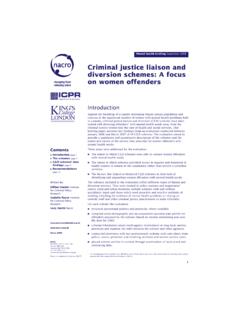
3 Black communities ,mental health and thecriminal justice systemMental health and crime briefing 2007 ContentsIntroduction page 1 The criminal justice system page 2 The mental health system page 3 Government strategy and policydevelopment page 5 Effecting change page 6 Conclusion page 8 Nacro believes that responses to mentallydisordered offenders should focuson their care and treatment rather than onpunishment. To help bring about thischange, Nacro campaigns for: more effective working partnershipsbetween agencies the development of specialist skills inthe criminal justice system better information sharing the education and training of staff sothat they have the skills andencouragement they need towork with a group who can be difficultand unrewarding.
4 Nacro s Mental Health Unit has beenworking to tackle problems faced bymentally disordered offenders since work with government agencies at anational and local level to develop moreeffective ways to deal with mentallydisordered offenders. We provide a rangeof services: information and advice; policydevelopment and other consultancyservices; and training. We also run a majorannual conference on mental health has a specialist mental healthwebsite which offers information andsupport for practitioners and policy-makers working in the field of criminaljustice and mental health. To find outmore, visit contact the Mental Health Unit on 020 7840 6718, 020 7582 6500 or is a registered charity Health & Crime Briefing May07:Layout 1 17/5/07 10:25 Page 1 The criminal justice systemDiscrimination from criminal justice agenciesHome Office statistics produced annually undersection 95 of the Criminal Justice Act 1991revealthe extent of the disproportionate involvement ofblack people with criminal justice agencies assuspects, defendants and prisoners.
5 To fullyappreciate the implications of the following figures,it should be remembered that of the population inEngland and Wales, just are Black Caribbean, are Black African and are from other statistics for 2004-56show that: Black people were six times more likely thanwhite people to be stopped and searched undersection 1 of thePolice and Criminal Evidence Act1984compared to Asian people who were twiceas likely as white people to be stopped andsearched. Searches recorded by police under section 60 ofthe Criminal Justice and Public Order Act 1994show that 56% of searches were of white people,24% were of Black people, while 17% were ofAsians. Of the searches made under Sections 44 (1) and44 (2) of the Terrorism Act 2000 73% were ofwhite people, 8% were of Black people and 11%were of Asians, with 5% being carried out onthose of Other ethnic origin.
6 Of the million arrests made for notifiableoffences, 9% of them were Black people, 5% Asianpeople and came from other ethnic groups. Black people were more likely than white peopleto be committed at magistrates courts to betried by a jury at the Crown Court. The proportion of Black prisoners who areBritish nationals in the prison population is fivetimes higher than for white addition, higher proportions of Black people(particularly young people) were likely to bestopped by police, arrested and once arrested, lesslikely to be cautioned. Similarly, Black people weremore likely to be remanded in custody, more likelyto plead not guilty and where found guilty theywere also more likely to receive longer custodialsentences than their white coming to trial, an analysis of 13,000 casefiles carried out by the Crown Prosecution Servicefound that there were more likely to be objectionsto bail for Black males than for white such as this reveal that Black communitiesare over-represented at each stage of the criminaljustice process from initial contact right throughto are various criminological explanations as tothe root of this anomaly which include policediscrimination, socio-demographic factors.
7 And thefact that Black people who have previouslycommitted offences are known to the police and aretherefore perhaps more easily detected. However,the figures cannot just be explained away by thenotion that Black people are more likely to offendthan other the lifetime offendingrate for Black males is in fact significantly lowerthan that for white Given that there are higher rates of Black women inprisons than men, and that there is a higherincidence of Black women within psychiatric carethan white women, it is concerning thatexamination of the needs of Black female mentallydisordered offenders is so conspicuously absentfrom research literature and policy initiatives. InJune 2004, the percentage of foreign nationalwomen in prison made up 25% of the female prisonpopulation.
8 Notably, over 50% of female foreignnational prisoners were from Jamaica with over 90%of these receiving custodial sentences for minor players inconsiderably larger operations, these womenundergo the trauma of separation from family,children and their homeland for what are often verylengthy periods, which is bound to have adebilitating effect on their mental health. Immigration and asylumIndeed foreign nationals make up one third of allprisoners who are either Black or minority proportion of foreign nationals amongst thenumber of Black mentally disordered offenders islikely to increase further in future, given theintroduction of the Asylum and Immigration Act2004which has, for the first time, made it acriminal offence for someone to enter the UK whodoes not have a passport or who has destroyedtravel documents or who, once within the UK,refuses to co-operate with arrangements for theirremoval.
9 Those claiming asylum or refugee statusare likely to have undergone considerable mentalstress and trauma and, if this is not effectivelyaddressed, the trauma of the asylum experiencecould potentially bring to the surface any latentdistress they may have experienced experienced within the criminaljustice system is compounded for many blackpeople by difficulties they encounter followingrelease. A 2005 study by Nacro found that blackprisoners are less likely than their whiteBlack communities , mental health and the criminal justice systemNacro mental health and crime briefing2 Mental Health & Crime Briefing May07:Layout 1 17/5/07 10:25 Page 2counterparts to seek out resettlement servicesbased within Black prisonersexperience problems shared by the general prisonpopulation such as drug or alcohol dependency,family breakdown or poverty, their impact is furthercompounded by racism in its various forms whichwill intensify the difficulties they face in beingresettled upon example, whilehomelessness is a problem for many groups.
10 Adisproportionate number of Black householdsfigure in the homelessness registers of localauthorities and historically discrimination againstblack people has played a part in the allocation ofhousing result is that Black offenderscan end up being excluded and marginalised frommainstream society at a vulnerable time in theirlives, which is likely to aggravate any mental healthproblems present or even lead to their mental health systemRoutes of referral The 2005 Healthcare Commission census17ofmental health patients in England and Wales,carried out in conjunction with the Mental HealthAct Commission and the National Institute forMental Health in England (NIMHE), revealed thataround 9% of inpatients were Black , despite the factthat Black people comprise just of thepopulation according to government census found too that admission rates forblack people into mental health care were higherthan for all other groups, being three or more timeshigher than the recent years however, the debate has shiftedfrom a focus on the over-representation of blackpeople in the mental health system to increasinginvestigation of the ways in which they come to bethere.