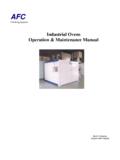
Transcription of Blast Booth Operation & Maintenance Manual
1 AFC Finishing Systems Blast Booth Operation & Maintenance Manual Built in America, Supported with Integrity . Disclaimer of Liability AFC Finishing Systems has used its best efforts in preparing this Manual and the information contained within. These efforts include testing, checking, and reviewing the functionality of the information. Because of the diversity and special individual customization of our Blast booths and Blast equipment, we cannot guarantee full agreement. However, the data contain within this Manual are reviewed on a regular basis and any necessary correction will be included in subsequent editions. Any suggestions for improvement are welcome. Trademarks AFC, AFC, Inc., AFC Finishing Systems, and Air Filtration Company are trademarks of AFC Finishing Systems. All other trademark symbols and names are registered trademarks of their respective companies.
2 They are included to the benefit of the respective trademark owners only and are included with no intention of infringing on those trademarks. AFC Finishing Systems 250 Airport Parkway Oroville, California 95965 Phone: (800) 331-7744 Fax: (530) 533-0179 Email: Web: Copyright 2003 by AFC Finishing Systems All rights reserved. No part of this publication may be reproduced, stored in a retrieval system, or transmitted, in any form or by any means, electronic, mechanical, photocopying, or otherwise, without the prior written permission of AFC Finishing Systems. Copyright 2003 by AFC Finishing Systems All rights reserved. No part of this publication may be reproduced, stored in a retrieval system, or transmitted, in any form or by any means, electronic, mechanical, photocopying, or otherwise, without the prior written permission of AFC Finishing Systems.
3 Introduction This Manual is intended for the initial setup of the electrical and control systems of blasts booths and how to operate and maintain Blast booths only. Please refer to the Booth installation instruction that comes with your Blast Booth for sheet metal installation. Electrical power to each system, fire suppression system and gas plumbing are also required and must be installed by qualified local contractor(s) prior to doing initial setup. AFC Finishing Systems offer free telephone support eight hours a day, five days a week from 8:00 to 5:00 PST, Monday through Friday. We could be reached at our toll-free number: (800) 331-7744. Supports and General information are also available online at our web site, Content Table of Content 1.
4 Start-Up and Operation Safety Precautions ..1-1 Initial Start-Up Procedure ..1-1 Operator Pre-start ..1-1 Operating Procedure ..1-1 Emergency operations ..1-2 2. Maintenance Operator Service Preventive Maintenance ..2-0 Troubleshooting Guides ..2-2 3. Appendices Spare Parts and Supply Warranty Information ..3-1 . Start-up & Operation Safety Precautions Fire Safety The interior of the Blast Booth is a rated Class 1, Division 1 hazardous area. Except for vehicles or parts to be blasted, no sparks, spark generating equipment, or open flame inside the Blast Booth at any time. Three feet around any opening into the Booth is a rated Class 1, Division 2 hazardous area. Caution should be taken not to place or have any flammable or flame causing equipment within three feet of any Booth openings.
5 Tampering with Safety Equipment All AFC spray booths are designed and built to the standard of the National Fire Protection Agency (NFPA 33, NFPA 86, NFPA 91, NFPA 101, NFPA 70), the Occupational Safety and Health Act (OSHA), BOCA (National Fire Prevention, National Building Code, & National Mechanical Code), the Uniform Fire Code (UFC), Uniform Building Code (UBC), and the Uniform Mechanical Code (UMC). All safety equipment, limit switches, air solenoid valve, etc., must not be tamper with. If the particular piece of equipment does not operate correctly, please have a qualify technician fix the problem immediately. Installation Improper installation, adjustment, alteration, service or Maintenance can cause injury or property damage. Refer to this Manual and the Power Flame burner Manual .
6 For additional assistance or additional information, consult a qualified installer, service agency, or call AFC at our toll-free number, (800) 331-7744. WARNING Fire or explosion hazard! Can cause property damage, severe injury, or death. Verify safety requirements whenever installing a spray Booth control system CAUTION Electrical shock hazard or equipment/control damage. Can cause electrical shock, or equipment damage. Disconnect power supply before beginning installation Initial Start-up procedure Initial start-up 1 Turn off all power to control panel. 2 Tighten all electrical connections (field and factory). 3 Turn on power to Booth . 4 Check for proper air flow. Operator Pre-start Safety Equipment Operator must use proper clothing and equipment when operating a Blast Booth . All Blast booths are designed to draw air and fumes away from the operator, but it is possible for hazardous fumes to be within breathing space of the operator.
7 Air Moving Equipment Air moving devices such as the exhaust fans must be in good operating status and running prior to any spray Operation . Check for belt tensions, cracks, and other signs of wears and tears on a regular basis. Door Limit Switches If exist, door limit switches are there to prevent dangerous fumes from leaking out of the Blast Booth . Make sure that by opening any of the doors, the spray gun is disabled. Note that some booths may have a time delay on the doors. Air Compressors Blast booths contain equipment that run on compressed air. Verify that air compressors are running prior to starting any Blast Booth . Operating Procedure Normal Operation 1 Turn on and verify that there s power to the control panel. 2 Turn the system on (turn system switch to the ON position).
8 All exhaust fans should turn on. 3 To shut down the system, turn the system switch to OFF. Emergency Operation Safety Equipment Failure Non-life Threatening Blast Booth safety equipment, like all other mechanical equipment, will eventually fail due to wears and tears. The safety device on Blast booths that may be safely bypass for short, emergency operations are: Door limit switch. The door limit switch may be temporary bypass by tying the two wires on terminal 5 and terminal 6 inside the switch together. Be sure to disable all power sources to the control panel prior to bypassing to prevent electrical shocks. Safety Equipment Failure, Life Threatening In case of life threatening equipment failure, immediately exit Blast Booth and if possible, shut down all control systems. Call service and Maintenance and have the particular equipment fix prior to the next Operation .
9 Air Moving Device Failure Air moving device (fans and fan motors) failure must be fixed before the Blast Booth can be put into Operation mode again. There is no temporary fix to have the Booth running in an emergency status. Forcing and bypassing safety protective devices for air moving devices can lead to serious health hazard, injuries or even death. Lightings In case of complete lighting failure, the power source for all lighting fixtures may be re-routed temporary for emergency Operation . If lighting is provided by AFC, then there is a lighting circuit breaker and a lighting contactor relay inside the control panel. Note that all electrical must be done outside of the Blast Booth unless the equipment are rated for NFPA class 1 division 1 hazardous location Operation . Compressed Air The compressed air for blasting inside the Blast Booth is controlled by an electrically controlled solenoid valve on the air line immediately outside of the Booth .
10 If this device fails, compressed air for blasting may be brought into the Booth via a flexible air line from a source outside of the Booth . Maintenance Operator Service Requirement The operator is required to make the following services and Maintenance . General Service Booth operator should practice good basic housekeeping. There should be no prepping in the Booth unless the system is design specifically for prepping and not for painting ( Work Station, Prep Benches, or non-enclosed systems like the Exhaust Benches, Bench Filter booths , or Floor Filter booths ).