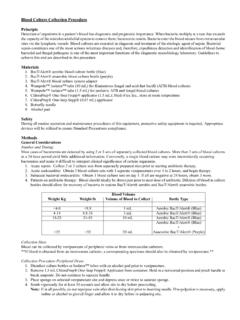
Transcription of Blood Culture Collection Instructions
1 A partner for lifelong health 325 Maine Street, Lawrence, Kansas 66044 785-505-6179 Blood Culture Collection Instructions Investigations have shown that a bacteremia is usually constant and it is unnecessary to delay culturing Blood until the patient has a chill or sudden rise in temperature. It is suggested that three Blood cultures taken 30 minutes apart are sufficient to obtain the organism in almost all cases in which there has not been antibiotic therapy. When it is necessary, the cultures can be taken five minutes apart from different sites.
2 However, in this facility, the time intervals, and the number of cultures taken are left to the discretion of the attending physician, and the cultures are taken in compliance with his/her wishes. When the physician does not specify a time interval, the laboratory will collect them five minutes apart from different sites. Extreme care must be exercised in collecting the Blood sample to prevent accidental contamination of the Culture media with organisms from the skin or environment. The rate of Blood Culture contamination should not exceed 3% according to the standards published by the American Society of Microbiology.
3 The contamination rate at LMH is monitored on a monthly basis. In adults, it is optimal to obtain 20 mls of Blood per Culture set (2 bottles) to increase the yield of true positive cultures. The laboratory periodically monitors collected Blood volumes on samples drawn from adults and provides feedback to clinical staff. (Cutoff for acceptable volume is a minimum of 5 mls per bottle.) Blood cultures can be held at room temperature for up to 12 hours after Collection before placing in the BacTAlert. After 12 hours they can no longer be tested in the analyzer.
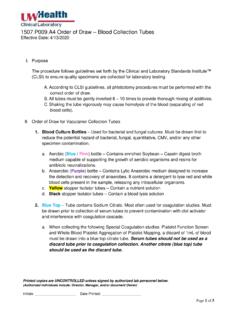
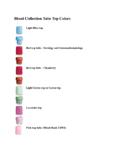
4 REAGENTS/MATERIALS Aerobic Culture bottles-Blue top Anaerobic Culture bottle-Purple top Sterile syringe Butterfly Needle Vacutainer adaptor Blood Culture holder cap and insert Tourniquet Sterile Gauze, alcohol pads Medi-Flex ChloraPreps (2% CHG/70% IPA) Note: Blood Culture bottles must be stored in the dark. If sensor on bottle turns yellow, discard bottle. PROCEDURE: 1. Bottles are marked with an optimal 10 ml fill line. Kits are packaged containing an aerobic bottle, anaerobic bottle, and 2-3 Medi-Flex ChloraPreps. The Blood Culture kits are taken to the bed side.
5 The rubber stoppers in the bottles are cleansed with alcohol prior to inoculation. 2. The request for Blood Collection must contain the patient s last name, first name, date of birth, and sex. The information is entered into the Cerner Laboratory Information System. The phlebotomist will identify the patient using an outpatient requisition or through Specimen Collect in Powerchart. 3. The patient is positively identified by checking the name and hospital number on the wristband and comparing this with the labels and/or requisition. A partner for lifelong health 325 Maine Street, Lawrence, Kansas 66044 785-505-6179 4.
6 The patient s arm is examined and the venipuncture site selected. The site is cleansed with alcohol pads until the pads are clean and then three Medi-Flex ChloraPreps for 30 seconds each and allowed to air dry. With the third being in a circular motion beginning in the center and going out. Once disinfected, the venipuncture site should not be touched to avoid contamination. Make a mental notation of the vein s location in relation to certain skin markers (pigmentation, creases, etc.) Indentation markers are a good method of marking the vein and should be used as a second choice.
7 If continued palpation is necessary, palpating above and below the cleansed area can help relocate the vein. If the gloved finger touches the anticipated insertion point, the site must be properly disinfected using the exact same procedure as above. 5. It is optimal to draw the specimen using a butterfly needle, vacutainer adaptor, and Blood Culture holder cap with or without the insert. The holder insert is used to place in the cap if additional tests have been ordered. Blood Culture bottles should always be filled first. The aerobic bottle should be inoculated first for several reasons, including the fact that air from the tubing is pulled into the bottle compromising an anaerobic environment and if flow of Blood is interrupted, most of the organisms that cause septicemia (aerobic) will be recovered.
8 Allow the bottles to fill to but not pass the 10ml mark on the side of the bottle. After completing the venipuncture, the safety device is activated, the butterfly, vacutainer adaptor, and Blood Culture holder cap are disposed of in a sharps container. 6. A butterfly needle, syringe, and Blood Culture transfer device or a sterile syringe, straight needle, Blood Culture device is an option, but not recommended due to several reasons, including possibility of contamination, volume demands, and safety issues. If there are other tests to be collected, transfer Blood into the Blood Culture bottles prior to placing Blood into the other vacutainer tubes.
9 If an anaerobic bottle is included in the set, fill it first to prevent any air that might exist in the top of the syringe from entering and altering the anaerobic environment. It is recommended to use a safety needle and activate the safety device after obtaining Blood , remove the needle, and attach a transfer device to transfer Blood to Blood Culture bottles and tubes. After transferring the Blood , the transfer device and syringe are disposed of in a sharps container. 7. Never draw Blood cultures directly with a Blood Culture holder cap and vacutainer needle.
10 A butterfly adapter should always be used when using a Blood Culture holder cap to prevent reflux into the patient. 8. Ten ml of Blood is optimal in each Blood Culture bottle. Do not overfill the bottles as this can lead to false positive results due to excessive WBC s. If less than 10 ml is obtained, 7 ml is placed into the aerobic (blue) Blood Culture bottle and the rest is placed into the anaerobic (purple) bottle. If less than 7ml is obtained, such as for newborns, all of the Blood is placed into the aerobic (blue) Blood Culture bottle. If less than the optimal volume is collected, a notation should be made on the label.