Blood Safe Transfusion Administration Checklist
Transfusion Adminisffation Checklist* Ensure the right blood product is given to the right patient at the right time. Follow standard precautions Before blood product collected Medical prescription for product written and complete. Check for Pre-medication and any instructions for after or during transfusion eg diuretics
Tags:
Information
Domain:
Source:
Link to this page:
Documents from same domain

Standard 7 – Blood and Blood products
www.blood.gov.auStandard 7 Blood and Blood Products Standard 10 Preventing Falls and Harm from Falls Standard 1 Governance for Safety and Quality in Health

Trifold Patient Information Brochure - Blood
www.blood.gov.auBlood Authority website (www.blood.gov.au) for more information. Depending on your condition and circumstances, you may be offered SCIg therapy for self-administration outside hospital. You will be provided with a Patient Receipt and Use Diary to record your treatments. This information will need to be provided regularly to your doctor or

Patient Blood Management Guidelines: Module 5
www.blood.gov.au3.5.1 Point-of-care testing 49 3.5.2 Intraoperative cell salvage 50 3.5.3 Interventional radiology 51 3.5.4 Recombinant activated factor VII 53 3.5.5 Tranexamic acid 55 3.6 Considerations for Aboriginal and Torres Strait Islander women 58 4 Background questions 61 4.1 Anaemia as a risk factor 62 Patient Blood Management Guidelines: Module 5 ...

IRON PRODUCT CHOICE AND DOSE CALCULATION - Blood
www.blood.gov.aumanagement of iron deficiency in pregnancy4 recommend a target Hb of 110 g/L, based on pre- pregnancy weight, in women from the second trimester onwards and postpartum period, with iron deficiency anaemia who fail to respond to, or are intolerant of, oral iron.
Clinical indications for Apheresis and Whole Blood Platelets
www.blood.gov.aui.e. 301 ± 41 x109/pack vs 300 ± 44x109/pool (2). Similar number of residual white cells are found i.e. 0.21 ± 0.12 x10⁶/apheresis unit vs 0.30 ± 0.02x10⁶/pooled platelet unit. A review of in vitro and in vivo studies by Schrezenmeier comparing platelet survival, ‐
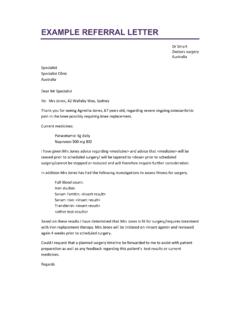
EXAMPLE REFERRAL LETTER - Blood
www.blood.gov.auAustralia Specialist Specialist Clinic Australia Dear Mr Specialist Re: Mrs Jones, 42 Wallaby Way, Sydney Thank you for seeing Agnetha Jones, 67 years old, regarding severe ongoing osteoarthritic pain in the knee possibly requiring knee replacement. Current medicines: Paracetamol 4g daily Naproxen 500 mg BID

Managing my iron - Blood
www.blood.gov.aucarboxymaltose. Your doctor will calculate the dose of intravenous iron based on how severe your iron deficiency is and your body weight. You may experience some side effects such as headache, muscle pain, shortness of breath or a rash. You will be closely monitored while you receive your infusion. If you experience any symptoms either during or
PREOPERATIVE BLEEDING RISK ASSESSMENT TOOL
www.blood.gov.au6 The perioperative management of antithrombotic therapy: American College of Chest Physicians Evidence-Based Clinical 8Practice Guidelines (8th Edition), 2008; 6 New oral anticoagulants: a practical guide on prescription, laboratory testing and

Guidelines on the prophylactic use of Rh D immunoglobulin ...
www.blood.gov.auguidelines will be used to implement a multi-faceted strategy for securing future supply, which includes measures to increase domestic production of Rh D immunoglobulin, as well as wide-ranging communication and education to promote its most appropriate use. This report is intended to update rather than replace the guidelines released in 1999.
Related documents

9.0 Blood Bank - Health Facility Guidelines
healthfacilityguidelines.com9.0 Blood Bank 9.1 Introduction 9.1.1 General The Blood Bank provides licensed facilities for the collection, storage, processing and distribution of human blood and blood components, in accordance with the National Blood Policy, 2002, under the administration of the Central Drugs Standard Control Organisation (CDSCO) India.

POLICY GUIDELINES MANUAL FOR ARTICLE 28 CERTIFIED …
www.emedny.orgPolicy Guidelines Manual for Article 28 Certified Clinics Version 2007 – 2 June 1, 2007 Page 1 of 42 ... except for transfusion services to hemophiliacs, in which case each transfusion visit ... blood draws or X-rays that are scheduled subsequent to the initial clinic visit do not qualify for
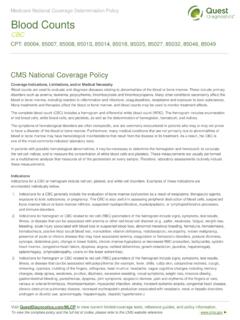
Medicare National Coverage Determination Policy Blood …
www.questdiagnostics.comBlood Counts CBC Coverage Indications, Limitations, and/or Medical Necessity Blood counts are used to evaluate and diagnose diseases relating to abnormalities of the blood or bone marrow. These include primary disorders such as anemia, leukemia, polycythemia, thrombocytosis and thrombocytopenia. Many other conditions secondarily affect the
National Consent Policy - Health Service Executive
www.hse.ieNational Consent Policy HSE V.1.3 This is a controlled document. Any printed version should be considered “uncontrolled”, and is therefore subject to validation against the controlled version Table of contents Page Glossary 11 Part One – General Principles 19 1. Introduction 20 1.1 Scope of this policy 20

Good Manufacturing Practice (GMP) -What
www.transfusionguidelines.org2. The range of tests, equipment, techniques and procedures used for blood grouping including: a. Routine ABO grouping b. Routine Rh grouping c. Other routine phenotyping 3. Significance of controls and procedures to adopt in the event of test/control failure 4. Antigens of major blood group systems 5. Special testing of blood samples i.e ...

Guidelines for Human Biospecimen
oir.nih.govDefinition of Human Biospecimens These guidelines apply to human biospecimens , including --but are not limited to --blood and other body fluids, tissues, and other biological material s obtained from humans.