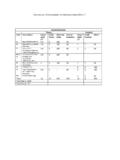
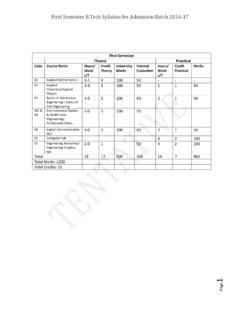
Transcription of BRANCH-AUTOMATION AND ROBOTICS
1 FIRST SEMESTER SYLLABUS FOR ADMISSION BATCH 2016-17. BRANCH-AUTOMATION AND ROBOTICS . st 1 Semester Specialization: automation AND ROBOTICS . First Semester Theory Practical Course Name Hours/ Credit University Internal Hours/ Credit Marks Week Theory Marks Evaluation Week Practical L/T L/T. Computational Methods 4-0 4 100 50 - - - and Techniques Internet of Things 4-0 4 100 50 - - - ROBOTICS -Analysis And Its 4-0 4 100 50 - - - Application In Industrial automation Industrial automation 4-0 4 100 50 - - - And Instrumentation Advanced 4-0 4 100 50 - - - Microprocessor And Microcontroller Lab-I 8 4 150. Total Total Marks: 900. Total Credits: 24.
2 1. Page FIRST SEMESTER SYLLABUS FOR ADMISSION BATCH 2016-17. INTERNET OF THINGS (IoT). MODULE I. Introduction to Internet of Things Introduction-Definition & Characteristics of IoT , Physical Design of IoT- Things in IoT , IoT Protocols, Logical Design of IoT- IoT Functional Blocks, IoT Communication Models, IoT Communication APIs , IoT Enabling Technologies- Wireless Sensor Networks , Cloud Computing, Big Data Analytics , Communication Protocols , Embedded Systems, IoT Levels & Deployment Templates. MODULE II. Domain Specific IoTs Home automation : Smart Lighting, Smart Appliances, Intrusion Detection, Smoke/Gas Detectors, Cities-Smart Parking, Smart Lighting, Smart Roads, Structural Health Monitoring, Surveillance, Emergency Response, Environment-Weather Monitoring, Air Pollution Monitoring, Noise Pollution Monitoring, Forest Fire Detection , River Floods Detection , Energy- Smart Grids , Renewable Energy Systems , Prognostics , Retail-Inventory Management , Smart Payments , Smart Vending Machines , Logistics-Route Generation & Scheduling , Fleet Tracking , Shipment Monitoring , Remote Vehicle Diagnostics, Agriculture-Smart Irrigation ,Green House Control.
3 Industry -Machine Diagnosis & Prognosis Indoor Air Quality Monitoring ,Health & Lifestyle -Health &. Fitness Monitoring, Wearable Electronics IoT and M2M. Introduction, M2M-Difference between IoT and M2M, SDN and NFV for IoT-Software Defined Networking , Network Function Virtualization MODULE III. IoT Platforms Design Methodology IoT Design Methodology-Purpose & Requirements Specification,Process Specification, Domain Model Specification, Inf ormation Model Specification , Service Specifications , IoT Level Specification, Functional View Specification , Operational View Specification , Device & Component Integration , Application Development, Case Study on IoT.
4 System for Weather Monitoring, Motivation for Using Python IoT Physical Devices & Endpoints What is an IoT Device-Basic building blocks of an IoT Device, Exemplary Device: Raspberry Pi, About the Board, Linux on Raspberry Pi , Raspberry Pi Interfaces Serial, SPI , I2C , Programming Raspberry Pi with Python-Controlling LED with Raspberry Pi , Interfacing an LED and Switch with Raspberry Pi ,Interfacing a Light Sensor (LDR) with Raspberry Pi , Other IoT Devices- pcDuino, Beagle Bone Black , Cubieboard MODULE IV. IoT & Beyond : Use of Big Data and Visualization in IoT, Industry Concepts. Overview of RFID, Low-power design (Bluetooth Low Energy), range extension techniques (data mining and mesh networking), and data- intensive IoT for continuous recognition applications.
5 Overview of Android / IOS App Development tools &. Internet Of Everything Text Books: 1. Internet of Things, A Hands on Approach, by Arshdeep Bahga & Vijay audisetti, University Press. Reference Books: 1. The Internet of Things, by Michael Millen, Pearson 2. Page FIRST SEMESTER SYLLABUS FOR ADMISSION BATCH 2016-17. COMPUTATIONAL METHODS AND TECHNIQUES. MODULE-I: Neural Networks: Artificial Neural Network and Introduction, Learning Rules, Knowledge Representation and Acquisition, Different Methods of Learning. Algorithms of Neural Network: Feed-forward Error Back Propagation, Hopfield Model, Kohonen's Featrure Map, K-Means Clustering, ART Networks, RBFN, Application of Neural Network to the relevant field.
6 MODULE-II: Fuzzy Logic: Basic Concepts of Fuzzy Logic, Fuzzy vs Crisp Set, Linguistic variables,Membership Functions, Operations of Fuzzy Sets, Fuzzy If-Then Rules, Variable Inference Techniques, Defuzzification, Basic Fuzzy Inference Algorithm, Fuzzy System Design, FKBC and PID Control, Antilock Breaking System(ABS), Industrial Applications. MODULE-III: Optimization Fundamentals: Definition, Classification of Optimization Problems, Unconstrained and Constrained Optimization, Optimality Conditions. LINEAR Programming: Simplex Method, Duality, Sensitivity Methods NON-LINEAR Programming: Newton's Method, GRG Method, Penalty Function Method, Augmented Langrange Multiplier Method, Dynamic Programming and Integer Programming, Interior Point Methods, Karmakar's Algorithm, Dual Affine, Primal Affine.
7 MODULE-IV: Genetic Algorithm: GA and Genetic Engineering, Finite Element based Optimization, PSO,BFO, Hybridization of Optimization technique , Application of Optimization technique for Solving Projects(Project solutions). Implementation of branch Relevant Industrial Applications by Matlab Code. Books Recommended: 1. Neural Networks- by Simon Haykin 2. Fuzzy Logic with Engineering Application- by ROSS (Tata Mc). 3. Neural Networks and Fuzzy Logic by Bart Kosko 4. An introduction Fuzzy Control by , H. Hellendorn, (Narosa Pub). 5. Fuzzy Neural Control by Junhong NIE & Derek Linkers (PHI). 6. Related IEEE/IEE Publications 7. Fuzzy System Design Principles, Building Fuzzy IF-THEN Rule Bases by Riza C.
8 Berikiu and Trubatch, IEEE Press 8. Ashok D. Begundu & chandrapatla Optimization concept and application in engineering ,Prentice Hall,1999. 9. Rao Engineering Optimization . 10. Gill,Murray and Wright , Practical Optimization . 11. James Electric Power System Application Of Optimization . 12. Song Y., Modern Optimization Techniques In Power System . 13. Optimization Research;Prabhakar Pai,Oxford University Press. 3. Page FIRST SEMESTER SYLLABUS FOR ADMISSION BATCH 2016-17. ROBOTICS -ANALYSIS AND ITS APPLICATION IN INDUSTRIAL automation . Module-1. Introduction. Construction of manipulators, advantages and disadvantages of various kinematic structures.
9 Applications, Non servo robots, motion planning. Feedback systems, encoders Kinematics, homogeneous coordinates solution of the inverse kinematic problem, multiple solutions, jacobian, work envelopes. Module-2. Trajectory planning. Joint Interpolated Trajectory, Link joints and their Manipulator dynamics and force control. Sensors: Vision, ranging, laser, acoustic, tactile. Developments in sensor technology, sensory control. Introduction to robotic Technology, Robot physical configuration, Basic robot motions. Types of Manipulators: Constructional features, Advantages and disadvantages of various kinematics structures, servo & non-servo manipulator.
10 UNIT-3. Actuators and transmission systems: pneumatic, hydraulic and electric actuators and their characteristics, Control systems. Feedback systems and sensors: Encoders and other feedback systems, vision, ranging systems, and tactile sensor. Concept of automation in industry, mechanization and automation , classification of automatic systems. Basis of automated work piece handling, working principles and techniques, job orienting job-feeding devices, transfer mechanisms. UNIT-4. Air cylinders design and mountings, pneumatic and hydraulic valves, flow control valves, direction control valves, and hydraulic servo systems Text Books / References: 1.